




01. Edit your form online
Type text, add images, blackout confidential details, add comments, highlights and more.

Type text, add images, blackout confidential details, add comments, highlights and more.

Draw your signature, type it, upload its image, or use your mobile device as a signature pad.

Send it via email, link, or fax. You can also download it, export it or print it out.
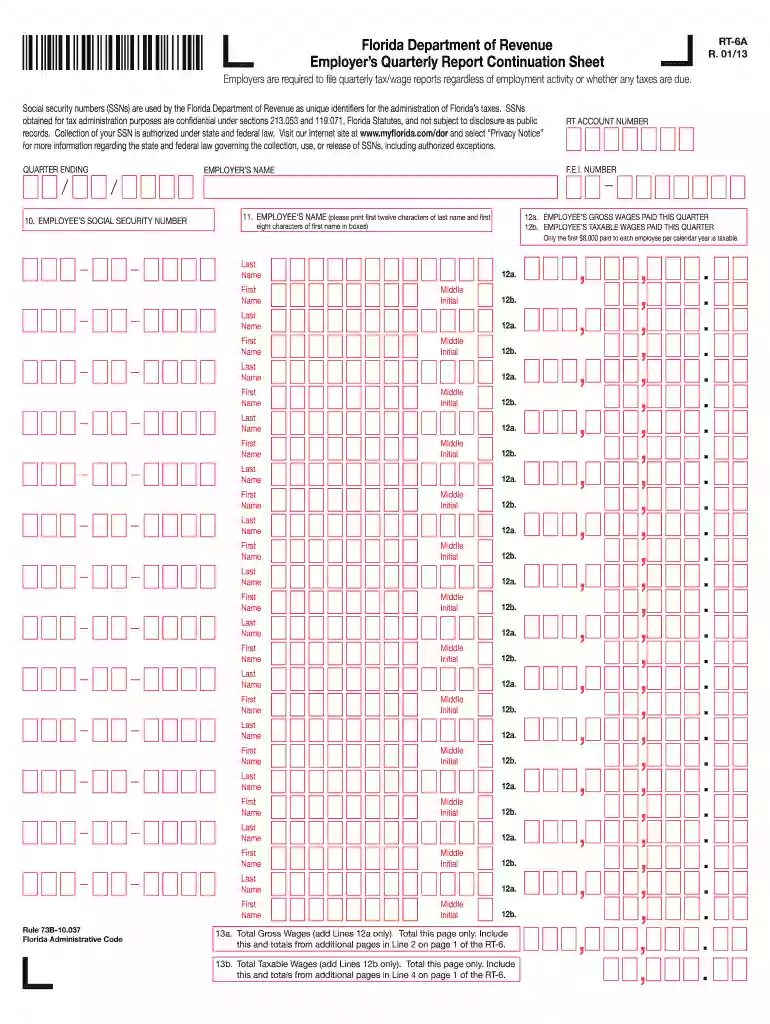
The Florida Quarterly 2013 Form, also known as the RT-6A, is essential for employers in Florida who need to report employee wages and taxes quarterly. This form includes several key elements critical for accurate completion:
Employer Identification: This section requires the employer's details, including the Florida Department of Revenue business partner number and federal employer identification number.
Employee Information: Employers must record each employee’s full name, Social Security Number, total gross wages, and taxable wages.
Quarter Details: The form specifies the quarter for which you're reporting, ensuring that all financial data aligns with the correct time frame.
Wage and Tax Calculations: Employers need to calculate and input total wages paid and taxes due. Accuracy here ensures compliance with state requirements.
Certification: A declaration at the end of the form where employers affirm the accuracy of the information provided.
Utilizing the RT-6A form effectively involves understanding its structure and ensuring accuracy:
Gather Employee Data: Collect detailed wage data for each employee, focusing on gross wages and any deductions.
Enter Information: Fill out each field meticulously to avoid discrepancies. Pay special attention to Social Security Numbers and wage amounts.
Calculate Taxes: Use the form’s instructions for calculating state unemployment taxes owed.
Review and Sign: Double-check every entry for accuracy before signing the certification.
Submit on Time: Ensure submissions are within the required deadlines to avoid penalties.
Completing this form demands attention to detail and adherence to specific steps:
Access the Form: Retrieve the form from the Florida Department of Revenue's website or use compatible software.
Fill Out Employer Information: Begin by entering your employer identification details.
List Employee Details: Enter each employee's information, ensuring correct spelling of names and accurate Social Security Numbers.
Report Wages and Taxes: Break down wages into total and taxable amounts, followed by tax calculations.
Final Review: Carefully review the entire form to confirm accuracy. Look out for computational errors.
Submit the Form: Follow submission instructions, choosing between mailing it or using the online portal for electronic submission.
The RT-6A form is chiefly utilized by:
Employers: Any entity with employees, including small businesses, corporations, and non-profits, needs this form for tax reporting.
Accountants: Professionals managing payroll for clients use this form to ensure timely tax compliance.
Payroll Departments: In larger companies, dedicated payroll teams handle the completion and submission of quarterly forms.


Proper legal usage is crucial to meet compliance standards:
Confidentiality: Employers must respect confidentiality, especially regarding Social Security Numbers, in alignment with state and federal laws.
Completeness and Accuracy: Submit comprehensive and accurate data to comply with Florida's legal reporting requirements.
Verification: Ensure that all information is truthful to the best of the employer’s knowledge to avoid legal pursuit.
Florida mandates specific guidelines:
Reporting: Employers must report quarterly, regardless of employment activity changes, to maintain compliance.
Wage Base Limits: Employers should be aware of the state wage base limit to accurately calculate unemployment taxes.
Submission Procedures: Depending on the volume of data, electronic filing may be required to streamline the process.
Timely submission of the RT-6A form is vital:
Quarterly Deadlines: Typically due by the last day of the month following each quarter end. For instance, the Q1 submission (January to March) is due by April 30.
Extensions: Florida may not offer extensions for this form, emphasizing the importance of meeting the deadline.
Failure to comply with submission requirements can result in:
Fines: Monetary penalties may be levied for late filings or inaccuracies.
Interest: Additional interest may accrue on unpaid taxes due to late filing.
Legal Repercussions: Continuous non-compliance might escalate to more severe legal actions by the state.
The RT-6A form is accessible in both formats:
Digital Advantages: Electronic submissions offer convenience, faster processing, and reduced error rates.
Paper Format: Permitted for those without digital access though might require longer processing times.
Preference: Employers often choose digital means for efficiency and ease of tracking.
Preparation for form completion involves having the following on hand:
Payroll Records: Up-to-date and precise payroll reports for wage verification.
Registration Documents: Employer identification numbers and business registration for authentication.
Previous Filings: Previous quarterly forms may aid in verifying continuity and consistency in reporting.
We've got more versions of the florida quarterly 2013 form form. Select the right florida quarterly 2013 form version from the list and start editing it straight away!
At DocHub, your data security is our priority. We follow HIPAA, SOC2, GDPR, and other standards, so you can work on your documents with confidence.
Effective 1/2013. (g) Form 9, Quarterly Gift Disclosure. To be utilized by persons who are required to file Form 1 or Form 6 and by State procurement
The rule changes expanded the authority of the Bureau of Enforcement to resolve more allegations of minor violations by mediation, therefore allowing resources.
Form CMS-2552-10, which contains instructions for the completion of the new cost report forms to be filed by hospitals and hospital health care complexes


