
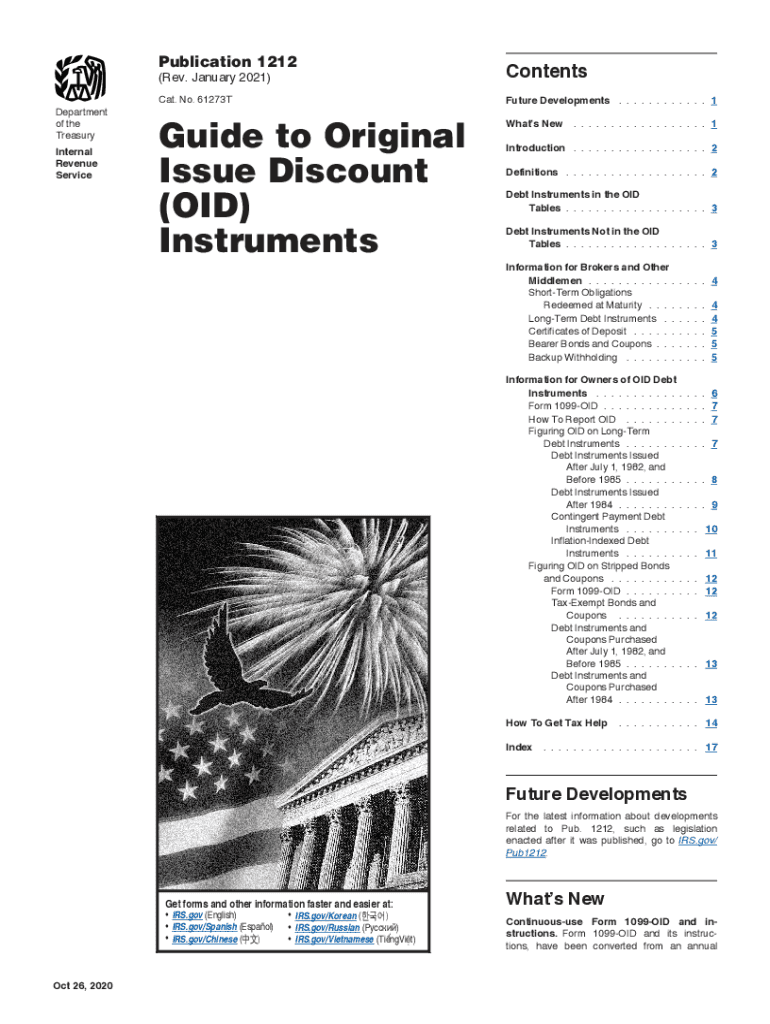







Definition and Meaning of Original Issue Discount (OID) Instruments
Original Issue Discount (OID) instruments are financial securities issued at a price significantly below their face value. The difference between the issuance price and the face amount is referred to as the OID. These instruments typically include bonds, debentures, and other debt securities that do not make periodic interest payments. Instead, the full return is realized upon maturity when the bondholder receives the face value. OID is treated as taxable interest over the life of the instrument, rather than at maturity, which has specific implications for both issuers and holders.
- Types of OID Instruments: Include zero-coupon bonds, short-term obligations, and stripped bonds or coupons.
- Tax Treatment: OID must be included in income annually as it accrues, even though the investor does not receive payments until maturity.
- Examples: A bond issued at $900 with a face value of $1,000 has a $100 OID.
How to Use the Guide to OID Instruments
Publication 1212 is an essential resource for anyone dealing with OID instruments. It provides detailed instructions and clarifications regarding the tax treatment, reporting requirements, and the calculation of OID.
- Filing Instructions: Follow guidelines for filling out Form 1099-OID, which reports OID income.
- Calculation Methods: Learn about the constant yield method to compute OID for complex debt instruments.
- Practical Examples: The guide includes calculations for different scenarios, like stripped bonds.
- Resources Included: Information on IRS tax help and backup withholding.
IRS Guidelines for OID Instruments
IRS guidelines stipulate the tax obligations associated with OID instruments. Focus is placed on annual inclusion of the accrued OID in the taxable income of holders.
- Form 1099-OID Reporting Requirements: Brokers must issue to holders reporting the amount of OID.
- Backup Withholding: Discusses when to apply backup withholding and how to handle erroneous withholdings.
Key Elements of Publication 1212
Publication 1212 outlines critical definitions and methodologies related to OID instruments. It addresses the legal and procedural aspects needed to comply with tax regulations.
- Debt Instrument Types: Discusses specifications for long-term, short-term, and inflation-indexed instruments.
- Yield to Maturity Calculations: Involves understanding interest assumptions and cash flow analysis.
Filing Deadlines and Important Dates
Timeliness in reporting and filing related tax forms is crucial to avoid penalties.
- Form 1099-OID Deadline: Typically due at the end of January for the previous year's income.
- Annual OID Inclusion: OID income should be reported on a taxpayer's annual tax return.
IRS schedules may have updates in case of extensions or adjustments.
Important Terms Related to Publication 1212
Understanding key terms in Publication 1212 facilitates clarity and compliance with relevant tax requirements.
- Issue Date: The beginning date for calculations of OID accrual.
- Stated Redemption Price at Maturity: Total amount to be received by the holder at maturity.
Legal Use and Implications
Adherence to federal laws and IRS regulations when handling OID instruments is necessary. Missteps can incur penalties.
- Legal Compliance: Ensure records match IRS reports and declare all income as per guidelines.
- Penalties for Non-Compliance: Failure to report accurately can result in fines or legal repercussions.
How to Obtain Publication 1212
Securing a copy of Publication 1212 can help users stay informed on compliance and procedural changes.
- Access Online: Downloadable from the IRS website for free.
- Contact IRS Directly: Request hard copies if necessary via mail for individuals without internet access.
These sections aim to provide an in-depth analysis and comprehensive understanding of the Publication 1212 guide, catering to both individual and business needs.




