




01. Edit your form online
Type text, add images, blackout confidential details, add comments, highlights and more.

Type text, add images, blackout confidential details, add comments, highlights and more.

Draw your signature, type it, upload its image, or use your mobile device as a signature pad.

Send it via email, link, or fax. You can also download it, export it or print it out.
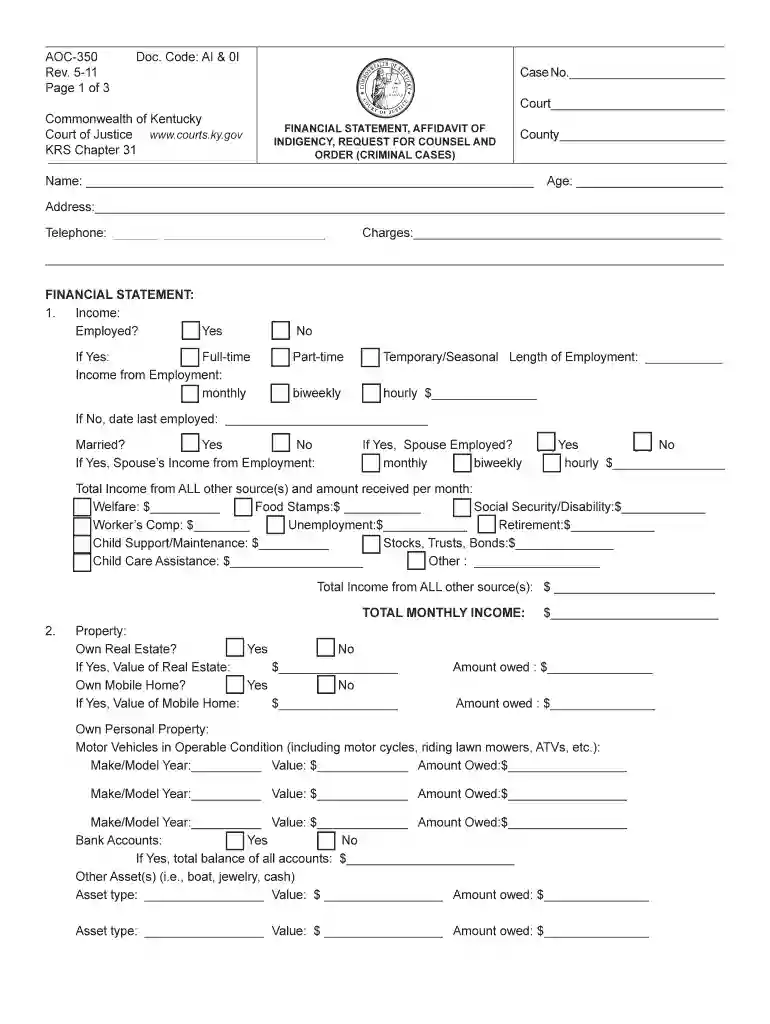
The "Financial Statement, Affidavit of" used in Kentucky courts serves as a crucial document in criminal cases. This form is designed to evaluate an individual's financial situation, encompassing various aspects such as income, property, dependents, and monthly expenditures. The primary intention is to assess eligibility for court-appointed legal counsel by providing comprehensive evidence of indigency. By detailing one's financial status, the affidavit aids the court in determining whether an individual is genuinely unable to afford private legal representation.
To utilize the Kentucky court's Financial Statement and Affidavit of Indigency effectively, individuals must complete the form with complete and accurate financial information. This includes specifying their income sources, listing properties owned, declaring the number of dependents, and itemizing monthly expenses. It's vital to ensure the data provided is thorough to prevent complications or delays in the court’s assessment process. Additionally, the completed form needs to be submitted to the appropriate legal authority handling the case, usually at the time of arraignment or another specified court appearance.
The affidavit includes several key elements requiring careful attention:
Accurate completion of these elements ensures that the court has a clear picture of your financial situation.
In Kentucky, certain state-specific protocols must be followed when using this form. The affidavit must be completed by individuals seeking court-appointed representation in criminal cases, specifically when claiming an inability to afford legal services. State laws dictate which financial thresholds determine indigency, and documentation may be required if the court requests additional proof of financial status. Adhering to these state-specific guidelines is imperative for ensuring eligibility and compliance.
The affidavit is legally used to ascertain whether a defendant in a criminal case qualifies for a court-appointed attorney. It provides a legal basis for the court to decide on granting or denying the request for counsel. As a sworn statement, it is submitted under oath, and any falsified information can lead to legal repercussions, including charges of perjury. Understanding these legal implications is crucial for individuals submitting the document.
The form is commonly used by defendants in criminal cases within Kentucky courts who cannot afford an attorney. This includes individuals with limited income, high expenditures, or significant financial liabilities. It is particularly relevant for those facing charges that could result in imprisonment or other severe penalties and who require legal representation but do not have the means to secure it independently.


In support of the affidavit, individuals may need to provide several documents:
Providing these documents alongside the affidavit ensures transparency and supports the case for financial support in receiving court-appointed counsel.
We've got more versions of the FINANCIAL STATEMENT, AFFIDAVIT OF - courts ky form. Select the right FINANCIAL STATEMENT, AFFIDAVIT OF - courts ky version from the list and start editing it straight away!
At DocHub, your data security is our priority. We follow HIPAA, SOC2, GDPR, and other standards, so you can work on your documents with confidence.
I understand that making a false statement in the Financial Statement, Affidavit of Indigence and Request for. Appointment of Counsel may subject me to the
Apr 9, 2010 At the Special Meeting the shareholders of Garmin Cayman will consider and vote upon a proposal for a redomestication (the ―Redomestication‖)


