PTO SB 17 (03 13) 2026

Get Form
pto sb 17 Preview on Page 1

Here's how it works

01. Edit your pto sb 17 online
Type text, add images, blackout confidential details, add comments, highlights and more.

02. Sign it in a few clicks
Draw your signature, type it, upload its image, or use your mobile device as a signature pad.

03. Share your form with others
Send it via email, link, or fax. You can also download it, export it or print it out.

Definition & Purpose of the PTO SB 17 (03 13)

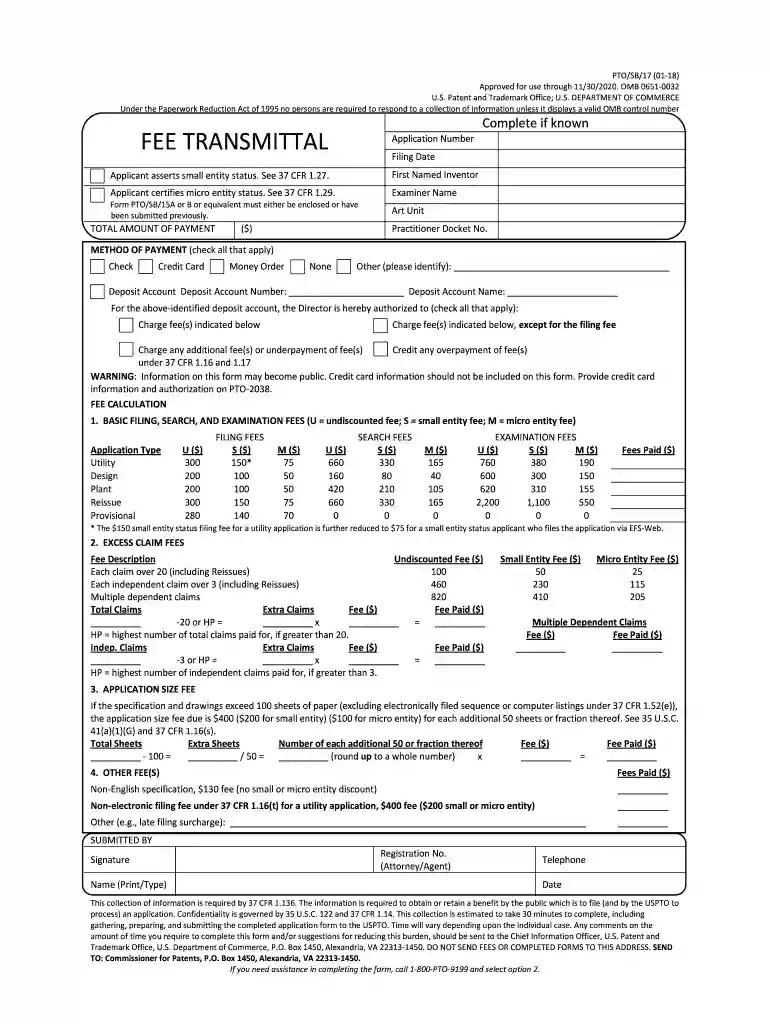
The PTO SB 17 (03 13) form is a fee transmittal document used for submitting payments to the U.S. Patent and Trademark Office (USPTO) during the patent application process. Its primary function is to ensure that applicants provide accurate and complete payment information alongside their patent filings. This form comprises sections to record applicant details, calculate various fees based on specific criteria, and confirm payment methods.

Key Components of the Form

  • Applicant Information: Collects personal or business identifiers, ensuring that payments are correctly attributed.
  • Fee Calculation: Breaks down the different types of fees applicable, such as filing, search, examination, and additional claim fees.
  • Payment Methods: Details available options for paying fees, ensuring compliance with USPTO guidelines.

Steps to Complete the PTO SB 17 (03 13)

Filling out the PTO SB 17 (03 13) requires an understanding of the patent application stages and associated fees. Here’s a step-by-step guide:

  1. Gather Document Information: Collect your application details, including entity status (small, micro, or standard).
  2. Calculate Applicable Fees: Use the form to determine the total fees based on filing type, number of claims, and any extras.
  3. Complete Personal or Business Information: Ensure your details match those on your patent application for clarity.
  4. Select a Payment Method: Choose between check, money order, or electronic transfer, and provide the necessary payment details.

Practical Example:

A small entity submitting a utility patent should accurately indicate their status, calculate based on reduced fees, and provide a credit card number if paying electronically.

How to Obtain the PTO SB 17 (03 13)

Acquiring the PTO SB 17 (03 13) is straightforward, as it is accessible through several methods:

  • USPTO Website: The form can be downloaded directly from the official U.S. Patent and Trademark Office’s website.
  • Patent Attorney or Agent: Legal representatives often supply these forms as part of their service.
  • Patent Offices and Libraries: Physical copies might be available at local patent offices or select libraries that house legal documents.

Legal Use of the PTO SB 17 (03 13)

The PTO SB 17 (03 13) must be used in compliance with USPTO regulations to ensure the legal filing of patents. Submitting accurate fee transmittals avoids issues with application processing and legal ambiguities.

Legal Considerations:

  • Compliance with ESIGN: Signatures on electronic submissions must adhere to legal standards under the ESIGN Act.
  • Correct Fee Payment: Incorrect payments can delay or void an application; hence, accurate calculations are indispensable.

Key Elements of the PTO SB 17 (03 13)

Several critical elements are integral to the effective use of the PTO SB 17 (03 13):

  • Entity Status Declaration: Differentiates between standard, small, and micro entities, affecting fee schedules.
  • Payment Confirmation: Ensures that payment methods and amounts adhere to legal and procedural standards.
  • Signatory Authorization: Requires authorized signatures to validate the payment transaction.

State-Specific Rules for the PTO SB 17 (03 13)

While the PTO SB 17 (03 13) is a federal form, some state-specific considerations can affect its use:

  • State-Based Filing Requirements: Some states might have additional documentary requirements that need attention during patent filings.
  • Partnership with State Patent Offices: Certain state offices can provide supplemental guidance for processing the PTO SB 17 (03 13).

Digital vs. Paper Version

The PTO SB 17 (03 13) is available in both digital and paper formats, each with its own set of advantages:

  • Digital Version: Facilitates electronic submissions, ensuring faster processing and compliance with modern business practices.
  • Paper Version: Still prevalent for those who prefer or require physical documentation. However, it can entail longer processing times.

Advantages of Electronic Submission:

  • Immediate Receipt: Digital submissions provide quicker acknowledgment from the USPTO.
  • Reduced Errors: Automated calculations and validation reduce human error in fee transmittals.

Software Compatibility

Several software solutions can streamline the completion and submission of the PTO SB 17 (03 13):

  • Patent Management Software: Tools like TurboTax for patents assist with accurate form completion and filing.
  • Accounting Integration: QuickBooks and similar software can help reconcile payment details with financial records.

Form Submission Methods

The PTO SB 17 (03 13) can be submitted through multiple channels:

  • Online: Via the USPTO’s electronic filing system, which is preferred for its speed and security.
  • Mail: Traditional mailing is an option but requires additional time for delivery and processing.
  • In-Person: Submission at a patent office allows for immediate verification and receipt.

Penalties for Non-Compliance

Errors or omissions on the PTO SB 17 (03 13) can lead to delays, additional fees, or application rejection. Common issues include incorrect fee calculation and improper completion of required sections.

Avoiding Penalties:

  • Double-Check Calculations: Ensure all figures are accurate and appropriate for your entity type.
  • Meet Deadlines: Submission past due dates can incur late fees or affect application status.

Important Terms Related to PTO SB 17 (03 13)

Understanding fundamental terms is essential for completing the form:

  • Entity Status: Defines whether you qualify for reduced fees.
  • Excess Claim Fees: Additional costs incurred for claims exceeding a statutory limit.
  • Transmittal Date: The date on which the USPTO receives payment, critical for processing timelines.

This comprehensive exploration of the PTO SB 17 (03 13) ensures that users understand not only the form’s necessity but also the exact process required for its completion and submission. By adhering to these guidelines, applicants can effectively manage their patent fees and contribute to a smooth patent application procedure.

See more PTO SB 17 (03 13) versions

We've got more versions of the PTO SB 17 (03 13) form. Select the right PTO SB 17 (03 13) version from the list and start editing it straight away!
Versions Form popularity Fillable & printable
2022 4.2 Satisfied (38 Votes)
2020 4.9 Satisfied (36 Votes)
2018 4 Satisfied (26 Votes)
2011 4.2 Satisfied (53 Votes)
be ready to get more

Complete this form in 5 minutes or less

Get form

Got questions?

We have answers to the most popular questions from our customers. If you can't find an answer to your question, please contact us.
Contact us
To qualify as a Micro Entity, the filer must be a Small Entity and must also meet the following criteria: The applicant has not been named as the inventor on a total of more than four utility patents (regular utility patents, as opposed to provisional patent applications), design patents, or plant patents.
What is the cheapest way to get a patent? The most cost-effective approach is to file a patent yourself. However, be sure to do your research and learn about intellectual property law, as errors can jeopardize your protection and rights.
The USPTO explains that this increase is due to inflationary pressures. As an example, first-stage utility patent maintenance fees would increase from $2,000 to $2,150, second-stage from $3,760 to $4,040, and third-stage from $7,700 to $8,280.
37 CFR 3.73(c) statement: This is a document filed with the USPTO to establish the assignees right to take action in a patent application.
Under 13 C.F.R. 121.802(a), an entity qualifies as a small business concern, and so qualifies for small entity status, if its number of employees, including affiliates, does not exceed 500 persons.

Security and compliance

At DocHub, your data security is our priority. We follow HIPAA, SOC2, GDPR, and other standards, so you can work on your documents with confidence.

Learn more
ccpa2
pci-dss
gdpr-compliance
hipaa
soc-compliance
be ready to get more

Complete this form in 5 minutes or less

Get form

People also ask

Neither the Applicant nor any Inventor has assigned, granted or conveyed, nor is under an obligation by contract or law to assign, grant, or convey, a license or other ownership interest in the application to an entity having a gross income exceeding $241,830 (see USPTOs Current Micro Entity Status Gross Income Limit
To establish micro entity status on the gross income basis, the applicant or patentee should file form SB/15A in the application or patent. To establish micro entity status on the institution of higher education basis, the applicant or patentee should file form SB/15B in the application or patent.
An inventor or other individual who has transferred some rights in the invention to one or more parties, or is under an obligation to transfer some rights in the invention to one or more parties, can also qualify for small entity status if all the parties who have had rights in the invention transferred to them also

Related links