




01. Edit your psrs 248 online
Type text, add images, blackout confidential details, add comments, highlights and more.

Type text, add images, blackout confidential details, add comments, highlights and more.

Draw your signature, type it, upload its image, or use your mobile device as a signature pad.

Send power psrs pa via email, link, or fax. You can also download it, export it or print it out.
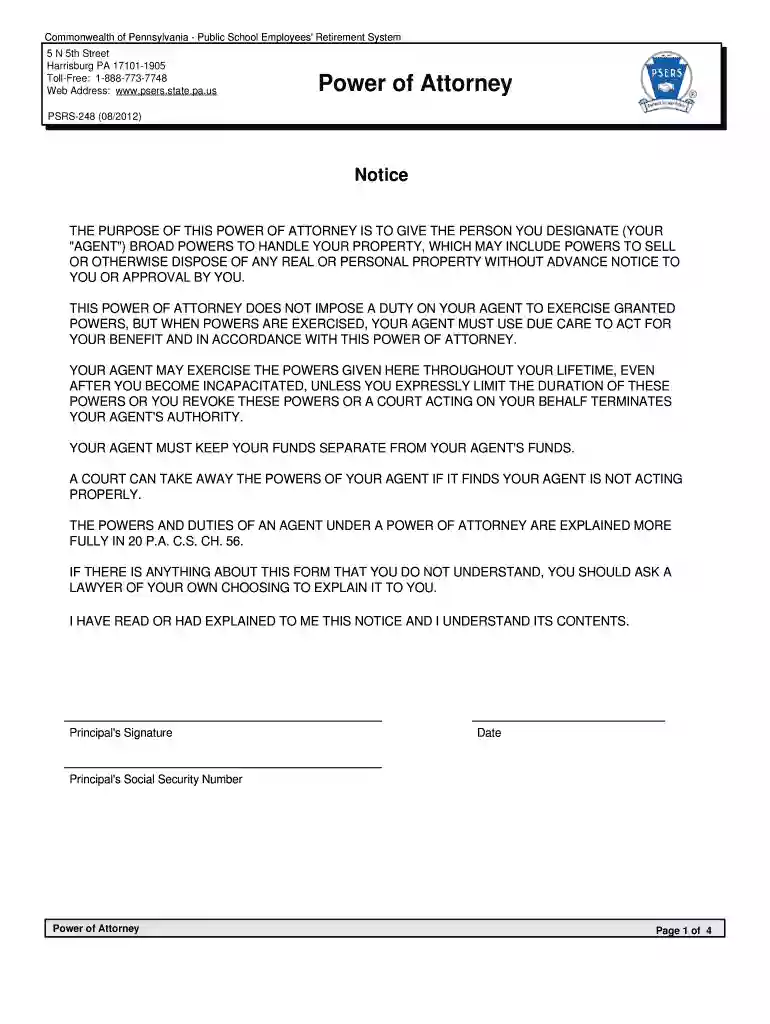
The "Power of Attorney for Public School Employees' Retirement System (PSERS) in Pennsylvania" is a legal document that empowers a designated agent to manage and execute transactions on behalf of the principal concerning their retirement benefits. This form is essential for members who want to authorize another party to handle specific tasks related to their retirement accounts within the PSERS framework.
To effectively use the Power of Attorney form, it's critical to understand its scope and limitations. The principal must clearly define the transactions the agent can perform, such as managing benefit disbursements or handling inquiries related to the account. It is vital for both the principal and agent to be explicit in specifying the powers granted to ensure clarity and prevent abuse. Review periods can be set to confirm the agent's actions are aligned with the principal's intentions.
It is essential to use the Power of Attorney form within the legal framework set by Pennsylvania state laws. The document grants the agent the authority to manage retirement accounts, a responsibility that comes with fiduciary duties. An agent’s actions must always conform to the principal's best interests and within the legal boundaries outlined in the document. Misuse can lead to legal consequences, including civil liabilities and penalties.
This form is predominantly used by members of the Public School Employees' Retirement System in Pennsylvania who wish to delegate the management of their retirement benefits. It's beneficial for principals who anticipate being unavailable to handle these matters themselves, such as those experiencing health issues or residing outside the country.


To complete the Power of Attorney form, the principal must provide identification documents for themselves and their designated agent. This often includes a government-issued ID, proof of address, and any other documentation the PSERS requires to authenticate the parties involved. Notarization is also critical, requiring additional identification for authenticity.
The Power of Attorney for PSERS must adhere to Pennsylvania state regulations, which may differ from those of other states. These rules dictate the form's execution, limitations, and validity. It's important to stay updated with any legislative changes that may affect how Powers of Attorney are recognized, especially regarding retirement benefits. Consulting with a legal advisor familiar with Pennsylvania law is advisable to ensure compliance and effective use of the document.
We've got more versions of the psrs 248 form. Select the right psrs 248 version from the list and start editing it straight away!
At DocHub, your data security is our priority. We follow HIPAA, SOC2, GDPR, and other standards, so you can work on your documents with confidence.
2018 Pennsylvania Patient Safety Authority. 45. PA-PSRS Event Analysis. (Jones and Magee). Page 46. 2018 Pennsylvania Patient Safety Authority. 46. PA-PSRS
This Power of Attorney (POA) authorizes your agent to perform on your behalf any transactions with the Public School Employees. Retirement System and the
Aug 7, 2025 The settings will be lost if you select another Voice or turn the power to the instrument off without executing the Save operation. Editing


