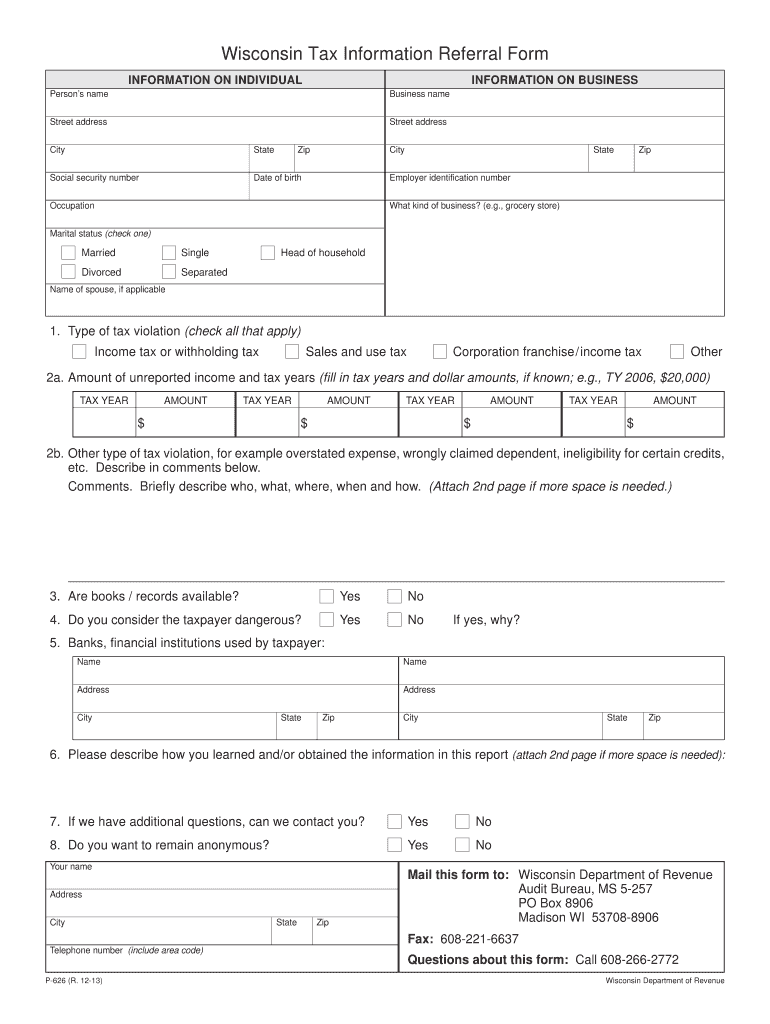







Definition and Purpose of the 2013 P-626 Wisconsin Tax Information Referral Form
The 2013 P-626 Wisconsin Tax Information Referral Form is designed to allow individuals to report tax violations such as incorrect income tax reporting, sales tax misfiling, or other related tax issues in Wisconsin. This document is crucial for maintaining tax compliance, offering a systematic way to highlight potential tax evasion or fraud to the Wisconsin Department of Revenue. By filling out this form, individuals contribute to ensuring that all tax liabilities are fairly administered and collected according to state laws.
How to Use the 2013 P-626 Form
To effectively utilize the P-626 form, the individual needs to provide comprehensive information about the tax violation they wish to report. This involves detailing the nature of the alleged tax evasion, the parties involved, and any relevant details that support the claim. Additionally, the form allows for anonymity, ensuring that the informant's identity can be protected upon request. It is crucial for users to review all sections carefully and provide thorough and accurate data.
Detailed Steps for Completing the Form
-
Identify the Tax Violation: Begin by clearly outlining the type of tax violation, whether it relates to income, sales, or other taxes.
-
Supply Personal and Business Information: Include details about the taxpayer involved, such as their name, address, and business identifiers.
-
Describe the Evidence: Provide clear evidence or reasons for suspecting tax non-compliance, which could include documents or firsthand experiences.
-
Comment on the Situation: Use the space provided to elaborate on the context, supporting your report with any additional insights you may have.
-
Submission and Anonymity Options: Decide whether to remain anonymous and follow the instructions for either paper or digital submission to the correct department within the Wisconsin Department of Revenue.
Obtaining the 2013 P-626 Wisconsin Tax Information Referral Form
Individuals seeking to report a tax violation can obtain the P-626 form through various channels. It is available for download on the Wisconsin Department of Revenue's website or can be requested in paper form by contacting the department directly. For those preferring digital formats, the form can often be filled out online, simplifying the reporting process.
Key Components of the 2013 P-626 Form
The P-626 form comprises several critical sections designed to collect necessary data for tax violation reports:
- Personal Information: Details of the informant, if anonymity is not requested.
- Taxpayer Information: Identification of the alleged violator.
- Nature of Violation: Description and evidence of the suspected tax-related misconduct.
- Comments Section: An area for further details and narrative explanations.
- Document Submission Details: Instructions on where and how to submit the completed form.
Legal Use and Importance
Submitting the P-626 form is a formal process that helps uphold tax laws within Wisconsin. Reporting forms like the P-626 are crucial for the state to investigate and rectify potential breaches of tax regulations, ensuring fairness in the tax system. It's essential for those filing this form to provide accurate information to assist thorough and lawful investigations.
Eligibility and Typical Users
This form is primarily used by individuals or businesses who have credible evidence or reasonable suspicion of tax evasion activities in the state of Wisconsin. While anyone can submit the form, it is particularly relevant for accountants, tax professionals, and business partners who have the financial insights necessary to identify discrepancies or fraudulent activities.
Penalties and Compliance
Failure to accurately report tax violations or knowingly submitting false information can lead to legal consequences. It's vital that those using the P-626 form are honest and precise in their reporting to avoid any repercussions against wrongful accusations.
Taxpayer Scenarios
Several scenarios warrant the use of the P-626 form, including:
- Self-Employed Individuals: Observing discrepancies in reported income.
- Business Competitors: Reporting non-compliance in sales tax collection.
- Retired Individuals: Noticing unreported sources of income among peers.
When utilized correctly, the P-626 form serves as a powerful instrument towards tax integrity and compliance in Wisconsin.