
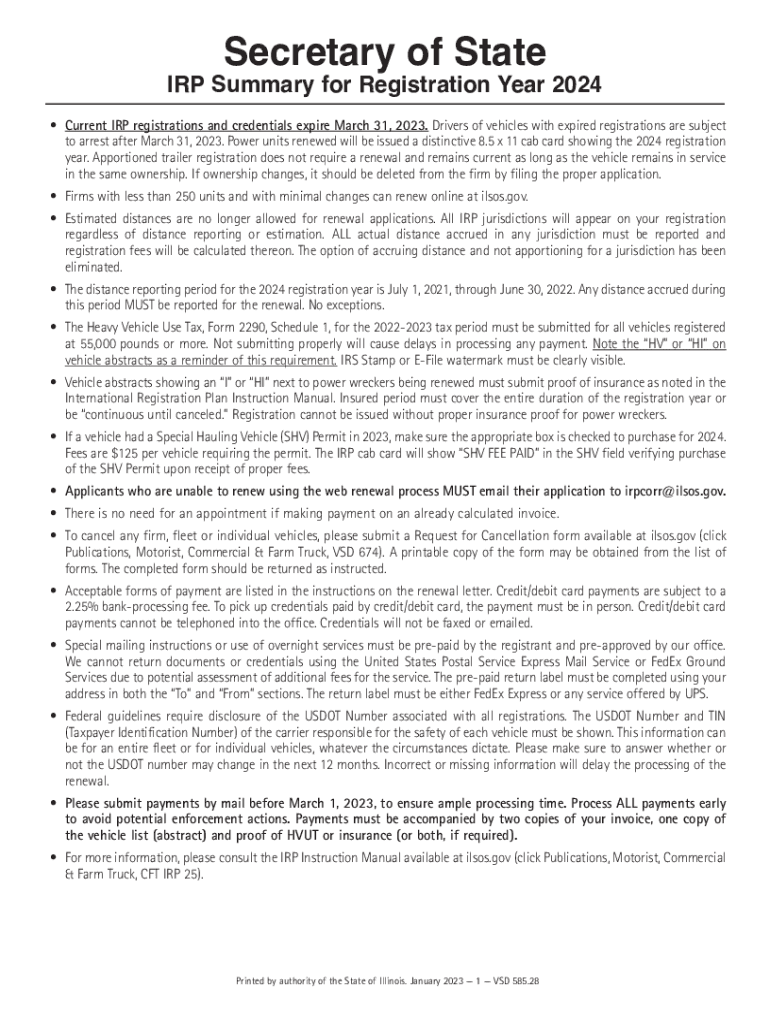







Definition and Meaning of the International Registration Plan (IRP)
The International Registration Plan (IRP) is a cooperative agreement among the United States, the District of Columbia, and Canadian provinces. Its primary purpose is to facilitate the registration and collection of apportioned fees for commercial motor vehicles traveling across multiple jurisdictions. Under the IRP, vehicles are only required to carry a single registration plate and cab card, which streamline operations and reduce paperwork for trucking companies and owner-operators operating interstate and internationally.
Steps to Complete the IRP Application
Completing the IRP application involves several key steps to ensure compliance and accurate fee calculation:
- Gather Documentation: Collect essential information such as vehicle details, business credentials, previous mileage records, and proof of payment for the Heavy Vehicle Use Tax.
- Mileage Reporting: Accurately report the actual miles traveled by your fleet in each jurisdiction over the previous reporting period to calculate your apportioned fees effectively.
- Complete the IRP Application Form: Fill out the necessary sections of the IRP application, ensuring every field is accurate to avoid processing delays.
- Submit Supporting Documents: Attach all required documents, including insurance proof, copies of title, and any necessary permits for special hauling vehicles.
- Application Submission: Submit your completed application and documentation either online, via email, or through mail, following state-specific instructions.
- Payment: Provide payment for the apportioned fees using the accepted methods outlined by your base jurisdiction.
Eligibility Criteria for the IRP
Understanding the eligibility criteria is essential when applying for the IRP:
- Vehicles must be used for commercial purposes and have a gross vehicle weight rating of over 26,000 pounds or be designed to transport more than one passenger, including the driver.
- The vehicle must operate in two or more IRP jurisdictions.
- Applicants must demonstrate the business's established place of residence or business operation within the base jurisdiction, along with proof of proper insurance coverage.


Required Documents for IRP Application
To ensure a successful IRP application, applicants must provide the following documents:
- Vehicle Title: Proof of ownership or lease agreement of the commercial vehicle.
- Mileage Records: Historical mileage data for each jurisdiction the vehicle operated in during the specified period.
- Insurance Certificate: Valid proof of insurance that meets or exceeds the minimum requirements set by the base jurisdiction.
- HVUT Payment Receipt: Documentation of the Heavy Vehicle Use Tax payment for all qualifying vehicles.
- Special Permits: Necessary permits for operating special categories such as power wreckers or special hauling vehicles.
Why Apply for the International Registration Plan (IRP)
The IRP offers numerous benefits making it essential for applicable commercial transportation operations:
- Simplified Registration: A single registration plate and cab card eliminate the need for multiple vehicle registrations across different jurisdictions.
- Cost Efficiency: Fees are apportioned based on miles traveled in each jurisdiction, which ensures equitable distribution of road maintenance costs.
- Operational Flexibility: Registered vehicles can travel freely across participating jurisdictions, broadening business opportunities and operational reach.
- Compliance Assurance: Adhering to IRP requirements helps companies avoid penalties and ensures legal operation across state and provincial borders.
Key Elements of the IRP
The IRP application process encompasses several critical elements that applicants need to familiarize themselves with:
- Apportionment: The calculation of fees based on miles traveled within each jurisdiction and vehicle weight.
- Cab Card: An official document carried in each vehicle that provides proof of registration and displays apportioned areas.
- Base Jurisdiction: The home state or province where the vehicle is registered and primary administrative tasks are conducted.
Legal Use of the IRP
The IRP stipulates the legal requirements and guidelines for operating commercial vehicles across participating jurisdictions:
- Adherence to IRP guidelines is legally binding once registered, requiring accurate distance reporting and timely fee payment.
- Modifications to vehicle operations, such as adding vehicles or changing jurisdictions, must be promptly reported to maintain compliance.
- Failure to comply can result in penalties, fines, or operational restrictions, emphasizing the importance of accurate record-keeping and adherence to protocols.
Filing Deadlines and Important Dates
Applicants must be vigilant about compliance with IRP deadlines to avoid penalties:
- Renewal Deadlines: Ensure that all renewal applications are submitted by the specified date to avoid lapses in registration.
- Distance Reporting: Provide accurate and timely mileage data within the designated reporting period to facilitate the calculation of apportioned fees.
- Tax Submission: File HVUT and any other required tax payments in accordance with IRS deadlines to ensure smooth processing and uninterrupted operations.




