
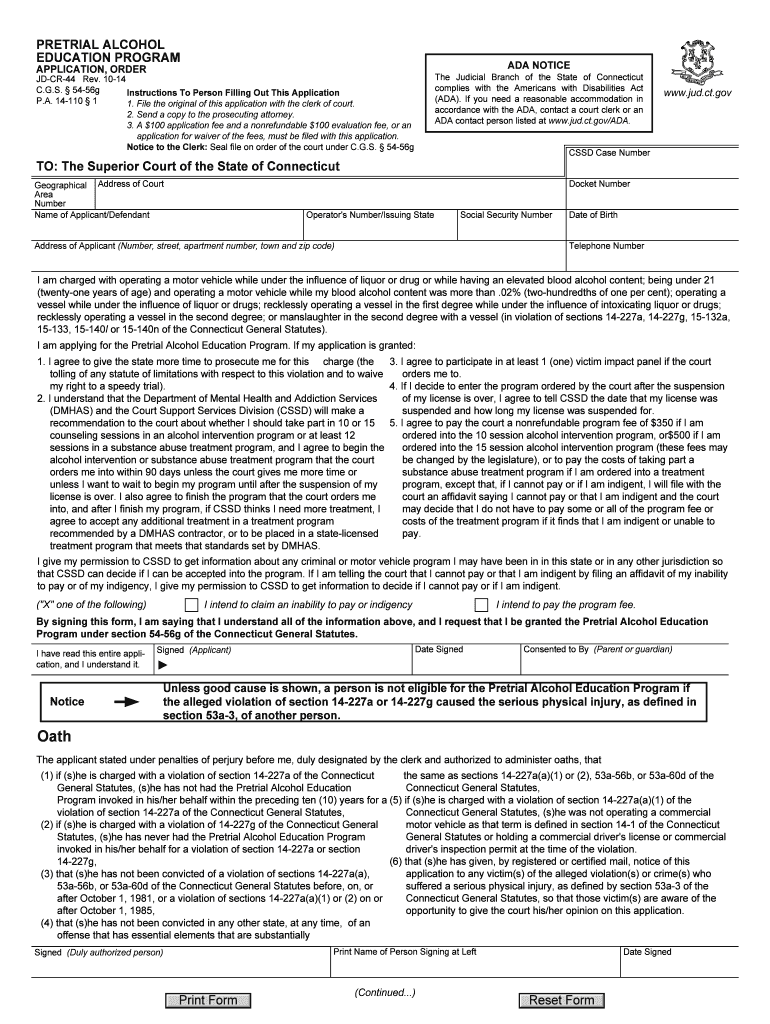







Definition & Purpose of the Pretrial Alcohol Education Program
The Pretrial Alcohol Education Program run by the Connecticut Judicial Branch is designed to educate and rehabilitate individuals involved in alcohol-related offenses. This program provides an alternative to traditional legal penalties, offering education on alcohol abuse and its implications. Participants who successfully complete the program might have the opportunity to dismiss their charges, emphasizing rehabilitation over punishment. Enrollment is contingent on eligibility criteria and varies depending on the individual's offense history and the judicial assessment.
Eligibility Criteria
Participants must meet specific eligibility requirements to be accepted into the program. Typically, first-time offenders charged with certain alcohol-related offenses qualify for this educational alternative. The court assesses factors such as the nature of the offense, the applicant's criminal record, and their willingness to complete the program successfully. Prior participation in similar programs might affect eligibility.

Required Conditions for Participation
- Must be charged with a qualifying alcohol-related offense
- Typical exclusion for individuals who have participated in a similar program within a certain period
- Acceptance of program terms, including attendance and course completion
Steps to Apply for the Program
- Initial Court Hearing: At your first appearance, inform the court of your intention to apply for the Pretrial Alcohol Education Program.
- Application Submission: Fill out the necessary paperwork provided by the court clerk.
- Assessment: Undergo an evaluation to determine suitability and program placement.
- Fee Payment: Pay the program fee, which may vary based on the individual's situation.
- Judicial Approval: Await the court's decision on your application. Approval depends on meeting eligibility criteria and court discretion.
Alternative Procedures
- For Non-Approval: If not approved, standard legal procedures and potential penalties for the offense apply.
Key Elements of the Program
The primary aspects of the program focus on education and rehabilitation. Participants engage in structured sessions covering:
- The impact of alcohol consumption and abuse
- Legal consequences of alcohol-related offenses
- Strategies for managing and avoiding future alcohol-related issues
Supporting Components
- Regular attendance is mandatory.
- Participation in individual or group counseling sessions
- Completion of educational modules within a specified timeframe
Legal Use and Compliance
Completing the program can lead to the dismissal of charges related to the original offense, contingent on successful completion and judicial approval. The program offers a legally compliant path to mitigate the consequences of alcohol-related offenses.
Possible Outcomes
- Successful Completion: Dismissal of charges, provided all program requirements are met.
- Non-Compliance: Continuation of the judicial process, with standard penalties enforced.
State-Specific Rules and Judicial Guidelines
Connecticut's rules and procedures for the Pretrial Alcohol Education Program are managed by the Connecticut Judicial Branch. This ensures consistency in application and fairness in handling cases.
State-Imposed Conditions
- Adherence to the program's prescribed structure
- Compliance with any additional court-ordered conditions
Required Documentation for Application
Applicants must prepare and submit several specific documents to apply successfully:
- Official application form for the Pretrial Alcohol Education Program
- Proof of identity and relevant legal documentation (e.g., court order)
- Payment receipt for any application or program fees
Form Submission Methods
Applicants can submit their forms through various methods in line with state guidelines:
- In-Person Submission: Deliver documents directly to the court.
- Mail: Send completed forms to the appropriate judicial address.
- Online: Utilize the available online platforms facilitated by the Connecticut Judicial Branch, if offered.
Preparation for Submission
- Verification: Ensure accuracy and completeness of information before submission.
- Confirmation: Follow up to confirm receipt and processing of your application.
Impact & Implications of Successful Completion
Participants benefit from a rehabilitative approach that potentially reduces legal repercussions and fosters long-term behavioral change, contributing to lower recidivism rates and a more informed view of alcohol's impact.
Long-Term Benefits
- Dismissal of charges upon successful completion
- Enhanced understanding and management of alcohol-related behavior
- Potential eligibility for similar future programs with more stringent monitoring




