




01. Edit your form online
Type text, add images, blackout confidential details, add comments, highlights and more.

Type text, add images, blackout confidential details, add comments, highlights and more.

Draw your signature, type it, upload its image, or use your mobile device as a signature pad.

Send it via email, link, or fax. You can also download it, export it or print it out.
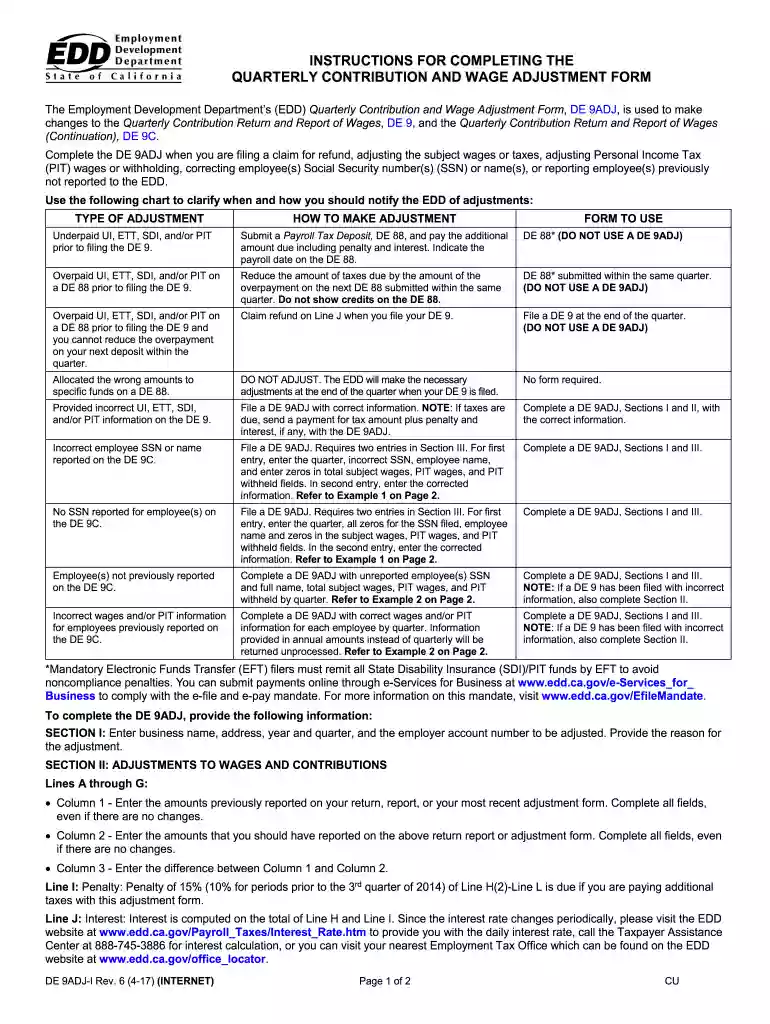
The DE 9ADJ form, formally known as the Employment Development Department’s (EDD) Quarterly Contribution and Wage Adjustment Form, serves a critical role in allowing businesses to report and adjust wages, taxes, and employee information. It's designed to facilitate corrections for previously reported data concerning wage contributions and employer taxes. Businesses operating in California use this form to ensure that their financial records and state tax obligations are accurate.
To use the DE 9ADJ form effectively, begin by evaluating your existing quarterly wage and contribution reports. Identify any discrepancies or changes needed for wages, taxes, or employee data. Once these areas are pinpointed, enter the necessary corrections on the form. It’s essential to ensure accuracy, as the data provided will directly impact your tax obligations and any potential refunds or credits due.
Filling out the DE 9ADJ form requires careful adherence to specific steps to ensure compliance. Each section of the form deals with different aspects of employer tax adjustments.
Typically, the DE 9ADJ form is used by employers in California who need to amend previously submitted quarterly wage reports. These include small to large businesses across various industries, accountants managing payroll services, and financial departments within organizations that handle employee compensation:


The legal application of the DE 9ADJ form involves complying with California state requirements for tax contributions and wage reporting. It is crucial for maintaining accurate financial records and meeting regulatory obligations. The form ensures businesses are transparent and truthful in their financial dealings, ultimately protecting employers from potential audits or penalties.
The form comprises multiple sections which must be filled accurately:
California-specific regulations guide the use of the DE 9ADJ form, mandating that any adjustments to previously filed reports must be satisfactorily justified with documented evidence. Complying with these rules ensures that businesses rectify their records in accordance with state tax requirements.
There are three primary methods for submitting the DE 9ADJ form:
This approach allows flexibility based on business resources and preferences for managing state filings.
We've got more versions of the de 9adj i 2011 form form. Select the right de 9adj i 2011 form version from the list and start editing it straight away!
At DocHub, your data security is our priority. We follow HIPAA, SOC2, GDPR, and other standards, so you can work on your documents with confidence.
Part I. Taxpayer Identification Number (TIN). Enter your TIN in the appropriate box. The TIN provided must match the name given on the Name line.
Dec 21, 2011 To get the payees SSN or EIN, use Form W-9, Request pate in the Self-Select PIN (personal identification number) for Taxpayer
Quarterly Contribution and Wage Adjustment Form (DE 9ADJ) should be used to file the corrected information. DE 83 Rev. 1 (4-18). Page 4 of 8. Page 19


