




01. Edit your 837p claim form online
Type text, add images, blackout confidential details, add comments, highlights and more.

Type text, add images, blackout confidential details, add comments, highlights and more.

Draw your signature, type it, upload its image, or use your mobile device as a signature pad.

Send 837p form via email, link, or fax. You can also download it, export it or print it out.
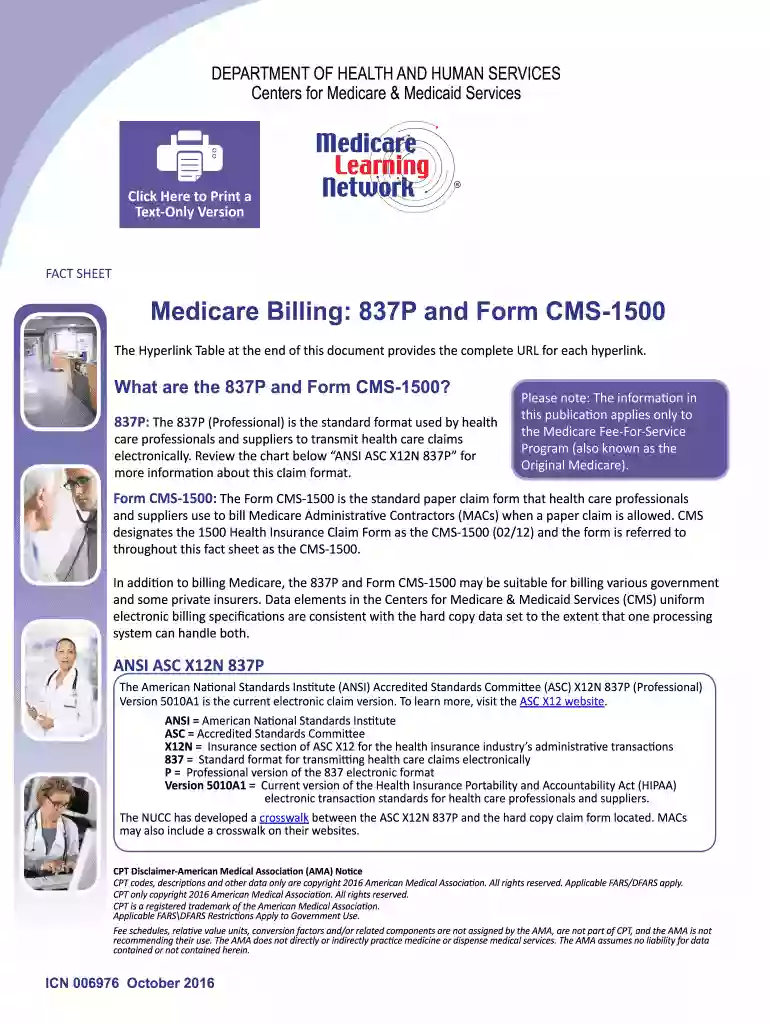
The 837P form, also known as the Professional Claim Form, is primarily utilized for the electronic submission of healthcare claims. Adopted by healthcare providers across the United States, this form streamlines the billing process by standardizing claim submissions to insurance payers. It is specifically designed for services provided by healthcare professionals, including physicians, nurses, and outpatient services, ensuring accurate billing and compliance with healthcare regulations. The form encompasses detailed information regarding the patient, healthcare provider, service rendered, and associated costs.
The 837P form is structured to capture comprehensive billing information. It includes various segments such as patient demographics, insurance details, diagnosis codes, and procedure codes. The form also requires information about the provider, including their National Provider Identifier (NPI). Accurate coding and validation of data are critical, as errors can lead to claim rejections or delays. Additionally, the 837P form supports multiple service lines, allowing the inclusion of various procedures or treatments in a single claim.
Filling out the 837P form requires meticulous attention to detail. Here is a step-by-step guide to completing the form accurately:
The primary users of the 837P form are healthcare providers and billing companies engaged in outpatient and professional billing. This includes individual practitioners, clinics, and specialty service providers such as radiologists and physical therapists. The form is also applicable to any facility billing for professional services rendered, as well as third-party billing agencies managing healthcare claims on behalf of providers.


Accessing the 837P form generally requires enrollment with an electronic clearinghouse or healthcare information management system that accommodates the standard format. Providers must establish agreements with these intermediaries and ensure their software is compliant with HIPAA standards for electronic transmission. Many practice management systems include built-in capabilities for generating and submitting the 837P form as part of their billing functionalities.
The 837P form must be used in compliance with the Health Insurance Portability and Accountability Act (HIPAA), governing electronic health transactions. HIPAA mandates confidentiality and data security, necessitating encrypted transmission and storage of the information detailed in the form. Adherence to these legal requirements is essential to safeguarding patient data and ensuring successful claim processing.
Understanding specific terms is crucial for effectively managing 837P forms:
While the 837P form provides a standardized approach to claim submissions, states may impose additional requirements or regulations affecting how these forms are utilized. Some states might mandate specific fields or value-added information uniquely required by state health departments or Medicaid programs. Providers should be familiar with regional policies affecting claim submissions to ensure compliance and mitigate the risk of rejections or denials.
Consider a scenario where a cardiologist submits an 837P form for an outpatient consultation service. In this case, patient demographics, diagnosis codes related to cardiovascular conditions, and procedure codes for the consultation are accurately recorded. Following validation, the form is electronically transmitted to a private insurer. The insurer evaluates the submission, processing payment based on covered services and the agreed fee schedule, demonstrating the form’s effectiveness in facilitating smooth billing and reimbursement processes.
Through these structured sections, the comprehensive utility and functionality of the 837P form are highlighted, providing clarity and facilitating effective claims management.
We've got more versions of the 837p claim form form. Select the right 837p claim form version from the list and start editing it straight away!
At DocHub, your data security is our priority. We follow HIPAA, SOC2, GDPR, and other standards, so you can work on your documents with confidence.
Sep 16, 2011 Physicians who choose to submit their Medicaid claims electronically are required to use the HIPAA 837 Professional. (837P) transaction. 2.2
The 837P is the electronic version of the CMS-1500. Its the standard format for transmitting healthcare claims from professional providers to payers like


