Definition and Meaning of Form 3 Partnership 2014
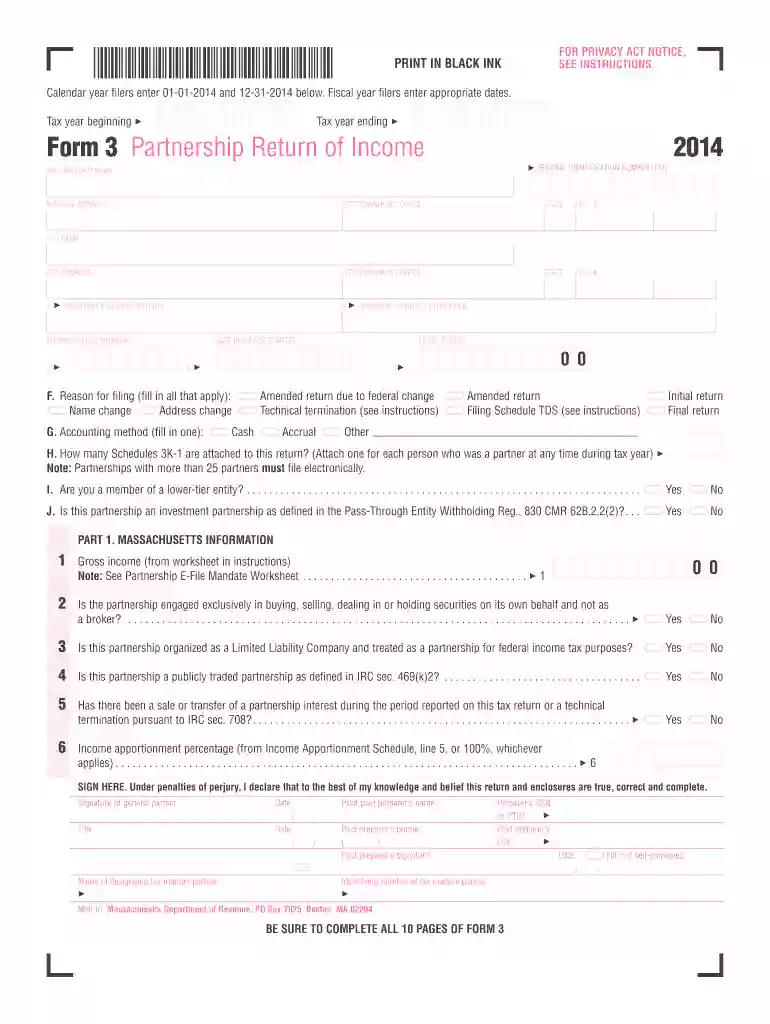
The 2014 Massachusetts Form 3 Partnership Return of Income is a tax document used by partnerships to report their financial information, including income, deductions, and credits. It serves as a comprehensive financial summary that allows partnerships to comply with state tax obligations. The form requires detailed input on various financial metrics and is essential for ensuring that partnerships are accurately assessed for taxes owed to the state.
Key Details Included
- Federal Identification Number: Each partnership must provide its unique federal identification number, which is essential for identification and tax processing.
- Partnership Name and Address: Complete and accurate representation of the business name and mailing address related to the partnership.
- Income Apportionment: Crucial for partnerships conducting business both within and outside Massachusetts, requiring the calculation of income derived from Massachusetts sources.
- Financial Figures: Includes detailed reporting of income, expenses, and other financial outcomes pertinent to the partnership’s operations during the tax year.
Steps to Complete the Form 3 Partnership 2014
Completing the Form 3 Partnership 2014 requires careful attention to detail and accurate data entry. Here is a step-by-step guide for effectively filling out the form:
- Gather Necessary Information: Collect all relevant financial documentation, including income statements, expense receipts, and apportionment schedules.
- Fill Out Identification Details: Enter the partnership's federal identification number, along with the name and address exactly as registered.
- Complete Income and Expenses Sections: Add figures for total income and deduct the allowable expenses to determine net income.
- Calculate Apportionment: If applicable, use the apportionment worksheets to calculate the income allocated to Massachusetts.
- Deductions and Credits: Identify available deductions and tax credits and apply them to reduce the overall taxable amount.
- Attach Additional Schedules if Necessary: Include any required supporting schedules or worksheets to substantiate claims.
- Review and Submit: Double-check all entries for accuracy before submitting the form by the specified deadline.
Common Errors to Avoid
- Misreporting income or expenses due to incorrect calculations.
- Omitting necessary supporting documents or schedules.
- Not understanding specific deductions applicable to the partnership type.
Important Terms Related to Form 3 Partnership 2014
Understanding key terminology can aid in the accurate completion of the Form 3 Partnership 2014. Here are some important terms:
- Apportionment: The method used to divide and assign income to various jurisdictions, based on specific ratios.
- Deductions: Specific expenses allowed to be subtracted from total income to reduce taxable income.
- Credits: Monetary values that directly reduce the amount of tax owed, often applicable after deductions are considered.
Clarifications
- Net Income: This represents the total revenue minus expenses and deductions, forming the basis for state tax calculations.
- Federal Taxable Income: The income figure used on federal returns that serves as the starting point for state adjustments.
State-Specific Rules for the Form 3 Partnership 2014
Massachusetts has particular rules governing the filing of partnership returns. Here are some considerations:
- Apportionment Factors: Massachusetts requires specific apportionment formulas which may differ from other states' methodologies, often based on property, payroll, and sales within the state.
- Filing Requirements: Certain partnerships, particularly those deriving a specific percentage of income from Massachusetts, are mandated to file.
- Additional Schedules: Massachusetts may require additional documentation, such as Schedule T, to verify apportioned income.
Who Typically Uses the Form 3 Partnership 2014
Form 3 Partnership 2014 is predominantly filed by partnerships registered in or conducting business within Massachusetts. Key user types include:

- General Partnerships: Two or more individuals sharing business profits, often without a formal entity structure.
- Limited Partnerships (LPs): Consisting of both general and limited partners, where liability may be limited to the extent of their investment.
- Limited Liability Partnerships (LLPs): Providing partners with liability protection from certain debts of the partnership.
Examples of Eligible Partnerships
- Professional Service Firms: Such as law firms, accounting practices, or architectural firms.
- Real Estate Ventures: Including partnerships formed to manage joint real estate projects or holdings.
Legal Use of the Form 3 Partnership 2014
Compliance with tax laws and partnership agreements makes the legal use of Form 3 Partnership 2014 imperative. Proper filing helps prevent legal complications such as audits or penalties.
Compliance Checks
- Timely Submission: Partnerships must adhere to annual filing deadlines to avoid late penalties.
- Accurate Reporting: Ensuring all provided information is truthful and verifiable minimizes the risk of future legal scrutiny.
- Use of Certified Information: Financial documentation should be sourced from credible and validated records, increasing the form's legitimacy.
Penalties for Non-Compliance
Failure to comply with filing requirements can result in various penalties. It's vital to understand the implications of non-compliance with Form 3 Partnership 2014:
- Late Filing Penalties: Typically assessed as a percentage of unpaid tax due, increasing the longer the delay.
- Interest Charges: Accrue on unpaid balances from the filing deadline until the date of payment.
- Increased Scrutiny: Non-compliant partnerships may be subject to more rigorous audits, extending into other areas of tax liability.
Filing Deadlines and Important Dates
Adhering to specific timelines is crucial for the filing of the Form 3 Partnership 2014.
Key Dates
- Filing Deadline: Typically due on the 15th day of the fourth month following the close of the fiscal year of the partnership.
- Extension Periods: Extensions are possible, though interest and penalties may still apply if there are unpaid taxes during this period.
Form Submission Methods: Online, Mail, In-Person
Partnerships have several methods available for filing Form 3 Partnership 2014, each offering distinct advantages:
- Online Submission: Fastest method, allowing for electronic completion and immediate confirmation upon filing.
- Mail: Traditional approach, requiring the form and all supporting documents to be mailed to the state tax authority.
- In-Person: Less common, but partnerships can deliver forms to designated tax office locations.
Considerations for Method Selection
- Efficiency: Online methods provide immediate feedback and error-checking, reducing submission errors.
- Security: Proper mailing or online encryption ensures that sensitive information is protected during submission.
- Receipt Confirmation: Online filing offers quick confirmation receipts, whereas mailed forms may require additional verification.