




01. Edit your form online
Type text, add images, blackout confidential details, add comments, highlights and more.

Type text, add images, blackout confidential details, add comments, highlights and more.

Draw your signature, type it, upload its image, or use your mobile device as a signature pad.

Send it via email, link, or fax. You can also download it, export it or print it out.
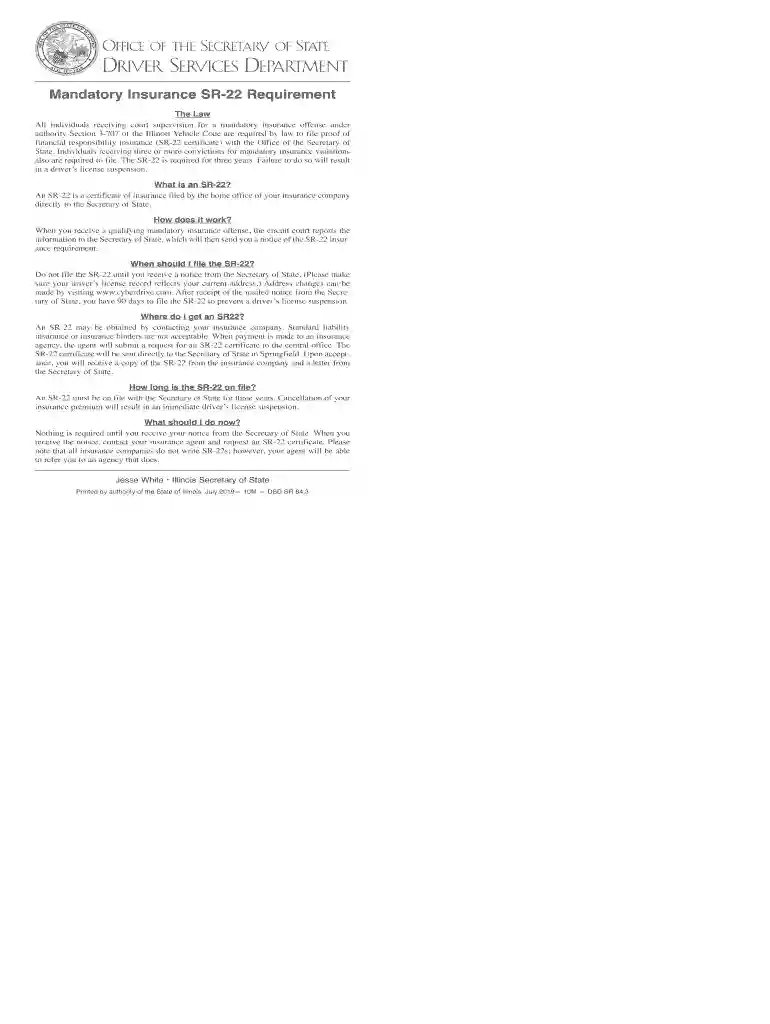
SR-22 Insurance is a vehicle liability insurance document required by the Division of Motor Vehicles and the Department of Motor Vehicles in various states. It's primarily for drivers who have been involved in offenses such as DUIs, reckless driving, or driving without insurance. The SR-22 is not an insurance policy itself but a certificate of financial responsibility, ensuring that the driver meets the minimum liability coverage.
Contact your insurer: Speak with your current insurance provider to find out if they offer SR-22 filing services. Not all companies provide this certificate.
New Policy Acquisition: If your insurer does not offer SR-22, you may have to switch to a provider who does. Ensure the new policy meets state liability requirements.
Pay the Fee: Insurance companies charge a filing fee for the SR-22 certificate, typically ranging from fifteen to twenty-five dollars.
Issuance and Submission: Once you pay the fee, the insurer will submit the SR-22 form to your state's Motor Vehicle Department. The process is often swift, typically completed within a few days.
Duration: Most states mandate that drivers maintain SR-22 for three years. However, the timeframe can vary based on individual circumstances and state regulations.
Coverage Levels: States usually prescribe minimum liability coverage that SR-22 must meet. This coverage often includes bodily injury and property damage liabilities.
State Variations: For example, Illinois requires SR-22 for those with multiple insurance offenses. Texas has distinct conditions and durations for SR-22 filings, often tied to the severity of the offense.
Non-compliance Penalties: Failing to maintain SR-22 as required can result in license suspension, increased fines, or extended SR-22 duration.
License Reinstatement: SR-22 certification is often a prerequisite for reinstating a suspended license, ensuring ongoing insurance coverage.
Mandatory Filing: For drivers ordered by the court or DMV, obtaining an SR-22 is compulsory. Ignorance of these requirements can lead to severe legal and financial consequences.
Certificate of Financial Responsibility (CFR): Another term for SR-22, confirming proof of insurance.
Filing Fee: A nominal fee charged by insurers to file the SR-22 form with the state.
Minimum Liability Coverage: The mandatory minimum insurance coverage required by law, ensuring third parties are compensated in accidents.
Drivers with DUI Convictions: Offenders must often file an SR-22 as part of their penalty.
Repeat Offenders: Individuals with multiple traffic violations may be required to obtain an SR-22 to demonstrate compliance with insurance laws.
Uninsured Drivers: Those caught driving without insurance in states requiring liability proof are mandated to file an SR-22.
Efficiency: Digital SR-22 forms are processed faster, reducing wait times for drivers needing license reinstatement.
Tracking: Paper SR-22 may lack the straightforward tracking features available in digital submissions.
Error Reduction: Digital submission often includes built-in validation checks to minimize filing errors and rejections.
Online: Most insurance companies offer digital submission options, streamlining the process and offering immediate confirmation.
Mail: Filing via mail is slower, requiring manual processing that can extend the filing time.
In-Person: Some states offer the ability to submit in-person at DMV offices, beneficial for those needing direct assistance or facing complex cases.
License Suspension: Immediate suspension of driving privileges upon verification of non-compliance.
Increased Premiums: Insurance providers consider non-compliance as high-risk behavior, often resulting in premium hikes.
Extended SR-22 Requirement: In some states, non-compliance may result in an extended SR-22 duration, adding additional years to the requirement.
We've got more versions of the SR-22 Insurance, Division of Motor Vehicles, Department of form. Select the right SR-22 Insurance, Division of Motor Vehicles, Department of version from the list and start editing it straight away!
At DocHub, your data security is our priority. We follow HIPAA, SOC2, GDPR, and other standards, so you can work on your documents with confidence.
Carry a certificate of insurance (SR-22/bond) for one year*; Pay a reinstatement fee. *For a first offense Non-Compliance added to the record prior to April 9
You may obtain further information concerning these warranties by following the procedure outlined in the INFINITI OWNER. SATISFACTION ASSISTANCE section of.


