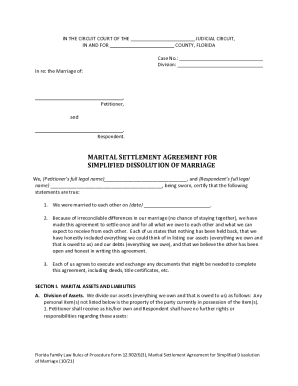
Definition & Purpose of Form 12.982(f)
Form 12.982(f) is a Florida Supreme Court Approved Family Law document used for petitioning a change of name for a family. This form is essential for families seeking to legally change last names in the state of Florida. It requires accurate and thorough completion to ensure the change is recognized by law. Comprising several sections, it covers personal details, the desired new name, and the reasons for the name change to assess its legitimacy and intention.
How to Use Form 12.982(f)
-
Filling the Form: Gather all current legal identification documents for each family member involved. Fill out the form with current names, desired new names, and justification for the change. Ensure the information is complete and correct to avoid processing delays.
-
Fingerprinting: As part of the process, adult applicants must undergo fingerprinting. This requirement is vital for a background check to ensure the name change is not being requested for illegal purposes. Schedule an appointment at an approved location to complete this step.
-
Filing the Petition: Submit the form, along with any additional required documents, to the family division of the local circuit court. It's essential to know whether electronic filing is available in your jurisdiction for efficiency.
-
Service of Process: Notify other relevant parties such as legal guardians or parents of minors involved in the petition. This step may require providing copies of the petition to ensure everyone is informed about the requested change.
Steps to Complete Form 12.982(f)
-
Gather Necessary Information: Collect all required identification and documentation. This helps in accurately completing each section.
-
Complete Sections Thoroughly: Fill out each section with precision, from names and addresses to reasons for the change. Every detail can affect the outcome.
-
Verify Information Twice: Before submission, review all entered information to confirm accuracy. Mistakes might lead to rejection or delays.
-
Attach Additional Documents: Include any necessary supporting documents, such as affidavits or consent forms from legal guardians of minors, which might be required for the process.
-
Court Submission: Depending on your local jurisdiction's rules, this could involve visiting the courthouse personally, mailing the documents, or uploading them electronically.
-
Await Confirmation and Hearing Notice: After submission, you'll receive confirmation and information on any further steps such as court appearances.
Legal Considerations and Requirements
-
Criminal History Checks: All adult petitioners must complete a criminal history background check. This step is crucial to prevent name changes for purposes such as evading law enforcement.
-
Obtaining Parental Consent: For minors, consent from both legal parents or guardians is typically required unless the court decides otherwise based on specific circumstances.
-
Court Hearing: A court hearing may be scheduled to review the petition. This provides an opportunity for the petitioner to present any necessary arguments in favor of the name change.
Essential Documents for Submission
-
Completed Form 12.982(f): The core document that begins the legal process for changing the family name.
-
Fingerprint Card: Necessary for the completion of background checks for adult petitioners.
-
Identification: Legal documents proving current identity, such as birth certificates or passports.
-
Consent Forms: In cases involving minors, signed consents from both parents might be required to accompany the petition.
Understanding Eligibility Criteria
-
Residency Requirement: Petitioners must be Florida residents to file this form, confirming jurisdictional relevance.
-
Legitimate Purpose: The name change must be for a legitimate reason, such as family unification or personal preference, and not for fraud or evasion.
-
Good Character Proof: The petition should reflect that all adult applicants are of good character with no ongoing legal issues that could be affected by the name change.


Importance of Electronic Filing
-
Efficiency: Electronic filing offers a quicker and often simpler method to submit the necessary documentation, reducing paper use and improving processing times.
-
Access to Updates: Online platforms often allow petitioners to track the status of their submission, aiding in easier management and follow-up.
-
Compliance: Many jurisdictions encourage or require electronic submissions, ensuring adherence to local court protocols.
Examples & Scenarios of Form 12.982(f) Usage
-
Family Unit Change: When adopting a stepchild, the family may choose to have a consistent last name for unity, necessitating this form.
-
Cultural Adaptation: Families emigrating from another country might wish to change their surname to better integrate into their new cultural environment.
-
Legal Consideration: In cases where a name has been derogatively used, a family may petition for a change to overcome associated stigma.
Filing Deadlines and Important Considerations
-
Timely Submission: Adhering to the specific deadlines set by the court is vital for timely processing. Late submissions might delay proceedings or require rescheduling.
-
Court Schedules: Understanding the local court's schedule can help in planning submissions around expected processing times, particularly during busy periods.
Who Typically Uses Form 12.982(f)
-
Families with Minors: Particularly those undergoing familial adjustments, such as adoption or divorce, where name alignment is desired.
-
Immigrant Families: Those transitioning culturally by adopting a name that better fits their new place of residence.
-
Blended Families: Stepsiblings or families combining through marriage may choose to unify under one surname for ease and cohesion.