
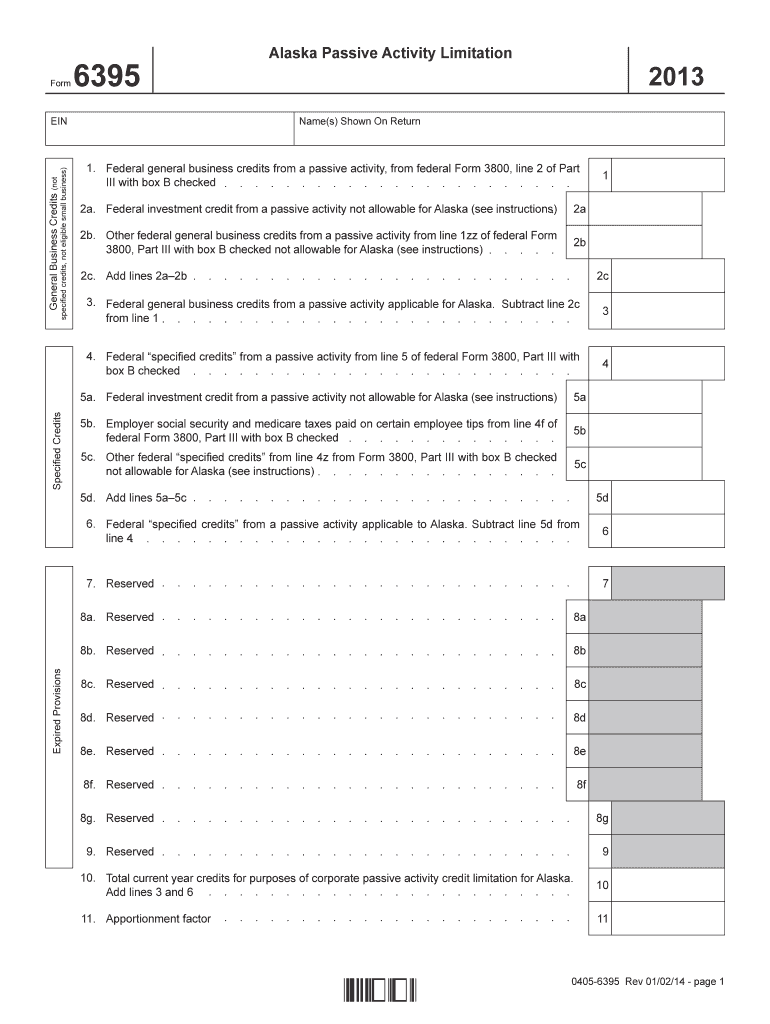







Definition and Purpose of the Alaska Tax Form
The Alaska Tax Form, often referred to in context as the Alaska Passive Activity Limitation Form 6395, serves a specific purpose within the state's tax framework. It's primarily designed to facilitate the calculation and reporting of federal general business credits and specified credits arising from passive activities. This form plays a pivotal role in determining the eligibility of various credits tied to passive income streams, providing a structured approach for taxpayers to account for these credits accurately.
The form ensures compliance with both federal and state regulations by requiring precise documentation of credits, adjustments for non-allowable credits, and the subsequent assessment of allowed passive activity credits. Given its targeted function, the form caters to taxpayers engaged in activities considered passive under tax regulations, such as lease income or limited partnership interests.
Steps to Complete the Alaska Tax Form
Completing the Alaska Tax Form requires a comprehensive understanding of the specific information needed and its implications. The process involves several detailed steps:
-
Gather Necessary Information: Before starting the form, ensure you have detailed records of all passive activities conducted within Alaska, including any investment or business engagements that generate passive income.
-
Calculation of Passive Activity Credits: Utilize the form to calculate eligible federal general business credits and specific credits from passive activities. This requires detailed records and knowledge of qualifying credits as per IRS guidelines.
-
Adjustments and Non-Allowable Credits: Identify and account for any credits that are not permissible. This is a crucial part of maintaining compliance and involves subtracting non-eligible credits from the total.
-
Completion and Verification: Fill out the respective sections of the form with the calculated credits and required information. Ensure all entries are accurate to the best of your knowledge to prevent issues with compliance.
-
Submission: After completing the form, review it for accuracy and completeness. Submit it through the designated method, whether online, via mail, or in-person, adhering to the Alaska Department of Revenue's protocols.
Key Elements of the Alaska Tax Form
Understanding the critical components of the Alaska Tax Form can significantly aid in its accurate completion:
-
Passive Activity Credits: Central to the form is the documentation of passive activity credits, which need to be carefully calculated and reported.
-
General Business Credits: The inclusion of federal general business credits that are pertinent to the passive activities conducted in Alaska.
-
Required Documentation: The form necessitates thorough documentation to support each claimed credit, enhancing transparency and compliance.
-
Reporting Adjustments: Sections dedicated to adjusting figures for non-allowable credits ensure that only eligible credits are claimed.
How to Obtain the Alaska Tax Form
Obtaining the Alaska Tax Form can be straightforward when you know the procedure:
-
Download from Official Sources: The Alaska Department of Revenue's official website provides the form for download. Ensure that the most current version is being used to account for any updates or changes in regulations.
-
Request by Mail: You may contact the Alaska Department of Revenue and request a physical copy be sent to your mailing address, particularly if internet access is limited.
-
Tax Software Integration: Many tax preparation software platforms, compatible with forms like TurboTax and QuickBooks, include the Alaska Tax Form within their system, allowing for easy integration and filing.
State-Specific Rules for the Alaska Tax Form
When dealing with the Alaska Tax Form, recognition of state-specific regulations is essential:
-
Alaska’s Unique Tax Position: Unlike most U.S. states, Alaska does not impose a state income tax, which may affect how passive activity credits are handled compared to other states.
-
Regulatory Compliance: All tax forms used within the state must adhere to not only federal tax codes but also Alaska's specific regulatory requirements for passive activities and associated credits.
Examples of Using the Alaska Tax Form
To better understand the practical application of the Alaska Tax Form, consider these scenarios:
-
Rental Property Owners: A taxpayer earning income from rental properties may need to report passive activity credits and general business credits, utilizing the form to calculate eligible credits from profits generated within Alaska effectively.
-
Investors in Limited Partnerships: Individuals with income from interests in limited partnerships may use the form to document passive activity credits derived from these investments.
IRS Guidelines Related to Passive Activity
The IRS provides extensive guidance on handling passive activities and applicable credits:
-
Defining Passive Activities: According to IRS regulations, passive activities typically include business ventures in which the taxpayer does not materially participate, such as rental income, which is crucial for understanding which activities qualify for credits on the form.
-
Credits Eligibility: The IRS specifies which general business credits and passive activity credits are claimable, and these guidelines serve as a reference point when completing the Alaska Tax Form.
Filing Deadlines and Important Dates
Adhering to deadlines is crucial for compliance:
-
Annual Filing Requirement: The Alaska Tax Form should be filed in conjunction with your federal tax return, making it essential to align with federal deadlines to avoid penalties.
-
Extension Considerations: If additional time is necessary, it's important to file for an extension according to the IRS guidelines, keeping in mind how it will affect state-level requirements.




