




01. Edit your form online
Type text, add images, blackout confidential details, add comments, highlights and more.

Type text, add images, blackout confidential details, add comments, highlights and more.

Draw your signature, type it, upload its image, or use your mobile device as a signature pad.

Send it via email, link, or fax. You can also download it, export it or print it out.
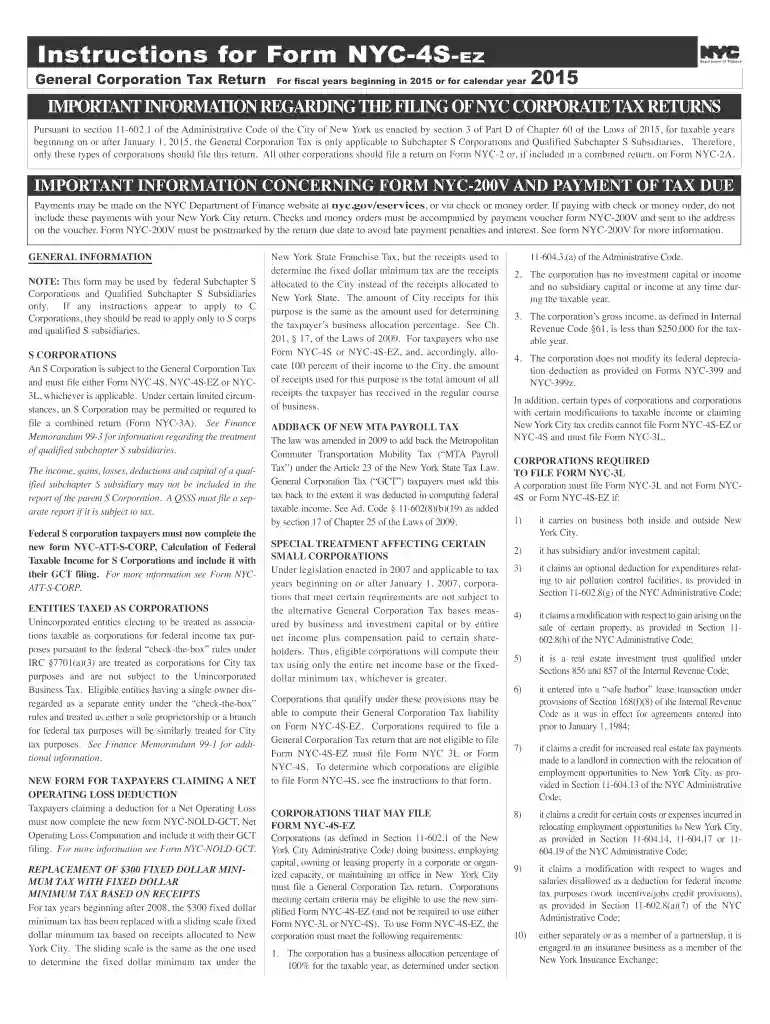
The NYC-4S-EZ 2015 form is a tax document used by Subchapter S Corporations and Qualified Subchapter S Subsidiaries (QSSS) to file their General Corporation Tax Return with New York City. This specific version of the form pertains to the fiscal year starting in 2015. The document provides a simplified method for eligible entities to report their tax obligations, focusing on key income, deduction, and credit details relevant to their financial activities within the city.
Understanding the tax terminology associated with the NYC-4S-EZ form is crucial for accurate filing:
Filing the form requires attention to detail and the availability of various financial documents:
This form is specifically designed for use by:


Subchapter S Corporations fall under various scenarios that necessitate filing:

To file the NYC-4S-EZ form, entities must meet several criteria:

Understanding the critical timelines for submission is essential to avoid penalties:
Failure to comply with filing requirements can result in significant penalties:
We've got more versions of the nyc 4s ez 2015 form form. Select the right nyc 4s ez 2015 form version from the list and start editing it straight away!
| Versions | Form popularity | Fillable & printable |
|---|---|---|
| 2024 | 4.9 Satisfied (25 Votes) | |
| 2023 | 4.2 Satisfied (41 Votes) | |
| 2022 | 4.8 Satisfied (30 Votes) | |
| 2021 | 4.8 Satisfied (60 Votes) | |
| 2020 | 4.3 Satisfied (198 Votes) | |
| 2019 | 4.3 Satisfied (29 Votes) | |
| 2018 | 4.2 Satisfied (117 Votes) | |
| 2018 | 4 Satisfied (54 Votes) | |
| 2017 | 4.2 Satisfied (121 Votes) | |
| 2016 | 4.3 Satisfied (238 Votes) | |
| 2015 | 4.3 Satisfied (326 Votes) | |
| 2012 | 4.4 Satisfied (161 Votes) |
At DocHub, your data security is our priority. We follow HIPAA, SOC2, GDPR, and other standards, so you can work on your documents with confidence.
First installment of estimated tax for period following that covered by this return: (a) If application for extension has been filed, enter amount from line 2
Form 4506T-EZ, Short Form Request for Individual Tax. Return Transcript. The request can be mailed or faxed to the appropriate address and/or fax number on
This form should be completed only by representatives of the ambulance service. This information shall be submitted annually by January 31, and anytime


