




01. Edit your form online
Type text, add images, blackout confidential details, add comments, highlights and more.

Type text, add images, blackout confidential details, add comments, highlights and more.

Draw your signature, type it, upload its image, or use your mobile device as a signature pad.

Send it via email, link, or fax. You can also download it, export it or print it out.
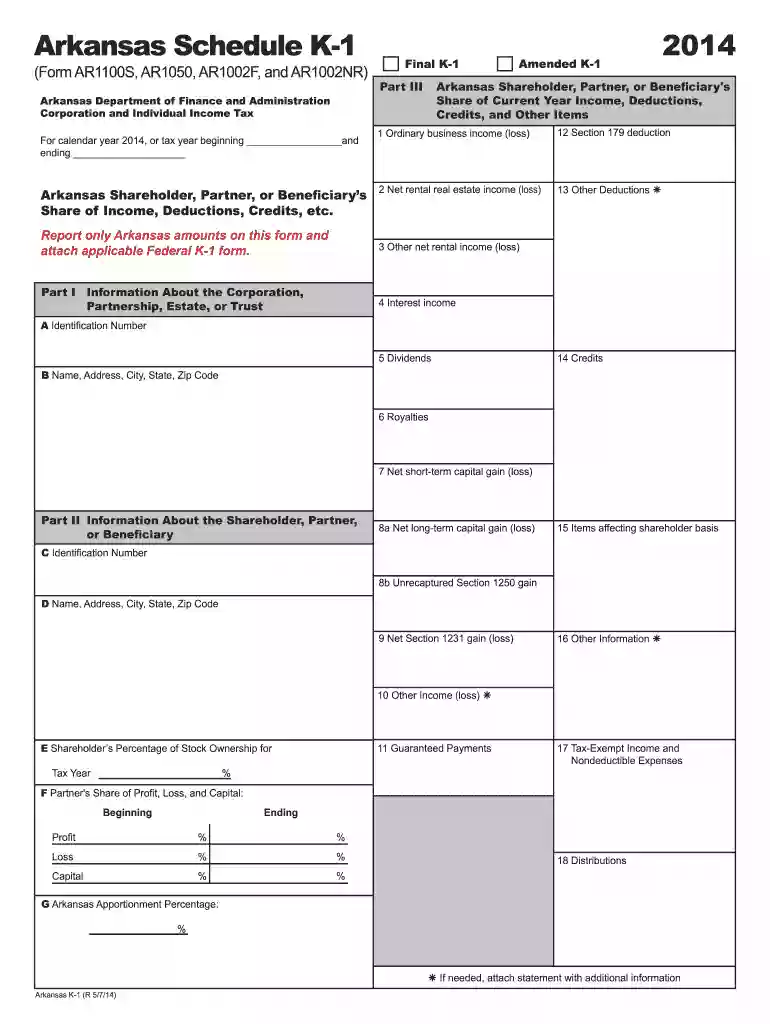
The Arkansas Schedule K-1 2014 is a form utilized by partnerships, S corporations, and estates/trusts to report each partner's, shareholder's, or beneficiary's share of income, deductions, credits, and other relevant tax items. It serves a critical role in ensuring that income is accurately attributed and taxed at the individual level as applicable.
Arkansas Schedule K-1 differs from the federal version by aligning with state tax laws, providing necessary information to report Arkansas-specific tax obligations. It includes fields for all types of earnings, ensuring comprehensive coverage for each business entity's fiscal activities.
To effectively use the form, individuals must:
Completing the form correctly ensures reliable taxpayer reporting, preventing legal complications and ensuring smooth tax filing processes.
Acquiring the Arkansas Schedule K-1 form requires:
These methods are crucial for taxpayers and financial professionals to gain timely access to the necessary tax documentation.
Important aspects include:
Fully understanding these sections ensures clarity in tax reporting and future planning processes.
Filing due dates generally coincide with the tax return deadline, typically April 15. For entities requiring extensions or encountering special conditions, monitoring Arkansas DFA announcements is essential for updated deadlines.
Recognizing these timelines is critical to mitigate last-minute complications and prevent potential penalties for late submissions.
Essential documents include:
Organizing these documents streamlines the completion and accuracy of the Schedule K-1.
Arkansas DFA offers multiple submission pathways for convenience:
Each submission method has specific instructions for compliance to facilitate seamless processing and validation.
Non-compliance penalties may include:
Understanding these consequences promotes timely and precise form handling to avoid adverse fiscal repercussions and compliance issues.
We've got more versions of the Arkansas Schedule K-1 2014 - dfa arkansas form. Select the right Arkansas Schedule K-1 2014 - dfa arkansas version from the list and start editing it straight away!
At DocHub, your data security is our priority. We follow HIPAA, SOC2, GDPR, and other standards, so you can work on your documents with confidence.
1) A Notice of Violation may be issued, by the Director or his or her designee, when any regulated entity is in violation of any requirements of the Arkansas
Preface. Stabilization/Solidification (S/S) is a remedial technology that has attracted widespread use around the world. S/S employs readily available
Complete Arkansas Schedule K-1 for each partner- ship, trust, estate, or corporation. ITEM A. Enter the identification number of the partnership, trust, estate,


