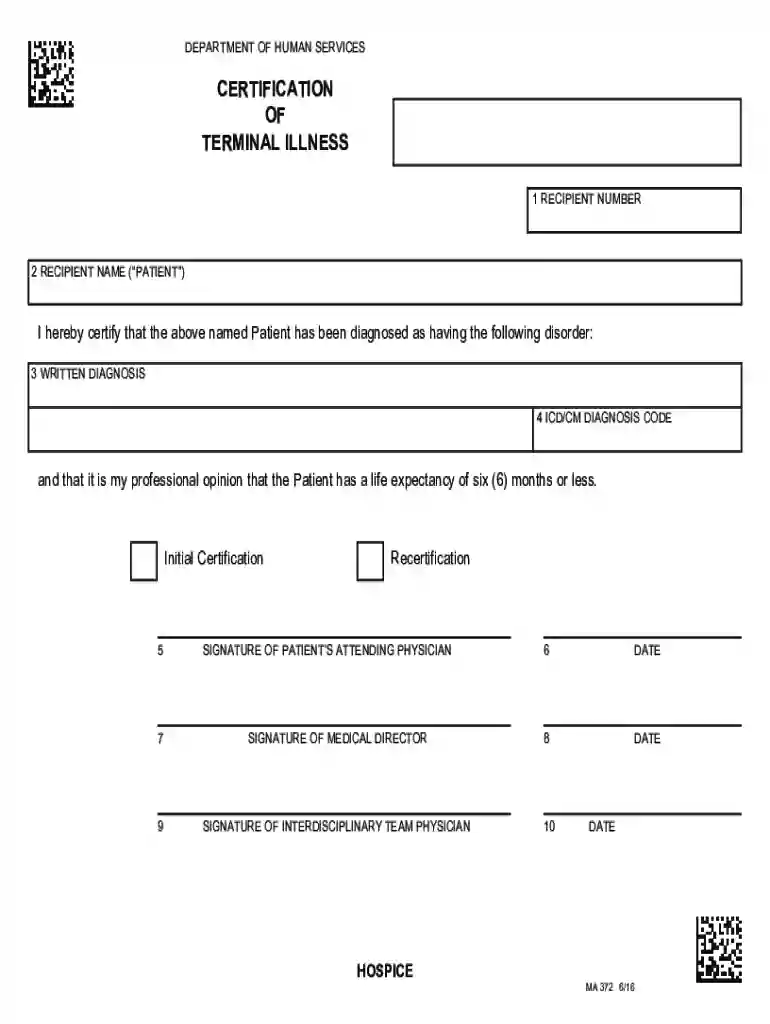
CERTIFICATION OF TERMINAL ILLNESS 2026

Get Form
sample hospice certification of terminal illness Preview on Page 1

Here's how it works

01. Edit your sample hospice certification of terminal illness online
Type text, add images, blackout confidential details, add comments, highlights and more.

02. Sign it in a few clicks
Draw your signature, type it, upload its image, or use your mobile device as a signature pad.

03. Share your form with others
Send it via email, link, or fax. You can also download it, export it or print it out.

Definition & Purpose of the Certification of Terminal Illness

The Certification of Terminal Illness is an essential document that confirms a patient's diagnosis of a terminal illness, indicating a life expectancy of six months or less. This certification is typically used to qualify patients for hospice care, allowing them to receive comfort-oriented medical treatment rather than curative therapies. The form includes critical information such as patient identification and medical details, which must be completed by healthcare professionals familiar with the patient's condition.

Key Elements of the Certification Form

The Certification of Terminal Illness includes several vital sections that ensure comprehensive documentation:

  • Patient Information: Basic details such as name, address, and date of birth.
  • Diagnosis Details: Specifics about the terminal illness diagnosis, including disease progression and prognosis.
  • Signatures: Required from the attending physician, medical director, and sometimes an interdisciplinary team physician, to validate the form.

These sections collectively provide a clear overview of the patient's medical status and the healthcare professionals involved in their care.

Steps to Complete the Certification of Terminal Illness

Completing the Certification of Terminal Illness involves several important steps:

  1. Gather Patient Data: Collect all necessary patient information and medical history relevant to the terminal diagnosis.
  2. Detail Diagnosis: Clearly outline the diagnosis, including relevant medical evaluations and expected disease trajectory.
  3. Healthcare Practitioner Signatures: Obtain signatures from all required medical practitioners involved in the patient's care to certify the information's accuracy.
  4. Review: Ensure all sections are filled out accurately and comprehensively before submission.

These steps help ensure that the form serves its intended purpose without delays or errors.

How to Obtain the Certification of Terminal Illness

Obtaining the Certification of Terminal Illness typically involves collaborating with healthcare providers who are already managing the patient’s care:

  • Consult with Your Physician: Discuss your needs with your doctors, as they will provide and fill out the necessary certification.
  • Request from Hospice Provider: Often provided through hospice services required for accessing specific types of end-of-life care.

Ensure that all involved parties understand their role in the process to complete the certification efficiently.

Why Certification is Essential

The Certification of Terminal Illness serves critical functions, primarily in:

  • Accessing Hospice Care: Enables patients to transition smoothly into hospice programs.
  • Insurance Authorization: Essential for insurance purposes, ensuring coverage for hospice and palliative care services.
  • Legal Verification: Provides legal confirmation of a patient's medical status, which can be necessary for various administrative and family-related decisions.

These functions emphasize the importance of accurate and timely certification.

Who Typically Uses the Certification

This certification is predominantly used by:

  • Healthcare Providers: To document and verify terminal diagnoses.
  • Insurance Companies: To process claims related to hospice and end-of-life care.
  • Hospice Organizations: To admit patients into palliative care programs.
  • Patients and Families: To facilitate informed decision-making and care planning.

Understanding the stakeholders helps ensure that the form fulfills its purpose for all parties involved.


decoration image ratings of Dochub

Legal Use and Implications

The Certification of Terminal Illness carries significant legal weight and should be completed with diligence:

  • Compliance with Healthcare Regulations: Ensures adherence to legal standards governing medical documentation.
  • Protection Against Fraud: Minimizing errors and misrepresentations that could lead to legal consequences.
  • Validity for Insurance and Care Decisions: Provides a legally recognized document to facilitate care and insurance processes.

These legal aspects underscore the necessity for accuracy and integrity in completing the certification.

State-Specific Rules and Variations

Though the Certification of Terminal Illness is generally standardized, variations may exist:

  • State-specific Healthcare Regulations: Some states may have unique requirements or additional documentation.
  • Additional Practitioner Signatures: Depending on the state, additional healthcare professionals may need to certify the form.
  • Variations in Form Design: Different states might use slightly varied formats or additional fields.

Staying informed about local regulations ensures compliance and avoids delays in receiving necessary care and services.

See more CERTIFICATION OF TERMINAL ILLNESS versions

We've got more versions of the CERTIFICATION OF TERMINAL ILLNESS form. Select the right CERTIFICATION OF TERMINAL ILLNESS version from the list and start editing it straight away!
Versions Form popularity Fillable & printable
2016 4.8 Satisfied (95 Votes)
2014 4 Satisfied (49 Votes)
be ready to get more

Complete this form in 5 minutes or less

Get form

Got questions?

We have answers to the most popular questions from our customers. If you can't find an answer to your question, please contact us.
Contact us
I docHub that John Doe is terminally ill with a life expectancy of six months or less if the terminal illness runs its normal course. 78 year old male with a diagnosis of stage four lung cancer.
A Terminal Illness benefit claim is a claim that can be made for your superannuation account balance and insurance benefits (if applicable) if its medically determined that that your illness or injury is terminal, and you have less than 24 months to live. The payment is generally tax-free.
The easiest way to show you have a terminal illness is to ask your GP or another doctor or consultant to fill in a form - its called an SR1 or a DS1500. This form gives the DWP evidence about your illness and treatment.
To receive hospice care, certification of terminal illness is mandatory.
Initial Certification Requirements for Hospice and Palliative Medicine Continuously maintain your family medicine certification. Complete a minimum of 12 months of full-time training in an ACGME-accredited Hospice and Palliative Medicine fellowship training program and submit verification of completion documentation.

Security and compliance

At DocHub, your data security is our priority. We follow HIPAA, SOC2, GDPR, and other standards, so you can work on your documents with confidence.

Learn more
ccpa2
pci-dss
gdpr-compliance
hipaa
soc-compliance