




01. Edit your process recording template online
Type text, add images, blackout confidential details, add comments, highlights and more.

Type text, add images, blackout confidential details, add comments, highlights and more.

Draw your signature, type it, upload its image, or use your mobile device as a signature pad.

Send process recording template social work via email, link, or fax. You can also download it, export it or print it out.
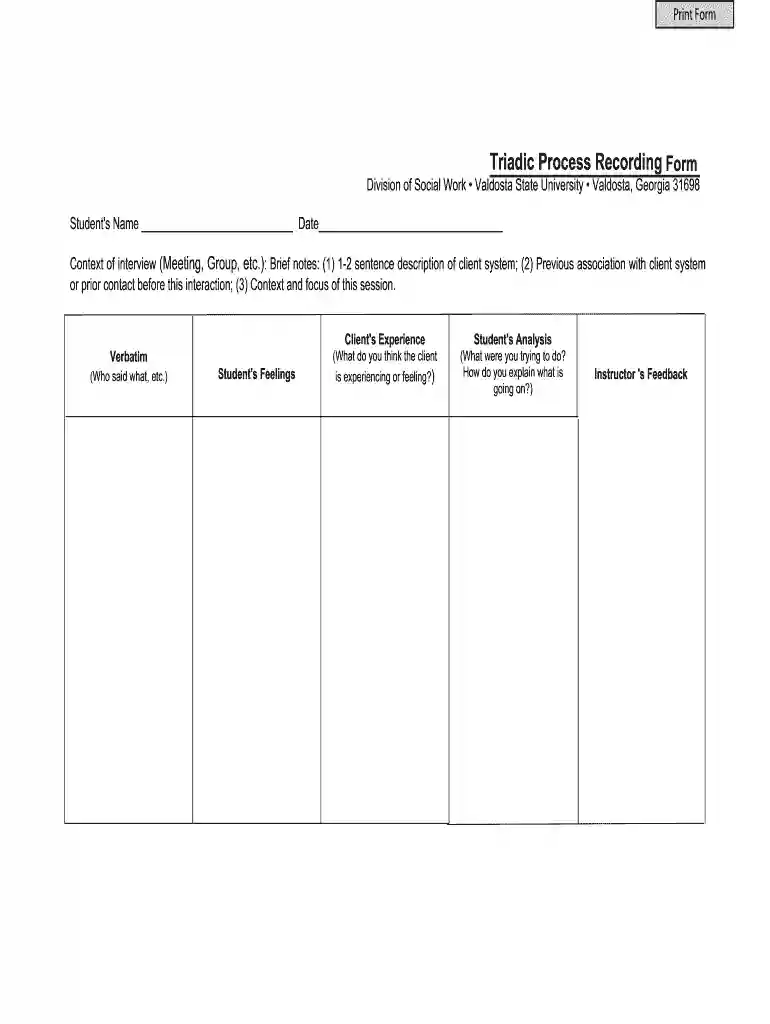
The process recording template is an essential tool for social work students and professionals, designed to facilitate the documentation of interactions and reflections during client sessions. This structured format serves to capture critical information, promoting a clear understanding of the engagement and enhancing the educational experience.
A well-structured process recording template features several key sections that guide users in documenting their experiences methodically. These include:
Context of the Interview: Document the environment of the interaction, including location, time, and any relevant background that influences the session.
Verbatim Dialogue: Capture direct quotes from the conversation with the client. This provides a clear reference for analysis and reflection.
Client Experiences: Reflect on the client’s feelings and reactions during the session. This can include non-verbal cues that may not be evident in dialogue alone.
Student Feelings: Describe your emotional responses and thoughts during the session, which can provide insights into your personal biases and influences.
Analysis: Evaluate the interaction, discussing what was effective and what could be improved. This section encourages critical thinking about the practice and promotes growth.
Instructor Feedback: Use this space for mentor or instructor observations and guidance on the recording. Feedback can be crucial for improvement and skill development.
Using the process recording template involves several steps that ensure accuracy and depth in documentation:
Prepare for the Session:
During the Session:
Immediately After the Session:
Submit for Review:
Process recording serves several critical functions in the field of social work:
Skill Development: By reflecting on each interaction, students enhance their observational and analytical skills, which are vital for professional growth.
Client Understanding: Documenting client experiences fosters empathy and deeper understanding of client situations, enhancing service delivery.
Accountability: These records serve as a formal accountability measure for social work practitioners, supporting ethical standards and reflective practice.
Educational Tool: For students, process recordings provide a framework for learning and receiving constructive feedback from supervisors or instructors.
To provide context, consider two examples of a process recording scenario:
Individual Counseling Session: In a session focused on anxiety, the student may document a client expressing fear of public speaking. Verbatim dialogue could capture the client's exact words, while the analysis section might explore their underlying beliefs and challenges.
Group Work Session: In a group setting, a student might record interactions among participants discussing coping strategies. The dialogue section could provide insights into group dynamics, while the analysis could reflect on the facilitator's interventions.
While the standard process recording template is commonly used, variations may exist based on educational institution requirements or specific social work contexts. Some key differences might include:
Template Customization: Some programs may encourage students to adapt their recording format based on individual preferences or specific assignment guidelines.
Electronic vs. Paper Submission: Today, many templates are available in PDF format for easy electronic submission, optimizing accessibility and ease of sharing.
This comprehensive overview of the process recording template PDF highlights its pivotal role in the educational journeys of social work participants. Engaging with this tool enhances self-reflection, accountability, and skill development in various social work contexts.
Managing your documents with DocHub this way is very easy after you have downloaded its extension for Google Chrome. Navigate to the Chrome Web Store and install DocHub - Sign PDF from Gmail to obtain it. Give our tool access to your Google account, and then open an email containing social work process recording template as an attachment and point to the file with your cursor - the DocHub extension button will automatically appear there. Click on it to open your document in our editor. Make any necessary edits, fill out the blanks, and click Sign to create your legally-binding eSignature.
Apart from an extensive toolset for editing PDFs on mobile phones, DocHub enables you to sign your process recording format along the way. Open our editor in your browser, make changes using DocHub’s toolset, and finish your editing by eSigning the completed form.
At DocHub, your data security is our priority. We follow HIPAA, SOC2, GDPR, and other standards, so you can work on your documents with confidence.
Write at least two pages and include a Summary. Brief description of the presenting problem(s), reason(s) for interaction: Objectives/purpose for thisRead more
Apr 28, 2014 This procedure provides details on the process for documenting and reporting contact with the media. Responsibility. TPB Supervisor Review andRead more
You can set up a weekly recording schedule by applying templates to cameras for each day of the week. 1. In the server Setup tab, click . The Recording ScheduleRead more


