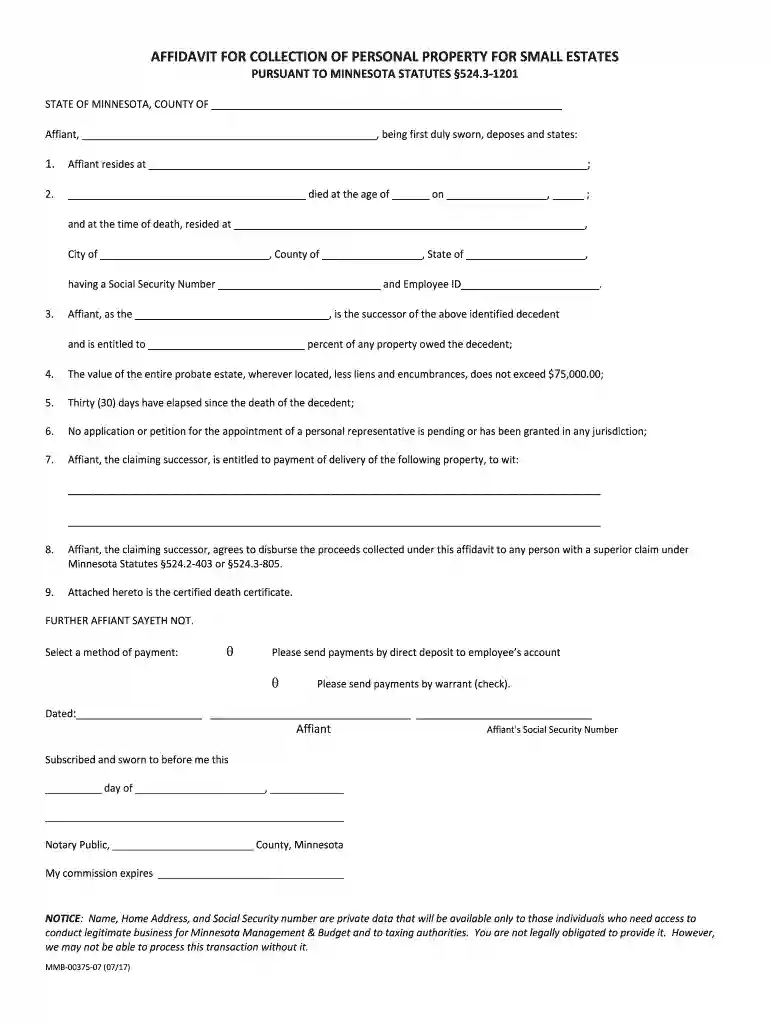
AFFIDAVIT FOR COLLECTION OF PERSONAL PROPERTY FOR SMALL ESTATES Affidavit For Collection of Personal 2026

Get Form
AFFIDAVIT FOR COLLECTION OF PERSONAL PROPERTY FOR SMALL ESTATES Affidavit For Collection of Personal Preview on Page 1

Here's how it works

01. Edit your form online
Type text, add images, blackout confidential details, add comments, highlights and more.

02. Sign it in a few clicks
Draw your signature, type it, upload its image, or use your mobile device as a signature pad.

03. Share your form with others
Send it via email, link, or fax. You can also download it, export it or print it out.

Understanding the Affidavit for Collection of Personal Property for Small Estates

The "Affidavit for Collection of Personal Property for Small Estates" is a legal document used to allow successors to collect a decedent's property valued under a certain threshold, typically $75,000 in states like Minnesota. This affidavit serves to streamline the process of transferring personal property without the need for formal probate proceedings. The document outlines the affiant's relationship to the deceased, confirms their eligibility to collect the property, and provides guidelines for the proper disbursement of the proceeds. This document requires attaching a certified death certificate and specifies acceptable payment methods.

Key Elements Included in the Affidavit

The affidavit contains crucial sections that ensure smooth processing and adherence to legal protocols:

  • Affiant Information: Includes the name, address, and relationship to the decedent.
  • Description of Property: List of all personal property intended for collection.
  • Value of Estate: Verifies that the total value of the property does not exceed state limitations.
  • Legal Declarations: Affirms the truthfulness of the statements made under penalty of perjury.
  • Certified Death Certificate: Requires attachment to validate the decedent's passing.

Steps to Complete the Affidavit

  1. Gather Required Information: Obtain details about the decedent's estate, including assets and their values.
  2. Complete the Affidavit: Enter personal information, description of the property, and declarations regarding the value and your rights as a successor.
  3. Attach Necessary Documents: Ensure to include the certified death certificate.
  4. Sign and Notarize: Affidavit must be signed in the presence of a notary public.
  5. Submit the Affidavit: File with appropriate entities to proceed with the collection of property.

Who Typically Uses This Affidavit

This affidavit is primarily used by individuals who are legally designated as successors to a decedent. Common users include:

  • Spouses: Surviving partners who have rights to a portion of the estate.
  • Children or Parents: Immediate family members with legal standing.
  • Appointed Executors: Individuals or entities designated in the will to handle the estate.

State-Specific Regulations

Different states may impose varying rules surrounding the use of this affidavit:

  • Value Thresholds: Each state has a set minimum and maximum value for estates that qualify.
  • Eligible Successors: Not all familial relationships qualify for collection without probate.
  • Processing Entities: Specific state departments or court systems where the affidavit must be filed.

Legal Use and Benefits

The affidavit's primary legal function is to expedite the transfer of personal property by enabling heirs to bypass extended probate processes. Benefits include:

  • Reduced Legal Fees: Less expensive than full probate proceedings.
  • Faster Estate Resolution: Allows for quicker access to assets.
  • Simplified Process: Minimizes documentation and court involvement.

Examples of Use Cases

Consider these scenarios where the affidavit proves especially beneficial:

  • Unmarried Adult with No Will: Allows parents to collect assets quickly.
  • Small Business Owners: Transfer of business assets to surviving partners or family without delay.
  • Individuals with Limited Assets: Simplifies the process for heirs when the estate only includes basic personal effects.

Required Documents for Filing

To file the affidavit, gather and attach the following:

  • Certified Death Certificate: Proof of the decedent's passing.
  • Proof of Identity: Valid identification for the affiant.
  • Asset Documentation: Papers evidencing ownership and value of personal property.

Application Process and Approval Time

The process generally includes submitting the completed affidavit to the relevant state authority. Approval times may vary, contingent on:

  • Accuracy of Information: Correctly filled forms expedite processing.
  • State Workload: Processing times depend on regional volume at the time of application.
  • Compliance with State Laws: Adherence to specific state guidelines ensures smoother approval.

Penalties for Non-Compliance

Failure to comply with affidavit submission guidelines or providing false information can result in serious consequences:

  • Legal Penalties: Possible fines or legal action for submission of false information.
  • Delayed Asset Collection: Non-compliance can lead to extended waiting times or complete dismissal of the affidavit.
  • Repercussions for Fraudulent Claims: Legal ramifications for intentionally misleading declarations.
be ready to get more

Complete this form in 5 minutes or less

Get form

Got questions?

We have answers to the most popular questions from our customers. If you can't find an answer to your question, please contact us.
Contact us
Of course, you should always be prepared to consult your estate planning attorney if matters are complicated. Otherwise, most individuals can complete their small estate affidavit on their own.
A Small Estate Affidavit is a legal form used to manage and distribute a deceased persons estate without going through long court processes. It works best when the total value of the estate falls below a certain limit set by state law.
Complete the affidavit: Fill out the form with the decedents information, a list of their assets and the names and addresses of all heirs or beneficiaries. docHub the affidavit: Sign the completed affidavit in front of a notary public. Some states might also require additional witnesses.
Further, the probate process can take anywhere between several months to several years. If the estate in question is eligible, a small estate affidavit can help a family skip through this entire process. Ideally, a small estate affidavit can get approved in just a few days, or a few weeks at most.
An Affidavit of Collection of Personal Property, also known as a small estate affidavit, allows an eligible individual to collect a decedents personal property without opening a formal probate case, as long as the estate qualifies as a small estate under Colorado law.

Security and compliance

At DocHub, your data security is our priority. We follow HIPAA, SOC2, GDPR, and other standards, so you can work on your documents with confidence.

Learn more
ccpa2
pci-dss
gdpr-compliance
hipaa
soc-compliance