







Definition & Meaning
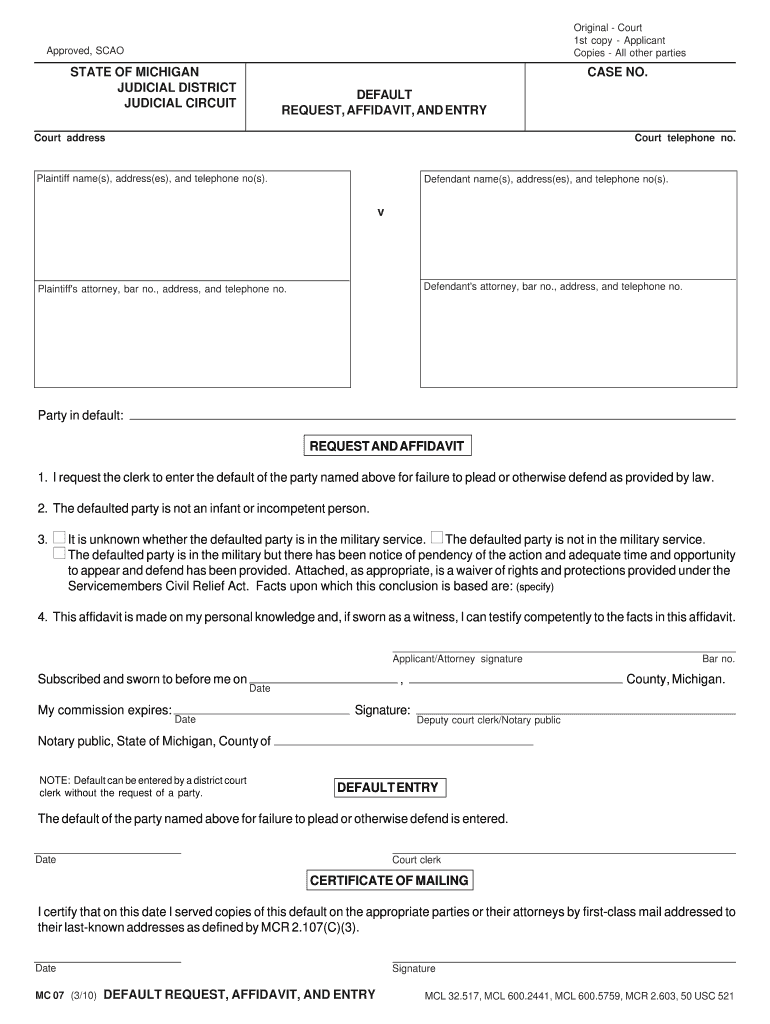
The "Original - Court 1st copy - Applicant Copies - All other parties Approved, SCAO STATE OF MICHIGAN JU" form is a legal document utilized in Michigan courts. It's mainly used for entering a default judgment against a defendant who has not responded to a legal notice or has failed to appear in court. This form serves multiple functions, providing an official record for both the court and the parties involved, ensuring that the judgment process is transparent and legally binding.
Components of the Form
- Applicant Information: Details about the person initiating the form, usually the plaintiff or their attorney.
- Parties Involved: Sections outlining information about all parties in the case.
- Affidavit of Default: A sworn statement that confirms the default status of the respondent.
- Certification of Mailing: Proof that all involved parties have received copies of the document.
These sections of the form ensure that the legal process is documented clearly and that all parties have acknowledged receipt and understanding of the proceedings.
How to Use the Original - Court 1st Copy Form
Steps to Utilize the Form
- Complete Applicant Information: Clearly fill out your personal information or that of the firm representing you.
- Document Parties Involved: List all relevant parties, including their addresses and roles in the legal matter.
- Swear to the Affidavit of Default: Provide a notarized sworn statement affirming that the defendant is in default.
- Certify Mailing: Confirm that all parties have received copies, which may involve delivering or mailing the form with proof of delivery.
Practical Scenarios
- Landlord-Tenant Disputes: When a tenant fails to respond to an eviction notice, this form can initiate the legal judgment process.
- Debt Collection: Used when the debtor defaults on payment and does not contest the claim in court.
These practical applications demonstrate the form's versatility in managing various legal scenarios requiring default judgments.
Steps to Complete the Form
Submission Process
- Gather Personal and Case Information: Prepare all necessary documents, including identification and case-related paperwork.
- Fill Out Sections Accurately: Ensure all fields on the form are complete and verified for accuracy.
- Obtain a Notary Public's Approval: A notary must witness and verify the affidavit section for the form's legality.
- File with the Court: Submit the completed form to the appropriate Michigan court, either in person or via mail.
Nuances and Variations
- Consider legal representation if the form's details or implications are unclear.
- Always check for the latest version to ensure compliance with current legal standards.
These layers and options emphasize the thoroughness needed in handling legal documents like the Michigan court form.
Legal Use of the Form
Authorized Applications
- Default Judgments: Primarily used for default judgments in civil cases.
- Certifying Compliance: Ensures that the applicant complies with court rules regarding default procedures.
- Notification Requirements: Legally confirms all relevant parties are informed of the default status.
Considerations
- Be mindful of the form's implications for non-responsive parties.
- Ensure proper documentation and adherence to procedural guidelines to avoid legal complications.
Understanding these elements is crucial for anyone involved in Michigan's legal processes, particularly in cases of default.
Important Terms Related to the Form
Key Definitions
- Default Judgment: A binding decision by the court in favor of one party due to the other party's failure to act.
- Affidavit: A written statement confirmed by oath for use as evidence in court.
- Certification of Mailing: A statement verifying that documents have been sent to all parties involved.
Contextual Use
- Default: In legal terms, when an individual or entity does not fulfill their obligation to respond to a court summons.
- Affidavit: Used to establish fact under penalty of perjury, often filed with supporting documentation.
These terms are integral to navigating and understanding the judicial processes that involve documentation like this Michigan court form.
State-Specific Rules
Michigan Regulations
- Servicemembers Civil Relief Act Considerations: Ensures actions comply with federal protections for military personnel.
- State Compliance: Adherence to unique Michigan court procedures and ordinances.
Legal Context
- Familiarity with state-specific legalities will aid in accurately executing the form.
- Understanding these nuances prevents potential legal challenges and ensures compliance with Michigan state laws.
Key Elements of the Form
Essential Sections
- Applicant and Contact Information: Ensures proper identification and communication between parties.
- Affidavit and Notary Requirements: Validates the applicant’s claims and affirms the legal standing of the document.
- Mailing Certification: Documents the distribution of the form to all applicable parties.
Common Mistakes
- Omitting necessary details can invalidate the form.
- Not obtaining proper notarization, which can hinder legal proceedings.
Following these guidelines harbors better clarity and utility in completing the form effectively.
Examples of Using the Form
Case Studies
- Property Management: A property manager initiates this form against a non-compliant tenant, leading to an expedited eviction process.
- Corporate Business Disputes: Corporations utilize the form to resolve disputes when one party fails to engage legally.
Real-World Applications
- Ensures timely resolution of legal matters when other means of communication have been exhausted.
- Provides a structured manner to document legal filings and notices.
These examples illustrate the form's application across various legal and corporate scenarios, showing its versatility and necessity in the judicial arena.




