







Definition & Meaning
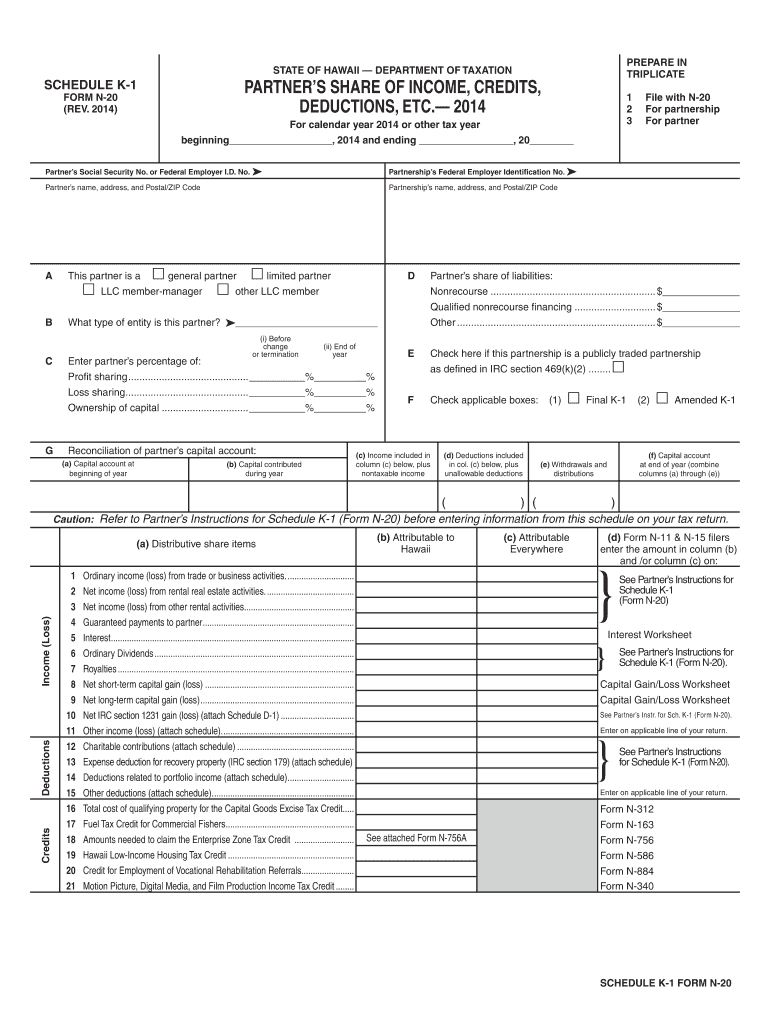
The Schedule K-1 (Form N-20) for 2014 is a tax document specifically used by Hawaii's Department of Taxation. This form details a partner's share of income, credits, deductions, and other financial information for a particular tax year. When filing state taxes in Hawaii, it's essential to understand how this form reflects your portion of the partnership’s financial activities, as each partner must report their respective share of these items on their individual tax returns. Importantly, this form provides a comprehensive view of a partnership's internal revenue distribution among its partners.
How to Use the Form N-20 2014
Using Form N-20 effectively requires an understanding of its sections and their significance. Partners need to review their percentage ownership in profits and losses, which directly influence the amounts reported. This form is then used to report these amounts on individual tax returns. Partners must ensure all information is accurately transcribed from Form N-20 to their personal returns to ensure compliance with state tax regulations. Misreporting any details could lead to discrepancies in tax calculations and potential audits.
Steps to Complete the Form N-20 2014
-
Partner Identification: Begin by accurately completing the partner identification section, which includes your name, address, and partnership interests. This crucial step ensures that your tax return reflects your correct share of partnership income.
-
Profit and Loss Sharing Percentages: Enter the correct profit and loss sharing percentages. These numbers determine the proportion of income and losses attributable to each partner, impacting your liability on your individual tax return.
-
Capital Account Reconciliation: Detail changes in your capital account over the tax year. This includes contributions, withdrawals, and your share of the income or losses, which are crucial for transparency in financial reporting.
-
Income and Deduction Categories: Accurately list your share of various income and deduction categories. This includes interest income, dividends, rents, and any special deductions. Such details greatly influence the computation of your taxable income.
Why Is Form N-20 Important?
Form N-20 is critical for partners in Hawaii-based partnerships as it captures the financial portion each partner must report on personal tax returns. It ensures transparency and fairness by clearly delineating each partner’s share of the partnership’s financial performance. Furthermore, it serves as a necessary compliance document to maintain state tax obligations. The precise recording of financial shares helps avoid tax liability discrepancies, ensuring each partner meets their individual tax responsibilities accurately.
Who Typically Uses the Form N-20 2014
Form N-20 is primarily used by partners in partnerships operating in Hawaii. These could include diverse business entities, such as limited liability companies (LLCs), S corporations, or simple general partnerships. Any individual or entity classified as a partner within these structures must complete and use the form to report their share of income, deductions, and credits. Notably, the form's detailed sections help cater to the specific needs of each type of partner, regardless of their industry or business focus.


Key Elements of the Form N-20 2014
- Partner Identification: Information about each partner within the partnership, which is crucial for accurate tax reporting.
- Profit and Loss Sharing: Detailed percentages that dictate the financial earnings and liabilities borne by each partner.
- Capital Account Reconciliation: Insights into each partner's equity changes throughout the tax year.
- Income and Deduction Entries: Specific entries that must be transcribed onto individual tax returns to reflect precise financial positions.
State-Specific Rules for the Form N-20 2014
Hawaii imposes specific rules for using and filing the N-20 form, aligning with its tax codes and administrative practices. These rules ensure that each partner accurately reflects their share of the partnership's earnings and liabilities in compliance with state requirements. For instance, Hawaii mandates strict adherence to identifying each partner’s correct share in financial declarations. Detailed comprehension of these rules is essential for partners to guarantee that their tax filings align with Hawaii’s unique taxation environment.
Filing Deadlines and Important Dates
Form N-20 must be filed according to the deadlines set forth by the Hawaii Department of Taxation. Typically, the due date aligns with federal tax deadlines unless adjusted by specific state regulations. Timely submission is critical to avoid penalties or interest charges. Partners must be well-informed of these timelines and ensure that all sections of the form, including any supplementary documentation, are submitted on time. Early preparation and review can aid in meeting these deadlines and maintaining compliance.




