




01. Edit your form online
Type text, add images, blackout confidential details, add comments, highlights and more.

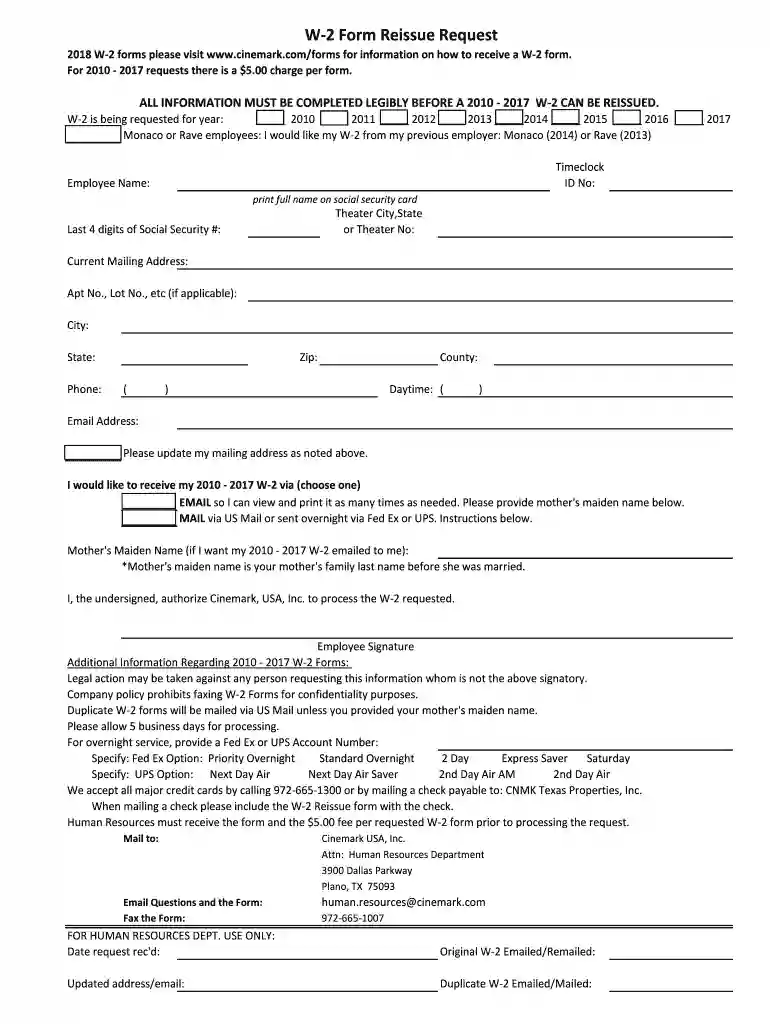
Type text, add images, blackout confidential details, add comments, highlights and more.

Draw your signature, type it, upload its image, or use your mobile device as a signature pad.

Send it via email, link, or fax. You can also download it, export it or print it out.
The 2018 W-2 form is a crucial tax document used in the United States by employers to report wages paid and taxes withheld for their employees during the 2018 tax year. This form provides detailed information on the amount of money earned by an employee and the taxes that have been deducted, which assists in calculating the overall tax liability. Each employee receives a copy of the W-2 form, while the employer submits additional copies to the Social Security Administration and state and local tax departments. Its accuracy is vital as it impacts both the employee's filing process and any potential refunds or liabilities.
To obtain a W-2 form, employees typically receive it directly from their employer. For the 2018 tax year, employers were required to send these forms to their employees by January 31, 2019. Employees who have not received their W-2 by early February should contact their employer to ensure it was sent correctly. No formal approval process exists for receiving a W-2 form since it is automatically generated by the employer. However, if corrections are needed due to errors on the form, the employer must issue a corrected version, known as a W-2c.
W-2 forms are legally required documents in the tax reporting process. Employers must provide accurate W-2 forms to their employees to ensure compliance with IRS regulations. The form's data is used to calculate the employee's income tax returns, Social Security contributions, and Medicare taxes. Non-compliance or inaccuracies can result in penalties from the IRS, emphasizing the legal importance of handling W-2 forms with care.
The IRS provides detailed guidelines regarding the issuance and handling of W-2 forms. Key points include:
Completing the W-2 form involves various essential steps:
Employees use the completed W-2 to prepare their tax returns, ensuring that the income and withholding details align with IRS records.
W-2 forms can be handled using various accounting and tax filing software, including TurboTax, QuickBooks, and other tax preparation tools. These platforms assist users in accurately reporting income and taxes, offering step-by-step guidance to ensure compliance and precision. Tax software often integrates data from W-2 forms directly into tax returns, streamlining the filing process and reducing the likelihood of errors.
Employers face stringent penalties for failing to meet W-2 form filing obligations. Late filing, inaccurate information, or omission can result in fines. Employers may incur a penalty ranging from $50 to $270 per form, depending on the delay and size of the business, capped at a maximum amount per year. Timely and accurate filing is thus crucial to avoid costly repercussions.
W-2 forms are used by a wide array of individuals, including:
Different employment types, from contractors to full-time staff, may have varying requirements for W-2s, but the form universally serves as a central document for tax reporting.
We've got more versions of the 2018 W-2 forms please visit www form. Select the right 2018 W-2 forms please visit www version from the list and start editing it straight away!
At DocHub, your data security is our priority. We follow HIPAA, SOC2, GDPR, and other standards, so you can work on your documents with confidence.
Specific information needed to complete Form W-2 is available in a separate booklet titled the 2018 General Instructions for. Forms W-2 and W-3. If you have
May 2, 2017 You can access IRS.gov 24 hours a day, 7 days a week to: Download, view, and order tax forms, instructions, and publications. Access
Earned income credit (EIC). You may be able to take the EIC for 2018 if your adjusted gross income. (AGI) is less than a certain amount.


