
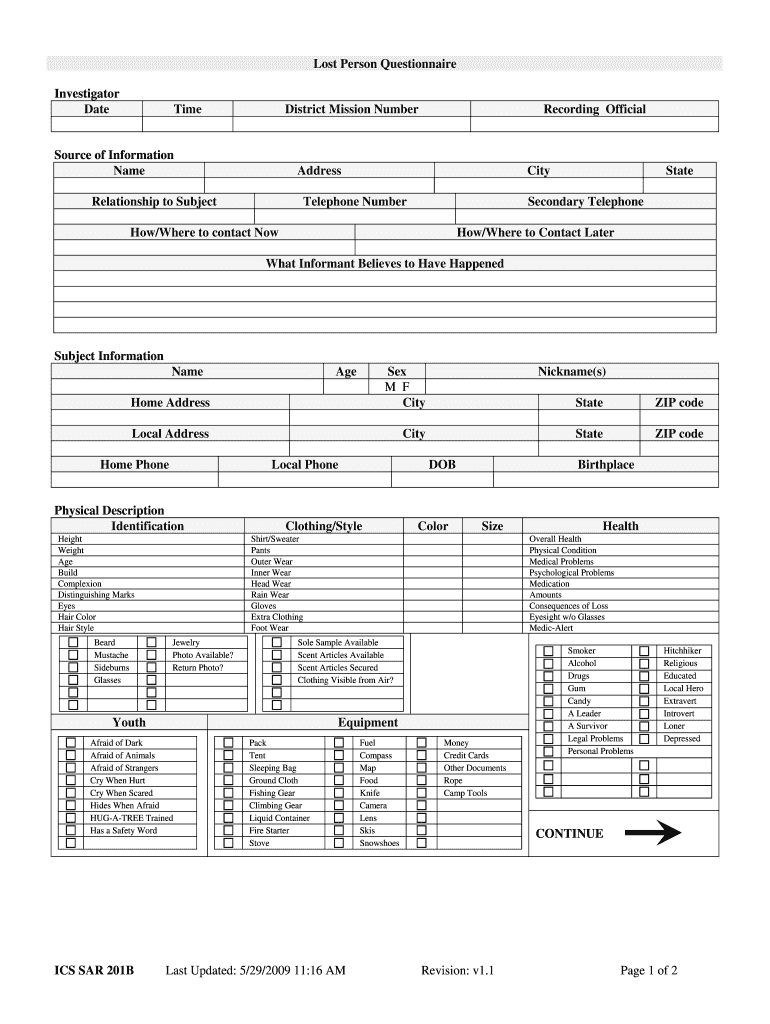







Key Elements of the Lost Person Questionnaire
The Lost Person Questionnaire is a critical tool used in search and rescue operations to compile essential information about missing persons. This form is structured to gather comprehensive data, facilitating a systematic approach to locating individuals. Key areas covered include:
- Personal Identification: Captures the missing individual's name, date of birth, and contact details.
- Physical Description: Documents features like height, weight, hair color, and distinguishing marks.
- Last Known Location: Provides details on where the person was last seen, along with date and time.
- Circumstances of Disappearance: Records the context and any unusual occurrences surrounding the disappearance.
- Health and Medical Information: Includes any medical conditions, medications, and potential health risks.
This nuanced data collection aids responders in tailoring their search strategies to the specific circumstances of each case.
Steps to Complete the Lost Person Questionnaire
Completing the Lost Person Questionnaire requires attention to detail and accuracy to ensure that all relevant information is gathered effectively:
- Gather Personal Information: Begin with basic details such as the full name, age, and contact numbers of the missing person.
- Detail Physical Characteristics: Accurately describe their physical appearance, including any identifying features or unique traits.
- Record Last Known Movements: Document the timeline and places visited before the disappearance for clarity.
- Understand the Context: Note any incidents or interactions that might have influenced their actions or decisions.
- Provide Medical History: List any health issues and medications, alongside allergies or special needs.
By following these steps meticulously, the questionnaire can provide a comprehensive profile that supports the search and rescue team’s efforts.
How to Obtain the Lost Person Questionnaire
Obtaining a Lost Person Questionnaire is a straightforward process, often facilitated through local law enforcement agencies or search and rescue organizations:
- Law Enforcement Agencies: Many police departments have standardized forms ready for use.
- Online Resources: Some agencies provide downloadable forms on their websites for ease of access.
- Search and Rescue Groups: Organizations specializing in search operations often have their version tailored to their methods.
Ensuring timely access to the questionnaire is crucial, as it sets the foundation for an effective search operation.
Who Typically Uses the Lost Person Questionnaire
The Lost Person Questionnaire is primarily used by:
- Law Enforcement Officials: Police departments utilize the form to organize investigations efficiently.
- Search and Rescue Teams: These teams depend on the detailed information to prioritize areas and strategies.
- Family Members and Friends: Individuals close to the missing person often provide initial data to complete the form.
- Emergency Response Coordinators: They coordinate efforts across various agencies to enhance the chances of a successful search.
Each user group leverages the form according to their role in the search and rescue process, underscoring its versatility and importance.


Examples of Using the Lost Person Questionnaire
Practical applications of the Lost Person Questionnaire are numerous:
- Mountain Search Operations: Utilized to gather details on the equipment a hiker may have taken with them.
- Urban Missing Person Cases: Helps law enforcement compile witness statements and last known electronic communications.
- Elderly Disappearances: Often used to record medical conditions that require special considerations during the search.
- Child Abductions: In these situations, the form aids in quickly providing descriptions to media and public alerts.
Each scenario emphasizes the questionnaire’s role in tailoring search efforts to the specific nuances of the disappearance.
Legal Use of the Lost Person Questionnaire
The legal framework surrounding the Lost Person Questionnaire ensures it is used effectively and ethically:
- Confidentiality Compliance: Information gathered is protected under privacy laws to prevent unauthorized access.
- Record Keeping: Agencies are responsible for maintaining accurate records as part of investigative procedures.
- Data Sharing Protocols: Information may be shared with different law enforcement entities to enhance collaborative efforts.
- Regulatory Oversight: Agencies must adhere to national and local guidelines when using the information obtained.
Understanding these legal aspects ensures the responsible use of sensitive information, fostering public trust and cooperation.
Digital vs. Paper Version
Modern search operations have seen a shift towards digital versions of the Lost Person Questionnaire, offering several benefits:
- Ease of Distribution: Digital forms can be emailed or shared via platforms, facilitating rapid dissemination.
- Enhanced Storage: Electronic records reduce physical storage needs and allow for easier retrieval and analysis.
- Increased Accuracy: Automated fields in digital versions minimize errors resulting from manual data entry.
- Real-Time Updates: Changes and updates can be made and communicated swiftly, ensuring all parties are informed.
Despite the advantages of digital forms, many agencies maintain paper versions to accommodate varied operational conditions and ensure accessibility in low-tech environments.
Important Terms Related to the Lost Person Questionnaire
Understanding the terminology associated with the Lost Person Questionnaire is critical for clarity and accuracy:
- Missing Person: Someone whose whereabouts are unknown and whose safety may be at risk.
- Physical Description: Detailed personal attributes, aiding in visual identification.
- Last Known Location: The most recent verified spot where the person was seen.
- Point Last Seen (PLS): Specific reference to the exact site of the last confirmed sighting.
- Next of Kin: Closest family members who may provide additional information and context.
These terms frame the questionnaire’s questions, guiding respondents to provide precise and informative answers.


