




01. Edit your form online
Type text, add images, blackout confidential details, add comments, highlights and more.

Type text, add images, blackout confidential details, add comments, highlights and more.

Draw your signature, type it, upload its image, or use your mobile device as a signature pad.

Send it via email, link, or fax. You can also download it, export it or print it out.
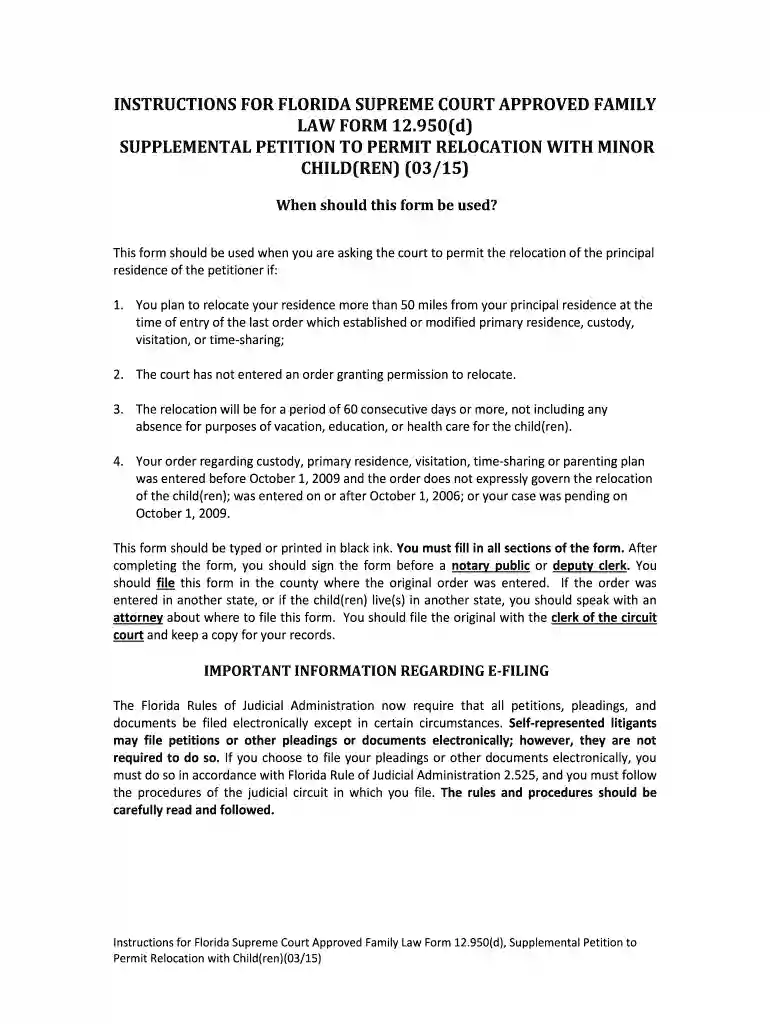
The Petition Relocation 2015 Form is used to formally request court approval for relocating a minor child more than 50 miles away from their current residence. This legal documentation is crucial for ensuring compliance with state laws regarding child custody and relocation. The form outlines the petitioner's desire to move, along with the reasons for the relocation, and the potential impact on the child's welfare and family dynamics. By submitting this form, the petitioner initiates a legal process that assesses the best interests of the child in accordance with family law statutes.
To use the Petition Relocation 2015 Form effectively, begin by gathering all necessary information regarding the planned move, including the new address, intended relocation date, and detailed rationale for the move. Complete the form with meticulous attention to detail, ensuring that all sections are filled out accurately. Once completed, the petitioner should submit the form to the appropriate family law court for processing. It’s important to notify the non-relocating parent of the petition and provide them with a copy of the completed form. Responding parties typically have a set period, usually 20 days, to file an objection or agree to the relocation request.
Obtaining the Petition Relocation 2015 Form can be done through several channels. Interested parties can visit the local family court clerk’s office, where paper versions of the form are typically available. Additionally, many states offer downloadable versions of the form on their judicial websites, allowing easy access to the necessary documents online. In some jurisdictions, legal aid organizations might also provide access to the form and guidance in completing it. It's crucial to ensure that you are using the correct version specific to the state and year, as legal requirements may vary.
The Petition Relocation 2015 Form is typically used within family law courts to initiate a formal request to move a minor child to a new location outside the permissible distance set by law. This legal documentation is essential for custodial parents who wish to relocate, as it ensures compliance with state laws and provides a forum for discussing the potential impacts on the child’s welfare. The form is processed by the court to assess whether the move serves the child's best interests, considering factors like educational opportunities, family support in the new location, and changes to the child's living environment.
Each state has specific laws regarding the relocation of minor children, often codified in family law statutes. These rules dictate the distance that constitutes a relocation, the requirements for notifying the non-relocating parent, and the standards the court will use to decide whether to grant the relocation. For instance, some states require mediation before a court hearing if the other parent objects to the move. It is important to research the specific requirements applicable in the petitioner’s state to ensure compliance with all legal obligations and deadlines.
When filing the Petition Relocation 2015 Form, several supporting documents are typically required. These may include:
The Petition Relocation 2015 Form is primarily used by custodial parents who are looking to relocate to a new geographic area and require legal authorization to do so. This form is also utilized by non-custodial parents or guardians who may need to respond to such a petition. Additionally, attorneys specializing in family law often work with this form in representing their clients’ interests during custody proceedings. Judges and mediators also interact with this form when making determinations about the appropriateness and legality of a proposed relocation.


We've got more versions of the petition relocation 2015 form form. Select the right petition relocation 2015 form version from the list and start editing it straight away!
At DocHub, your data security is our priority. We follow HIPAA, SOC2, GDPR, and other standards, so you can work on your documents with confidence.
2015 was a pivotal year for Cheniere Energy Partners, L.P. (Cheniere Partners), leading to the achievement of our most docHub milestone yet - the export of
The form of the notice and counter-affidavit are set forth in subdivisions (i) and (j) below. The notice shall be sent by certified mail, return receipt
Type: Relocation Date Added/Updated: 03/2015. 12.950(c). Petition for dissolution of marriage with dependent or minor child(ren) and relocation. Download: PDF


