




01. Edit your form online
Type text, add images, blackout confidential details, add comments, highlights and more.

Type text, add images, blackout confidential details, add comments, highlights and more.

Draw your signature, type it, upload its image, or use your mobile device as a signature pad.

Send it via email, link, or fax. You can also download it, export it or print it out.
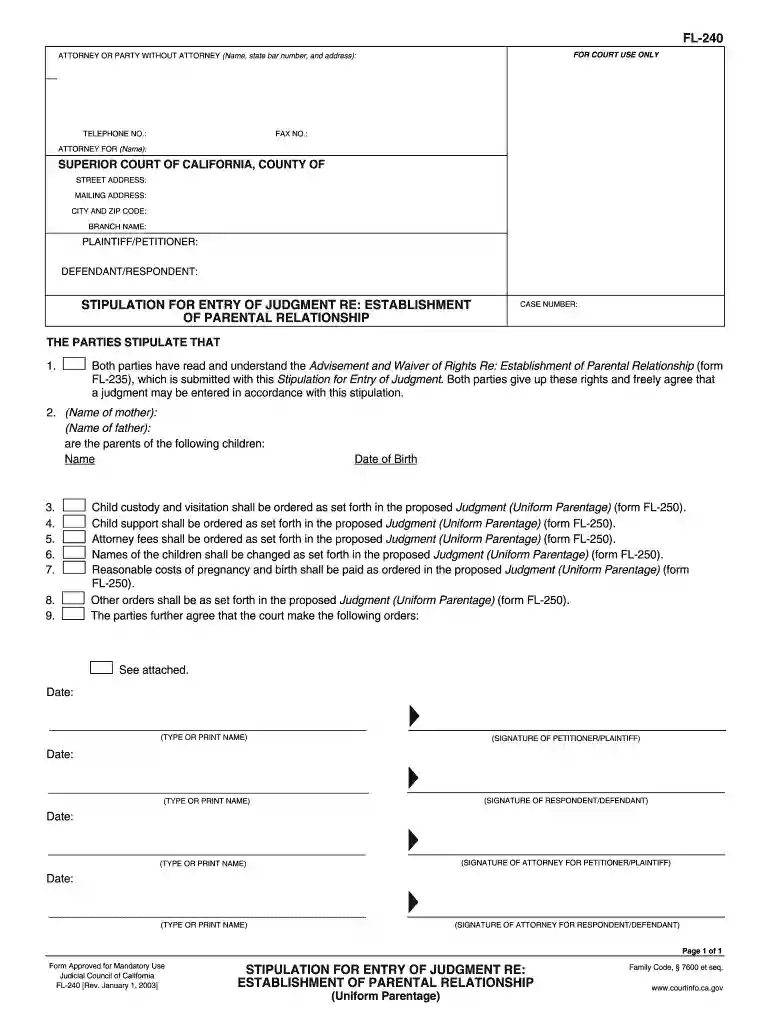
The FL-240 form, known as the "Stipulation for Entry of Judgment" in California courts, pertains to establishing a parental relationship. This legal document allows both parties, typically parents, to agree on terms regarding child custody, visitation, child support, attorney fees, and related orders. It serves as a mutual agreement that simplifies court proceedings by outlining agreed-upon terms before presenting them to a judge for approval. By understanding the stipulation process, parties can ensure that their rights are acknowledged while facilitating smoother legal transactions.
Acquire the Form: Obtain the FL-240 form from the California Courts website or your local courthouse. Ensure you have the most recent version.
Fill Out Personal Information: Enter the names, addresses, and contact details of both parties involved. This includes the petitioner and the respondent.
Detail Agreement Terms: Clearly specify the terms agreed upon by both parties. This includes child custody, visitation rights, child support amounts, and other necessary arrangements.
Review Legal Rights: Ensure that both parties understand their legal rights, particularly regarding modifications, enforcement, and potential consequences of non-compliance.
Sign the Document: Both parties must sign the form to indicate their agreement to the terms. Witnesses or a notary public may be necessary to validate the signatures.
File with the Court: Submit the completed form to the appropriate California court for approval. The court will review the stipulation terms and make a judgment.
Parental Relationship Establishment: The primary purpose is to formally recognize and establish the rights and responsibilities between the child's parents.
Child Support and Custody: It addresses how child support will be handled, including calculation methods and payment schedules. Custody and visitation are also crucial elements, ensuring fair arrangements for both parties.
Agreement Acknowledgement: The form signifies that both parties are fully aware of the conditions and stipulations they are consenting to, which is critical for maintaining trust and understanding.
Petitioner: The individual who initiates the legal proceedings by filing the form.
Respondent: The other party involved in the case who responds to the court's inquiry about the stipulation.
Judgment: The court's final decision based on the stipulation, which becomes legally binding for both parties.
Stipulation: A mutual agreement between parties to settle issues without litigation.
Utilizing the FL-240 is a strategic move in legal proceedings involving parental responsibilities. It prevents lengthy court battles by providing a consensual pathway to resolving disputes related to child welfare. Once approved by a judge, the stipulation becomes part of the court record, holding both parties accountable. It's essential for individuals to seek legal advice if there are concerns about the implications of the form's content or if modifications to the agreement may be required in the future.
The FL-240 form is commonly used by:
Parents: Generally, parents looking to establish their legal rights and duties towards their children post-separation.
Legal Professionals: Attorneys and paralegals completing the administrative requirements for family law matters.
Court Officials: Judges and clerks who process family law cases.
By understanding who uses the form, individuals can approach the process with clear expectations and seek appropriate assistance.


The stipulation form is governed by California state laws, which means that rules and regulations specific to California will apply. This includes guidelines on child support calculations and custody arrangements, reflecting California's family law statutes. Additionally, individuals from other states should consult local regulations, as procedural differences can affect how agreements are processed and enforced.
Failing to adhere to the terms outlined in the FL-240 can result in significant legal consequences. These may include:
Monetary Fines: Fines imposed for non-compliance, particularly for failing to meet financial commitments like child support.
Legal Action: The other party may seek court intervention to enforce the judgment.
Adjustment of Terms: The court may modify custody or visitation rights if non-compliance suggests an inability to maintain agreements responsibly.
Recognizing the potential repercussions underscores the importance of understanding and adhering to the form's stipulations.
We've got more versions of the FL-240 STIPULATION FOR ENTRY OF - California Courts - courts ca form. Select the right FL-240 STIPULATION FOR ENTRY OF - California Courts - courts ca version from the list and start editing it straight away!
At DocHub, your data security is our priority. We follow HIPAA, SOC2, GDPR, and other standards, so you can work on your documents with confidence.
This is the first page of the agreement you have with the childs other parent about establishing parentage, child custody and visitation.
by M County The Civilian Conservation Corps activities in the National Capital Region of the National Park Service illustrate the important role of this program in.
Jan 1, 2016 STIPULATION FOR ENTRY OF JUDGMENT RE: ESTABLISHMENT OF PARENTAL RELATIONSHIP. (UNIFORM PARENTAGE)(FL-240). E. Status Only or Bifurcated


