







Definition & Meaning
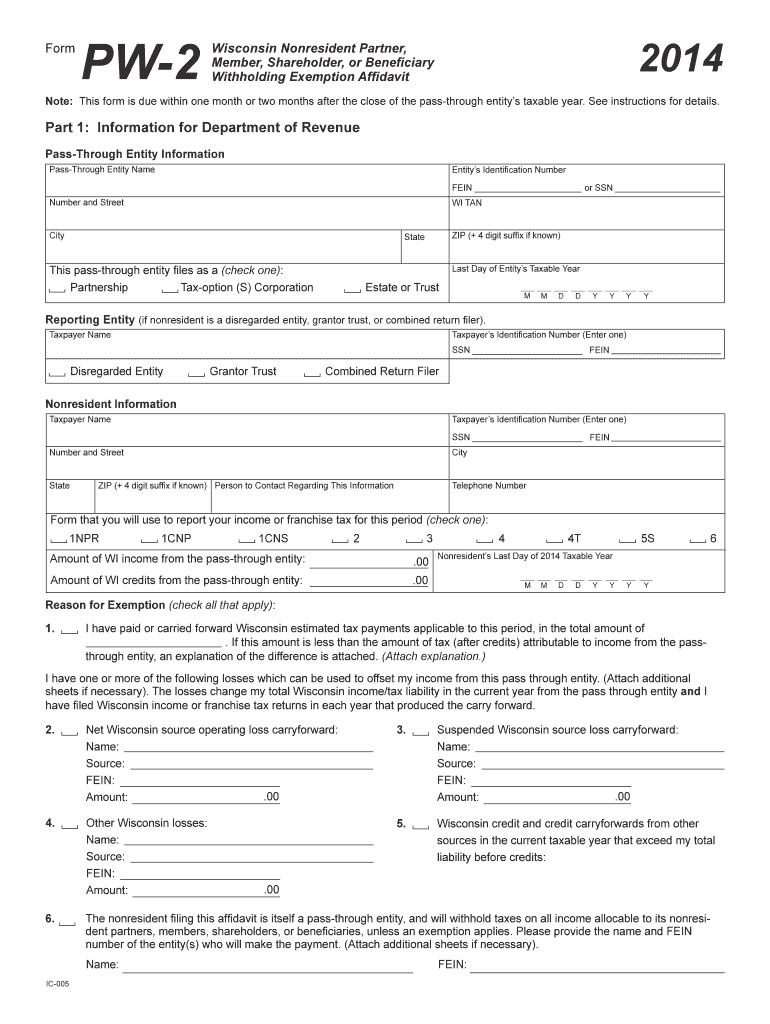
The Wisconsin Nonresident Partner, Member, Shareholder, or Beneficiary Withholding Exemption Affidavit, commonly known as Form PW-2 for the year 2014, is a document utilized by nonresident individuals involved with pass-through entities in Wisconsin. This specific form allows these individuals to seek an exemption from Wisconsin income or franchise tax withholding. By completing this form, the filer asserts that they meet certain criteria, justifying the exemption and ensuring compliance with Wisconsin's tax regulations.
Key Components of Form PW-2
- Declaration of Exemption: Nonresidents must declare that they qualify for the exemption based on their tax situation.
- Pass-Through Entity Information: Includes details about the entity through which income is received.
- Accurate Information Clause: Confirming the accuracy of the information provided.
How to Use Form PW-2 2014
Utilizing the PW-2 form involves several clear steps designed to guide nonresidents through the exemption application process. Understanding each aspect ensures compliance and proper usage.
- Identify Eligibility: Confirm that you are a nonresident with income passed through a Wisconsin-based entity.
- Gather Necessary Information: Collect details about the entity and any relevant personal financial data.
- Fill Out the Form: Pay special attention to exemption criteria and the declaration sections.
- Submit for Approval: Send the completed form to the relevant Wisconsin state authority for processing.
Common Mistakes to Avoid
- Failing to provide complete information about the pass-through entity.
- Omitting the declaration of accuracy, which is crucial for the form's acceptance.
Steps to Complete Form PW-2 2014
Filling out Form PW-2 requires deduction and precision. Follow these instructions to ensure accurate completion:
- Begin with Personal Information: Enter your full name, address, and tax ID or Social Security number.
- Provide Entity Details: Include the name and federal employer identification number (EIN) of the pass-through entity.
- Explain Exemption Reason: Detail any financial losses or credits relevant to your exemption request.
- Complete the Declaration Section: Certify the truthfulness of all provided information.
- Review Before Submission: Double-check all entries for accuracy.
Checklist for Completeness
- Personal information correctly entered
- Entity details matched with financial records
- Exemption reasons clearly documented
- Declaration signed and dated
Legal Use of Form PW-2 2014
The legal use of Form PW-2 lies in its role as an official request for tax withholding exemption. This forms part of the broader governmental regulation to prevent undue tax withholding from nonresidents associated with Wisconsin entities. The revisions introduced in 2014 ensure alignment with Wisconsin's tax laws.
Consequences of Misuse
- Rejection of the exemption application
- Possible fines or legal actions for falsified information
Who Typically Uses Form PW-2 2014
Form PW-2 is primarily used by:
- Nonresident Individuals: Those receiving income from a Wisconsin-based pass-through entity such as partnerships or S-corporations.
- Nonresident Shareholders: Shareholders who are not domiciled in Wisconsin but are part of a Wisconsin entity.
Scenarios Where Form PW-2 is Utilized
- Nonresident partners filing individually through a partnership
- Nonresident beneficiaries of a trust receiving dividends exempt from withholding
State-Specific Rules for Form PW-2 2014
Wisconsin imposes specific rules concerning the use of Form PW-2, reflecting its aim to streamline tax regulations for nonresidents involved in pass-through entities.
Compliance Requirements
- Adherence to Wisconsin tax codes
- Uniform application of disclosure requirements across similar entities
Penalties for Non-Compliance
Failure to comply with Wisconsin's stipulations regarding Form PW-2 can lead to several punitive measures:
- Financial Penalties: Charges imposed for under- or non-payment due to invalid exemptions.
- Legal Proceedings: In case of deliberate misinformation or refusal to comply with notification requirements.
Mitigating Non-Compliance Risks
- Ensuring detailed review of completed forms
- Educating oneself on state-specific tax laws and recent legislative updates
Business Entity Types That Benefit Most
Business entities that can maximize advantages from Form PW-2 include:
- Limited Liability Companies (LLC): With nonresident members
- S-Corporations and Partnerships: Receiving pass-through income
- Trusts/Estates: With nonresident beneficiaries
Examples of Advantageous Usage
- An LLC with diverse nonresident membership ensuring proper exemption processing
- A partnership distributing income to include full compliance with exemption clauses
Important Terms Related to Form PW-2 2014
Understanding relevant terminology is essential for potential users of Form PW-2:
- Pass-Through Entity: A business structure that does not pay corporate income taxes. Instead, income is passed to owners or investors.
- Withholding: The portion of wages not included in an employee's paycheck because it is sent directly to the government as partial payment of income tax.
- Exemption Affidavit: A sworn statement asserting eligibility exempting one from tax withholding.
Practical Applications of Key Terms
- Understanding "pass-through entity" assists a nonresident in accurately identifying their income source.
- Grasping "withholding" provides contextual knowledge for applying exemptions correctly.




