




01. Edit your form online
Type text, add images, blackout confidential details, add comments, highlights and more.

Type text, add images, blackout confidential details, add comments, highlights and more.

Draw your signature, type it, upload its image, or use your mobile device as a signature pad.

Send it via email, link, or fax. You can also download it, export it or print it out.
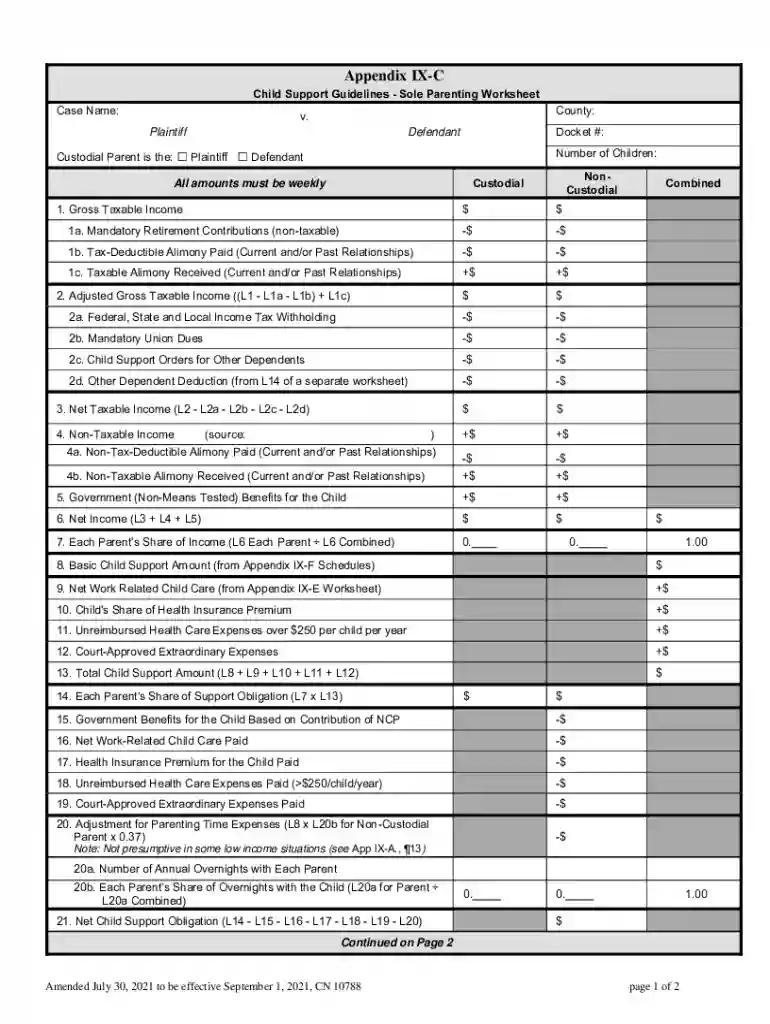
The "Child Support Guidelines Sole Parenting Worksheet - Rule Appendix IX-C" is a structured form used in the United States to calculate child support obligations in cases where one parent has sole parenting responsibilities. It plays a crucial role in balancing the financial responsibilities between parents, ensuring that the child receives adequate support. The worksheet gathers essential financial information from both parties to determine the fair share of support required from the non-custodial parent.
Gather Financial Information
Collect all necessary financial documents, including income statements, tax returns, and records of any deductions or child-related expenses.
Input Gross Taxable Income
Enter the gross taxable income of both parents. This forms the basis for calculating the support obligation. Ensure accuracy by cross-referencing with tax documents.
Calculate Deductions
Identify allowable deductions such as federal and state taxes, social security, and union dues. Deduct these from the gross income to determine the net income.
Account for Child-Related Expenses
Include expenses related to child care, education, and health insurance. These costs are crucial in determining the overall financial needs of the child.
Determine Child Support Obligation
Use the worksheet formula to calculate the child support obligation. Input all collected data, and follow the instructions to compute the amount owed by the non-custodial parent.
Gross Taxable Income: The total income before deductions, used to assess the financial capacity of each parent.
Deductions: Specific expenses that are subtracted from gross income to calculate net income.
Non-Custodial Parent: The parent who does not have primary custody of the child but is financially responsible for child support.
Sole Parenting: A scenario where one parent is primarily responsible for the child's upbringing and daily care.
Income Section: Requires detailed input of income sources, ensuring the completion of accurate support calculations.
Deductions and Expenses: This section captures essential deductions and child-related expenses impacting the final calculation.
Obligation Calculation: Includes the formula used to determine the support payment, ensuring transparency and fairness.
The worksheet is used in legal proceedings to establish a fair child support arrangement in sole parenting situations. Courts rely on the completed worksheet to ensure both parents contribute appropriately to the child's needs, reflecting both incomes and expenses accurately. Its use is sanctioned under the law to aid judicial decision-making and avoid arbitrary support arrangements.
Each state may have specific guidelines governing how the worksheet is completed. For example:
California: Uses a specific formula that factors in additional state-mandated deductions.
New Jersey: Obliges inclusion of extraordinary medical expenses under its regulations.
Understanding these state-specific nuances is critical for accurate completion and legal compliance.
Consider a scenario where the non-custodial parent earns $70,000 annually, while the custodial parent earns $50,000. After calculating deductions and child-related expenses, the worksheet helps determine a fair support amount based on a percentage of net income.
The worksheet is primarily used by:
Family Law Attorneys: To advise clients during custody and support negotiations.
Court Officials: In evaluating financial responsibilities in legal proceedings.
Parents: To ensure their financial contributions are fair and compliant with legal standards.
By providing a structured approach, the worksheet ensures that child support calculations remain consistent, equitable, and transparent, supporting the welfare of the child involved.


We've got more versions of the Child Support Guidelines Sole Parenting Worksheet - Rule Appendix IX-C form. Select the right Child Support Guidelines Sole Parenting Worksheet - Rule Appendix IX-C version from the list and start editing it straight away!
At DocHub, your data security is our priority. We follow HIPAA, SOC2, GDPR, and other standards, so you can work on your documents with confidence.
Apr 15, 1976 Increased section 179 deduction dollar limits. The maximum amount you can elect to deduct for most sec- tion 179 property you placed in
by N DEMYAN 2022 Cited by 1 the vast majority (94%) of child support orders used sole custody worksheets. This amount, again, is consistent with the average support order amount among sole.
Sep 1, 2021 Appendix IX-C. Child Support Guidelines - Sole Parenting Worksheet. Case Name: v. County: Plaintiff. Defendant. Docket #:. Custodial Parent is


