




01. Edit your form online
Type text, add images, blackout confidential details, add comments, highlights and more.

Type text, add images, blackout confidential details, add comments, highlights and more.

Draw your signature, type it, upload its image, or use your mobile device as a signature pad.

Send it via email, link, or fax. You can also download it, export it or print it out.
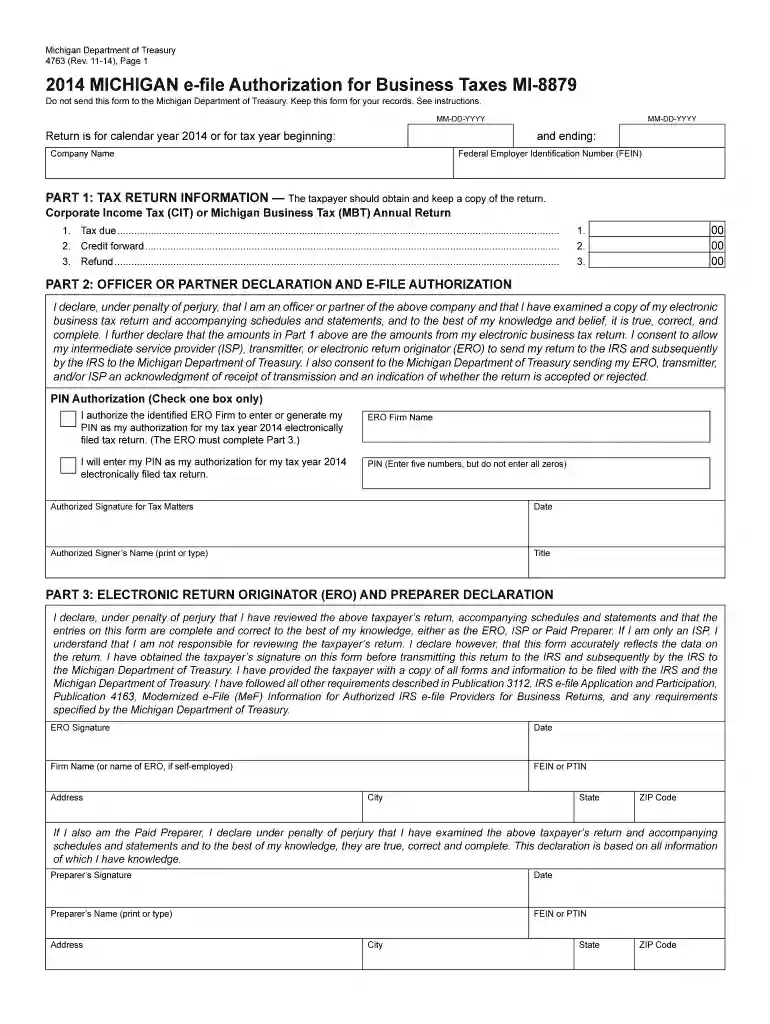
The Michigan Form 4763, commonly referred to as the Michigan e-file Authorization for Business Taxes MI-8879, is used to authorize electronic filing of a business’s tax return for the year 2014. This form serves as a declaration and provides the necessary signature to authorize EROs to submit tax returns to the Michigan Department of Treasury electronically. It outlines the responsibilities of both the business entity and the ERO and serves as a legal agreement between the two parties. Ensuring the accuracy and completeness of this form is crucial, as it significantly impacts the filing process.
Review Instructions and Guidelines: Before filling out the form, carefully review the instructions provided with Michigan Form 4. Understanding the requirements and terminology will help prevent errors.
Provide Business Details: Enter essential business information, including the name, address, and Federal Employer Identification Number (FEIN).
Enter Tax Return Information: Record the tax period covered by the form and summarize the details of the tax return being filed.
Signature Authorization: Ensure the authorized representative of the business signs and dates the form to approve the electronic filing.
Submit to ERO: Once completed, submit the form to your ERO, who will retain it for their records as proof of authorization.
Michigan Form 4 can be accessed through various channels for convenience:
Failure to properly complete or submit Michigan Form 4763 can result in serious repercussions:
Fitting Michigan Form 4763 into your document management strategy is essential for seamless tax filings — ensuring prompt, accurate, and compliant business operations.
We've got more versions of the michigan form 4763 2014 form. Select the right michigan form 4763 2014 version from the list and start editing it straight away!
At DocHub, your data security is our priority. We follow HIPAA, SOC2, GDPR, and other standards, so you can work on your documents with confidence.
Matthews International Corporation is a global provider of brand solutions, memorialization products and industrial technologies.
Non-taxable sales will be calculated automatically once gross sales and taxable sales have been entered. These totals must agree with Appendix 2 which is


