
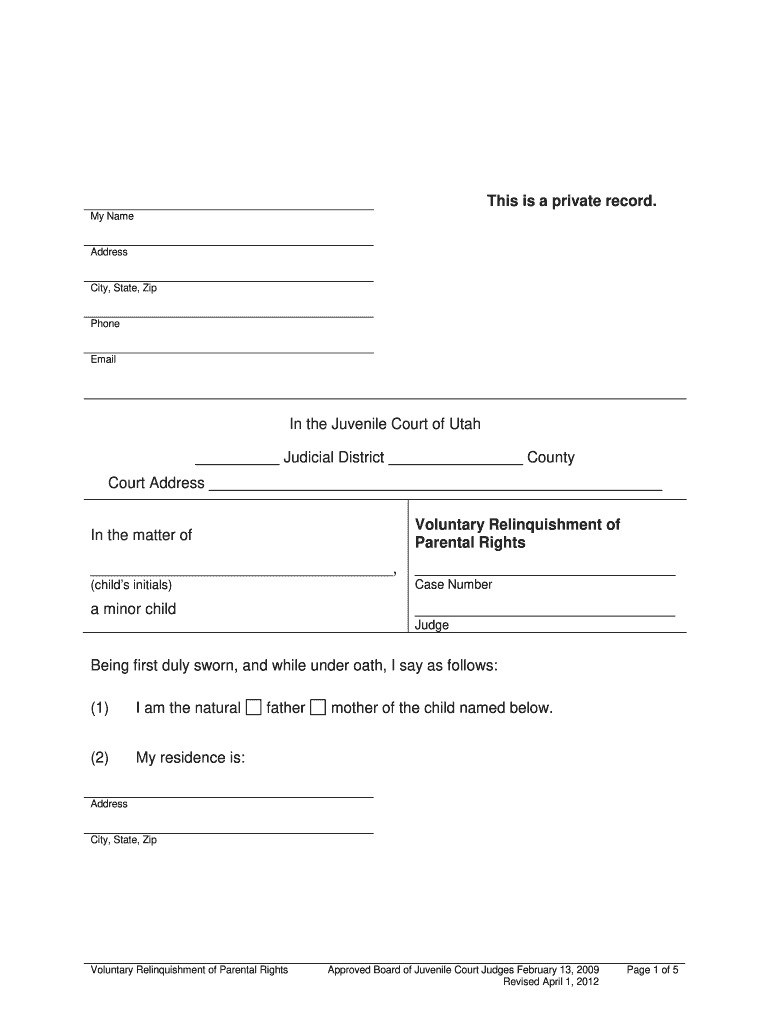







Definition and Meaning of Voluntary Relinquishment of Rights
The term "Voluntary Relinquishment of Rights" refers to a legal procedure where a parent willingly terminates their parental rights to a child. This process is formalized through a legal document filed within the Utah Courts system and signifies a parent's intent to permanently give up legal rights and responsibilities concerning their child. The document typically includes personal information about the parent and child, reasons for the decision, and affirmations that the parent is making this choice without coercion.
Key Elements
- Legal Procedure: The document officially ends parental rights, affecting custody, visitation, and decision-making for the child.
- Parental Voluntariness: The parent must willingly agree to relinquish their rights without any external pressure.
- Court's Role: The court reviews and must approve the voluntary relinquishment to ensure it's in the child's best interest.
How to Use the Voluntary Relinquishment of Rights Form
Using the "Voluntary Relinquishment of Rights" form involves correctly completing the document in accordance with Utah Court guidelines. The form requires specific information and must be filled out accurately to be valid in court proceedings.
Steps to Use the Form
- Access the Form: Obtain the form from the Utah Courts website or a legal resource center.
- Fill in Personal Information: Provide complete details for both the parent and child.
- State Reasons for Relinquishment: Clearly indicate why the rights are being relinquished.
- Sign the Document: The parent must sign to confirm understanding and voluntariness of the decision.
- Submit to Court: File the form with the Juvenile Court in Utah for approval.
Steps to Complete the Form
Completing the "Voluntary Relinquishment of Rights" form involves a careful and thorough approach to ensure all legal requirements are met.
- Gather Necessary Information: Before starting the form, gather all relevant details about the parent and the child.
- Complete Each Section: Methodically fill out each section, ensuring all information is correct and comprehensive.
- Review Legal Implications: Understand the consequences of relinquishing parental rights and confirm this understanding in the form.
- Notarize If Required: Some sections may need to be notarized; verify if this is necessary.
- Submit for Filing: File the completed document with the appropriate court, ensuring compliance with all local rules.
Legal Use of the Voluntary Relinquishment of Rights
The use of the form is primarily to legally terminate parental rights. This process is significant in adoption proceedings or situations where the parent is unable or unwilling to continue with their responsibilities.
Legal Implications
- Termination of Rights: Relinquishes legal responsibilities and rights, including custody and decision-making.
- Finality: The decision is final and cannot be undone once approved by the court.
- Adoption: Often a precursor to adoption, transferring parental rights to another party.
State-Specific Rules in Utah
Utah has specific rules governing the voluntary relinquishment of parental rights, designed to protect the welfare of the child involved.
Important Considerations
- Court Approval: The Juvenile Court must review and approve all filings.
- Best Interest of the Child: The court evaluates whether the relinquishment serves the child's best interests.
- Mandatory Counseling: Parents may be required to undergo counseling to understand the consequences fully.
Important Terms Related to the Form
Understanding specific terms used in the "Voluntary Relinquishment of Rights" form aids in completing it correctly.
Common Terms
- Parental Rights: Legal rights related to the care and custody of a child.
- Voluntariness: The state of willingly choosing to terminate parental rights.
- Juvenile Court: The division of the court system that handles cases involving minors.
Required Documents for Form Submission
Several documents may be required when submitting the voluntary relinquishment form to ensure all legal protocols are followed.
Checklist of Required Documents
- Identification Documents: Valid ID for the parent.
- Birth Certificate: Child’s birth certificate to verify parental link.
- Supporting Affidavits: Any required affidavits attesting to the voluntariness of the decision.
Examples of Using the Form
Real-life scenarios help illustrate the relevance and use of the voluntary relinquishment form.
Practical Scenarios
- Adoption Process: A biological parent relinquishes rights to allow a foster child’s adoption by foster parents.
- Financial Hardship: A parent unable to provide for a child’s needs may use this form in collaboration with family services to arrange better care.
By understanding these various aspects comprehensively, individuals can navigate the legal aspects of "Voluntary Relinquishment of Rights" within Utah Courts more effectively, ensuring all actions are informed and appropriately documented.




