




01. Edit your form online
Type text, add images, blackout confidential details, add comments, highlights and more.

Type text, add images, blackout confidential details, add comments, highlights and more.

Draw your signature, type it, upload its image, or use your mobile device as a signature pad.

Send it via email, link, or fax. You can also download it, export it or print it out.
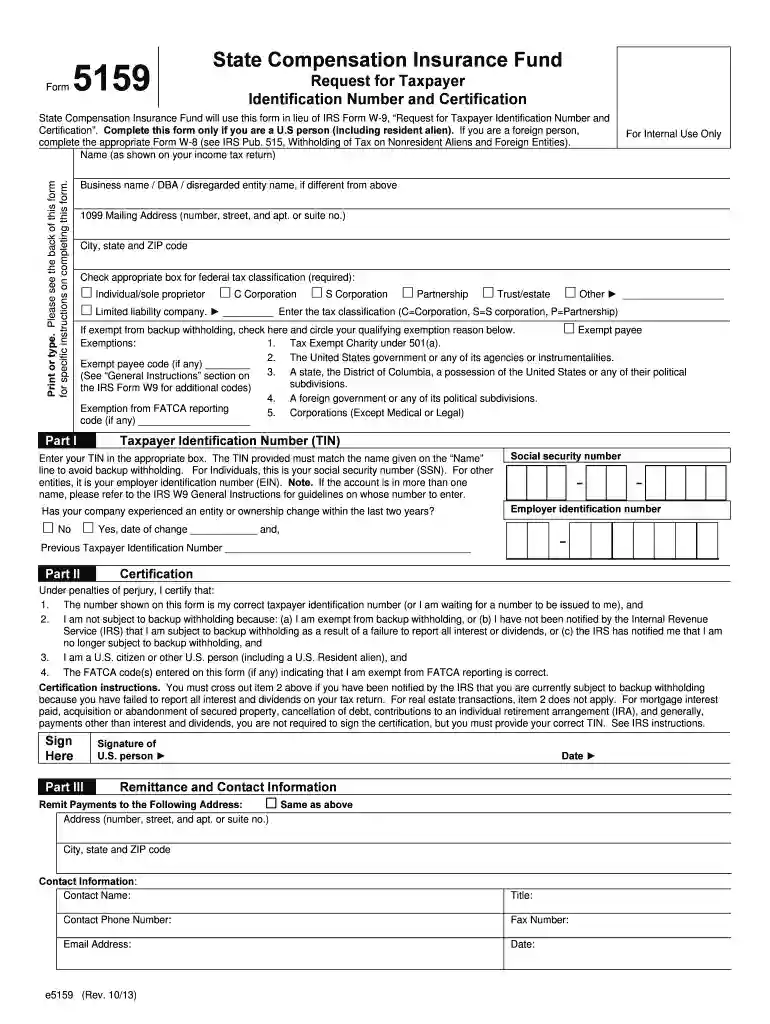
Form 5159, in this case dated 2013, is utilized by the State Compensation Insurance Fund as an alternative to the IRS W-9 form. It serves primarily to request a Taxpayer Identification Number (TIN) and includes certification features for individuals in the United States, such as U.S. citizens and resident aliens. The main objective is to provide a TIN to avoid backup withholding on certain payments. This form contains key segments such as personal identification, tax classification, TIN accuracy affirmation, and remittance instructions.
Using Form 5159 requires careful attention to the details requested. Individuals should ensure that they complete the personal information section, clearly stating their name, address, and other identifiers. The tax classification must be accurately selected to reflect an individual’s status, whether it be sole proprietor, corporation, or partnership. Once filled, the form must be signed to certify that the TIN provided is correct and that the person is not subject to backup withholding. Following these guidelines is crucial for maintaining compliance and ensuring that payments are processed without issues.
Form 5159 is mainly used by individuals and entities required to provide their TIN for tax reporting purposes. This includes:
To complete Form 5159, individuals need:
Form 5159 offers multiple submission methods to fit various needs and preferences:
Form 5159's primary legal use is substituting the traditional IRS W-9 to certify TIN for tax reporting and avoiding backup withholding. It satisfies compliance requirements for the State Compensation Insurance Fund by maintaining essential taxpayer information. Proper use ensures legality in receiving payments without unnecessary tax penalties, reflecting accurate taxpayer standing.
Failure to properly submit Form 5159 or provide an accurate TIN can lead to:
Ensuring accuracy and timely submission of Form 5159 helps avoid these potential complications and supports smooth financial operations.
We've got more versions of the form 5159 2013 form. Select the right form 5159 2013 version from the list and start editing it straight away!
At DocHub, your data security is our priority. We follow HIPAA, SOC2, GDPR, and other standards, so you can work on your documents with confidence.
The NRCs waste confidence principle was properly struck down by a federal court because, some 60 years into the commercial atomic age, it is patently
Feb 25, 2020 Indicate by check mark if the registrant is a well-known seasoned issuer, as defined in Rule 405 of the Securities Act. Yes ☒ No ☐.
All DOA Approvals must be obtained for the departments and/or funds that are being requested in this transfer. 12, For processing, email approved Form (both in


