




01. Edit your gc 240 online
Type text, add images, blackout confidential details, add comments, highlights and more.

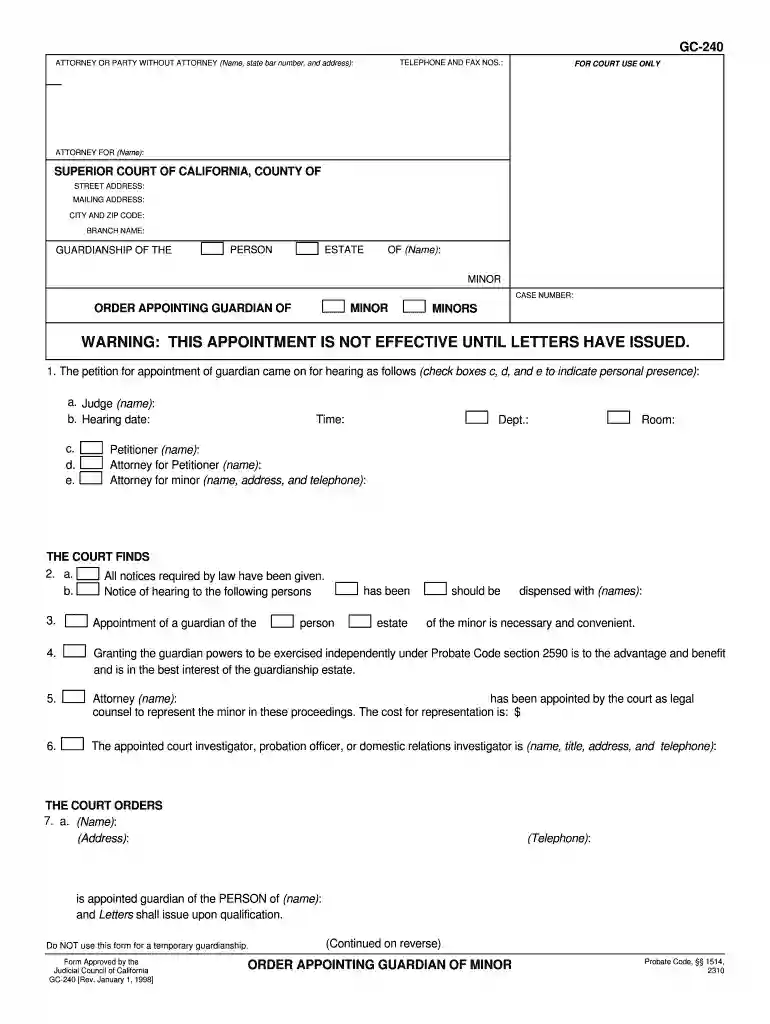
Type text, add images, blackout confidential details, add comments, highlights and more.

Draw your signature, type it, upload its image, or use your mobile device as a signature pad.

Send it via email, link, or fax. You can also download it, export it or print it out.
The GC-240 form, known officially as the "Order Appointing Guardian of Minor," is a legal document used by the Superior Court of California. It plays a critical role in the guardianship process, serving as the court's authoritative order that appoints a guardian for a minor. This form outlines crucial findings and orders related to the guardianship, ensuring that the appointed guardian is legally recognized for the care or management of the minor’s personal and/or financial interests. The order becomes effective only after certain qualifications and conditions are satisfied, thereby safeguarding the minor's welfare.
Acquiring the GC-240 form can be done through multiple channels, making it accessible for those seeking to be appointed as guardians. Primarily, the form can be obtained directly from the official website of the California Courts, where it is available for download. Alternatively, interested parties can visit the local courthouse to request a physical copy. It's important to ensure that the form version is current and that it includes all necessary supplementary documents that may need to be filed concurrently, as omissions can delay the process.
Download or Acquire the Form: Begin by downloading the GC-240 form from the California Courts website or collect a physical copy from the courthouse.
Read the Instructions Carefully: Each section of the form comes with detailed instructions. It is imperative to read these instructions to ensure accuracy and compliance.
Fill Out Personal and Minor Details: Include accurate details about the petitioner, the minor, and proposed guardian(s), such as names, addresses, and contact information.
List All Required Guardianship Information: Clearly state the reasons for seeking guardianship, the scope of guardianship (person, estate, or both), and any specific guardian responsibilities.
Attach Necessary Documentation: Include any required documents, such as proof of relationship or financial declarations, if applicable.
Review and Certify the Form: Ensure all information is accurate. Review the form thoroughly before signing and submitting it for court review.
Guardianship: The legal responsibility granted by the court to an individual (guardian) to care for and manage the personal and/or property interests of the minor.
Petitioner: The individual requesting the appointment of a guardian, usually a relative or a person with a vested interest in the minor’s well-being.
Estate: Refers to the minor's financial interests and any property they may own or inherit that requires management by the guardian.
Guardian of the Person: An appointed individual responsible for the minor's personal welfare, including healthcare, education, and daily needs.
Guardian of the Estate: A guardian appointed to manage and protect the minor’s financial interests.
The GC-240 form is legally binding and specifically utilized within the jurisdiction of California. It works as a court order that, upon approval, grants the petitioner the legal authority to act as the guardian of the minor. This legal use extends to critical decisions affecting the minor's welfare and may include managing educational, medical, and financial matters. The form must be filled accurately and in accordance with California laws to ensure its validity and enforceability in legal proceedings.
Primarily, the GC-240 form is used by individuals desiring to take on guardianship roles over a minor. Users typically include close relatives like grandparents, siblings, or extended family members. It may also be used by non-relatives if they can demonstrate a close relationship or special concern for the minor's best interests. Social workers or legal professionals may also assist in completing and filing the form on behalf of the petitioner.


Petitioner’s Information: Includes comprehensive details about the person filing the petition, establishing their relationship and intent regarding the minor.
Description of the Minor: Provides identifying details of the minor, such as age and current living situation.
Guardianship Specifications: Details whether the guardianship applies to the person, the estate, or both, and includes any conditions or limitations.
Court Findings and Orders: Outlines the considerations the court has made in approving the guardianship, detailing the legal rights and duties bestowed upon the guardian.
Effective Conditions: States the conditions under which the appointment becomes effective, ensuring compliance with legal standards.
California has distinct regulations governing the appointment of guardians, reflected in the GC-240 form requirements. Petitioners must adhere to these state-specific rules, which include residency requirements and background checks. The court requires a rigorous evaluation to confirm the guardian’s suitability, focused on the minor's best interests. Additionally, any modifications to guardianship post-appointment must also be approved by the court, following formal submission of justifiable reasons.
When filing the GC-240 form, several ancillary documents are typically required to support the petition:
Proof of Relationship: Documents such as birth certificates or guardianship paperwork establishing the petitioner’s relationship to the minor.
Financial Disclosure: For those applying for guardianship of the estate, disclosures may include financial statements or inventory of the minor's assets.
Consent Letters: If possible, written consent from the minor’s parents or current legal guardians supporting the petition for guardianship.
We've got more versions of the gc 240 form. Select the right gc 240 version from the list and start editing it straight away!
At DocHub, your data security is our priority. We follow HIPAA, SOC2, GDPR, and other standards, so you can work on your documents with confidence.
Do NOT use this form for a temporary guardianship. Page 1 of 3. Form Adopted for Mandatory Use. Judicial Council of California. GC-240 [Rev. July 1, 2016].
Note that this form must be signed by the parent/guardian unless the SP is an emancipated minor (check with your supervisor for the rules governing
The adult in need of protection may not have the ability or capacity to come back to court if the guardian is not complying with the order. In most cases, the


