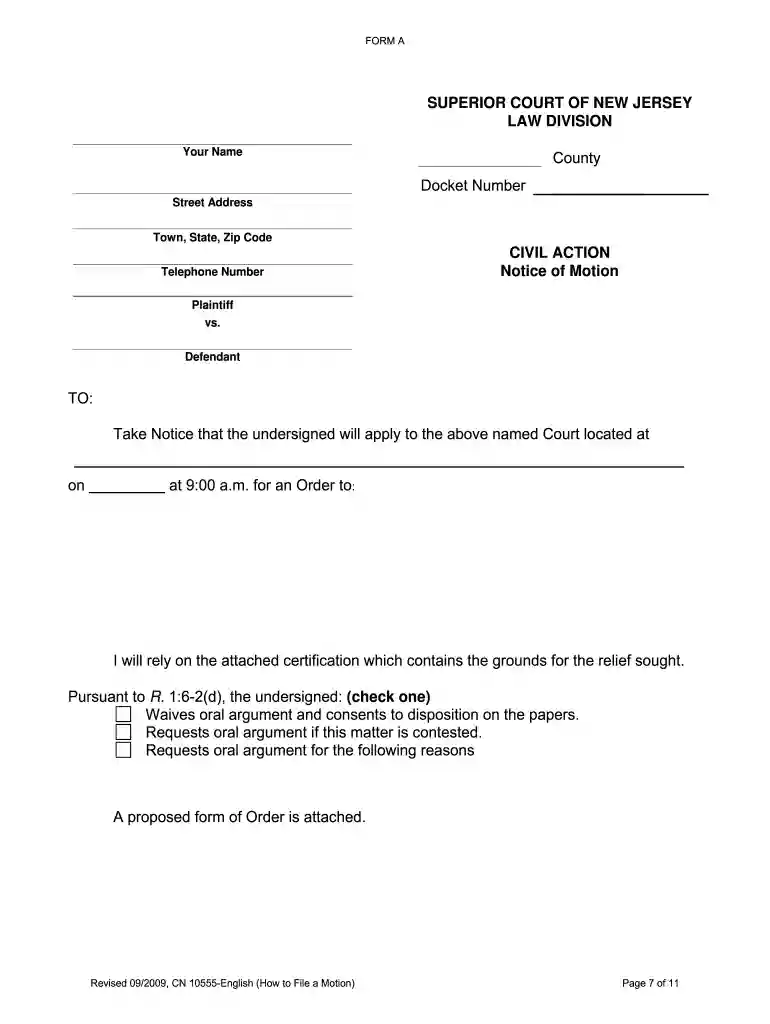
How to File a Motion in the Superior Court - New Jersey Courts - judiciary state nj 2026

Get Form
How to File a Motion in the Superior Court - New Jersey Courts - judiciary state nj Preview on Page 1

Here's how it works

01. Edit your form online
Type text, add images, blackout confidential details, add comments, highlights and more.

02. Sign it in a few clicks
Draw your signature, type it, upload its image, or use your mobile device as a signature pad.

03. Share your form with others
Send it via email, link, or fax. You can also download it, export it or print it out.

Definition of a Motion in the Superior Court

A motion in the Superior Court of New Jersey is a formal request for the court to make a specific ruling or order. This request is typically made by a party involved in a legal proceeding who seeks to resolve a dispute or gain clarification on legal rights. Motions can cover a wide range of issues, including requests to dismiss a case, to compel discovery, or for summary judgments. Each motion must adhere to specific court rules and include supporting documentation to justify the request.

How to Use the Motion Form

To use the form effectively, begin by thoroughly reading the instructions provided with the form. The form typically requires you to fill in details such as the case caption, docket number, and the names of the parties involved. You must clearly state the nature of your motion, the relief sought, and the legal basis for your request. Ensure that all necessary sections of the form are completed and that it is signed and dated. Attach all additional documents that support your motion, such as affidavits, exhibits, or legal memoranda.

Steps to File a Motion in the Superior Court

  1. Prepare Your Motion: Gather all necessary documents and information related to your case. Ensure that your motion is clearly written and outlines the relief you are seeking.
  2. Complete the Motion Form: Fill out the form, making sure all required fields are completed accurately.
  3. Serve the Motion: Provide a copy of the motion to all involved parties according to the court’s rules, typically via certified mail or another approved method.
  4. File with the Court: Submit the original motion and any supporting documents to the court clerk. You may need to pay a filing fee.
  5. Schedule a Hearing: The court clerk will typically schedule a hearing date. Ensure you are prepared to present your case on this date.

Important Terms Related to Motions

  • Affidavit: A written statement confirmed by oath or affirmation, used as evidence in court.
  • Docket Number: A unique identifier assigned to a case for tracking and reference.
  • Pro Se Litigant: An individual who represents themselves in court without an attorney.
  • Summary Judgment: A legal determination made by the court without a full trial when there is no dispute over the material facts.

Key Elements of Filing a Motion

  • Service of Process: Properly serving all documents to the involved parties in accordance with court rules.
  • Supporting Documentation: Providing evidence and legal arguments to validate the motion's claims.
  • Notice of Motion: Informing all parties of the time and place the motion will be heard.
  • Certificate of Service: Documenting how and when the motion was served to involved parties.

State-Specific Rules in New Jersey

New Jersey has specific procedural rules that must be followed when filing a motion in its Superior Court. These rules may dictate the timing of your submissions, the format of your documents, and the specific methods by which you must serve other parties. Familiarity with the New Jersey Court Rules, particularly Rules 1:6-2 and 1:6-3, is crucial for compliance.

Examples of Common Motions

  • Motion to Dismiss: A request for the court to dismiss the case for specific reasons, such as lack of jurisdiction.
  • Motion for Discovery: A request to compell the opposing party to produce evidence or documents pertinent to the case.
  • Motion for Summary Judgment: A request for the court to rule in favor of one party without a full trial based on undisputed facts.

Required Documents for Filing

  • A fully completed motion form with all necessary signatures.
  • Affidavits or declarations supporting the motion.
  • Copies of any exhibits referenced in the motion.
  • Proof of service indicating that all parties received the required documentation.

Form Submission Methods

Motions can be submitted in several ways:

  • Online: Through the New Jersey Courts Electronic Filing system for registered users.
  • Mail: Via postal service, ensuring all documentation is sent to the correct address for the court.
  • In-Person: By delivering the documents directly to the court clerk’s office during operation hours.

Eligibility Criteria for Filing

Anyone involved in a legal proceeding within the New Jersey Superior Court may file a motion. This includes individuals, businesses, and legal representatives. It is important to ensure that the person filing the motion has standing in the case, meaning they are directly affected by the court's decision on the motion.


decoration image ratings of Dochub

See more How to File a Motion in the Superior Court - New Jersey Courts - judiciary state nj versions

We've got more versions of the How to File a Motion in the Superior Court - New Jersey Courts - judiciary state nj form. Select the right How to File a Motion in the Superior Court - New Jersey Courts - judiciary state nj version from the list and start editing it straight away!
Versions Form popularity Fillable & printable
2022 4.8 Satisfied (41 Votes)
2014 4.8 Satisfied (166 Votes)
2009 4.3 Satisfied (199 Votes)
be ready to get more

Complete this form in 5 minutes or less

Get form

Got questions?

We have answers to the most popular questions from our customers. If you can't find an answer to your question, please contact us.
Contact us
If you want to file a motion, the process is generally something like this: You write your motion. You file your motion with the court clerk. The court clerk inserts the date and time your motion will be heard by the judge. You serve (mail) your motion to the other side.
Things You Should Know Write your legal argument by stating the rule and explaining how your facts apply to it. Then, add your signature, a Certificate of Service, and a Notice of Hearing. File your motion with the clerk of court overseeing your case. Then, give copies to each defendant.
12 Steps for Filing a Motion: Fill out the Notice of Motion (Form A) Get a court date for your motion Court Calendar. Fill out the Confidential Litigant Information Sheet. Fill out the Certification in Support of Motion (Form B) Fill out the Proposed Order (Form C)
Payment to Clerk of the Court for $50. There is a $50 filing fee assessed by the Court for every motion filed, which should be paid by check or money order.
You must serve your adversary no later than 16 days before the specified return date on your notice of motion. [If you are filing a motion for summary judgment, you must file it not later than 28 days before the time specified for the return date].

Security and compliance

At DocHub, your data security is our priority. We follow HIPAA, SOC2, GDPR, and other standards, so you can work on your documents with confidence.

Learn more
ccpa2
pci-dss
gdpr-compliance
hipaa
soc-compliance