




01. Edit your missouri application for claiming tax credits online
Type text, add images, blackout confidential details, add comments, highlights and more.

Type text, add images, blackout confidential details, add comments, highlights and more.

Draw your signature, type it, upload its image, or use your mobile device as a signature pad.

Send application for claiming tax credits missouri pregnancy via email, link, or fax. You can also download it, export it or print it out.
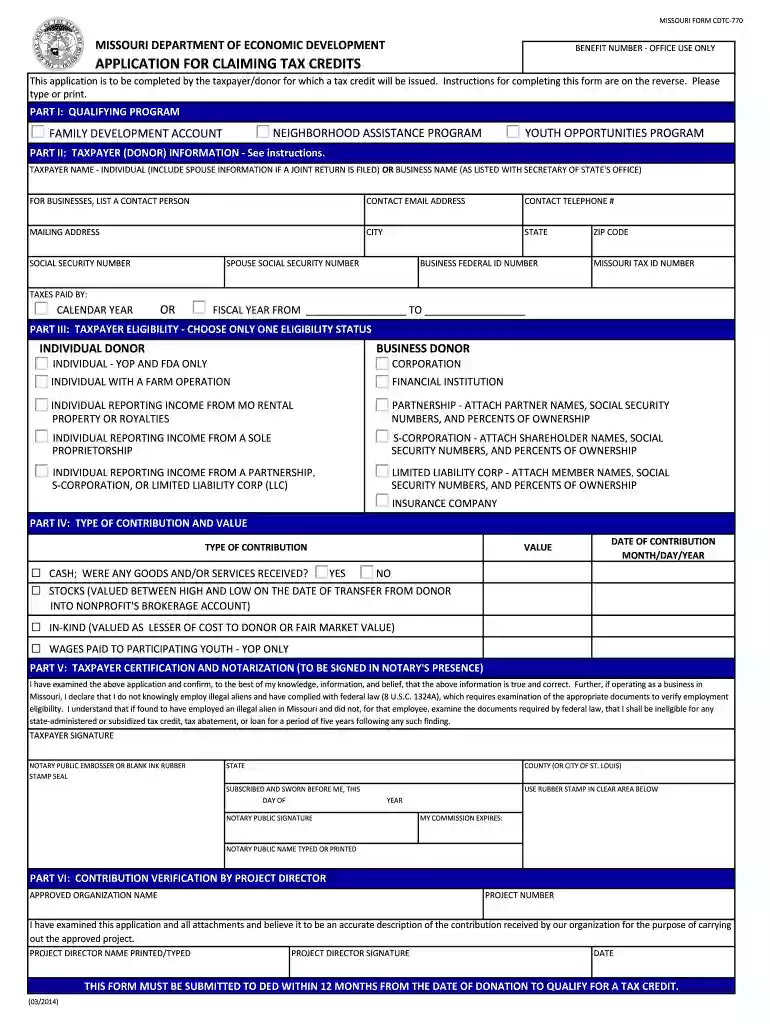
The Missouri Form CDTC-770, known as the Missouri claiming tax credits application, is an essential document that facilitates the claiming of tax credits for contributions made by individuals or businesses to approved programs in the state of Missouri. This application allows donors to receive tax credits for supporting initiatives such as the Neighborhood Assistance Program, Youth Opportunities Program, and Family Development Account. Taxpayers need to document contributions and eligibility, ensuring compliance with state tax laws.
The process involves accurately completing the Missouri Form CDTC-770 with relevant personal or business information, such as social security number or taxpayer identification number, and details about the contribution. Notarization of the form is mandatory before submission. Applicants must ensure that all sections are completed, as incomplete forms might delay or negate tax credit approval.
To accurately complete the Missouri claiming tax credits application, you will need several essential documents. These include receipts or confirmation letters from the recipient programs verifying your contribution, personal or business identification details, and previous tax filings to provide a reference for eligibility and claim calculation. Ensuring you have all necessary documentation will streamline the application process and aid compliance.
Eligibility primarily involves being a taxpayer in Missouri who has contributed to approved state programs. Both individuals and business entities, including corporations and partnerships, can use this application. Contributions must meet specified thresholds to qualify for credits, and the specific type of contribution, such as monetary donations or service hours, should align with program requirements.


After submission, the approval time for the Missouri claiming tax credits application varies. Typically, applicants receive confirmation within several weeks regarding the acceptance of their application and processing of their tax credit. Status updates can be requested from the Missouri Department of Revenue. Adhering to guidelines and providing correct documentation can expedite approval.
Missouri has unique rules governing tax credits. The state limits the total amount of tax credits available annually, which necessitates prompt application. Additionally, strict deadlines govern the timing of applications and corresponding eligibility periods. Contributions must comply with the criteria laid down for specific programs to be deemed valid, and the originating and residing state of the taxpayer should both be Missouri.
The Missouri claiming tax credits application is available in both digital and paper formats. Digital versions offer convenience with online submission capabilities, allowing faster processing and confirmation. Paper forms, while traditional, require more effort in terms of mailing and notarization logistics. Taxpayers should choose the format that best suits their circumstances, considering factors like ease of access and submission preferences.
Non-compliance with the form submission rules, such as late filing, incomplete documentation, or false claims, can result in penalties. Taxpayers might face fines, denial of credits, or exclusion from future programs. Ensuring adherence to guidelines and timely submissions is crucial to avoid these consequences. Always verify the completion and accuracy of your form before submission to mitigate potential issues.
We've got more versions of the missouri application for claiming tax credits form. Select the right missouri application for claiming tax credits version from the list and start editing it straight away!
At DocHub, your data security is our priority. We follow HIPAA, SOC2, GDPR, and other standards, so you can work on your documents with confidence.
You may use this tax form to file your 2021 Property Tax Credit. Claim (Form MO-PTC) if you meet the eligibility requirements on page 2 and are not required to
This application is to be completed by the taxpayer/donor for which the tax credit will be issued. Instructions for completing this form are on pg. 2.
Any receipts or invoices that have been altered in any way will not be accepted for tax-paid credits unless the licensee can demonstrate the receipt is valid.


