




01. Edit your nj lurp form online
Type text, add images, blackout confidential details, add comments, highlights and more.

Type text, add images, blackout confidential details, add comments, highlights and more.

Draw your signature, type it, upload its image, or use your mobile device as a signature pad.

Send njdep lurp form via email, link, or fax. You can also download it, export it or print it out.
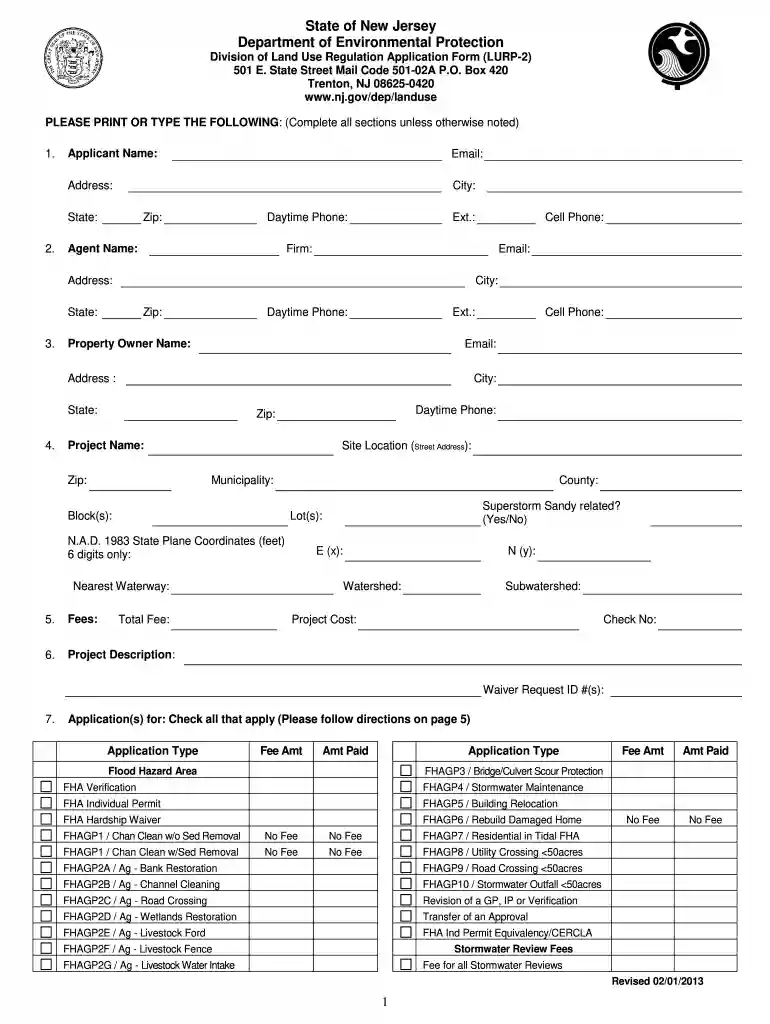
The term "form LURP" refers to the Land Use Regulation Program application utilized by the New Jersey Department of Environmental Protection. This form is specifically designed to manage land use proposals, ensuring that developments align with environmental regulations and state laws. The form LURP-2 includes extensive sections that collect detailed information about proposed projects, such as site location, project descriptions, and various associated fees. Understanding the purpose and structure of form LURP is critical for applicants aiming to gain project approval without facing legal or procedural setbacks.
Using the form LURP requires a thorough understanding of its sections and the type of information needed. Applicants should begin by gathering data concerning property specifics, including ownership details and the project's geographical location. It's essential to provide a clear project description, covering all aspects of the proposed land use and its environmental implications. Each section of the form may have specific instructions for completion, emphasizing the need for completeness and precision.
The form LURP encompasses several critical sections designed to capture comprehensive project data. Key elements include information on property ownership, project scope, environmental impact, and compliance with state regulations. Applicants must ensure accuracy, particularly in sections requiring maps and diagrams that depict the project's geographical setting. Inaccurate or incomplete submissions may delay approval or result in additional scrutiny by regulatory bodies.
Completing the form LURP involves more than merely filling in blanks; it requires a strategic approach to assembling coherent data. Begin by identifying all areas needing extensive documentation, such as any environmental studies or historical site usage reports. Collaborate with project stakeholders, including architects and environmental consultants, to ensure all technical details satisfy regulatory requirements.
The legal framework surrounding the form LURP is stringent, emphasizing adherence to state laws concerning land use and environmental protection. By completing the form, applicants certify their intention to comply with established statutes and are held accountable for any misinformation. The validity of permits and approvals derived from the form is contingent upon honest disclosures and the accuracy of the submitted data.
While the form LURP is specific to New Jersey, variances in local ordinances may affect how applications are interpreted and processed. Applicants must research municipal requirements and regional planning guidelines parallel to state regulations. Engaging local legal advisors with land use experience in specific New Jersey locales can provide valuable insights into unique regional compliance demands.
The primary users of the form LURP encompass a diverse group, including developers, environmental consultants, and municipal planners. Property owners initiating large-scale developments or modifications to existing structures also frequently engage with this form. Its users share a common goal: obtaining necessary approvals to ensure their projects proceed without regulatory delays.


For example, a developer planning to build a residential complex on previously undeveloped land in New Jersey will use the form LURP to apply for necessary permits. They might involve an environmental consultancy firm to conduct assessments of wetlands or endangered species that could impact development. This process underscores the form's role in facilitating responsible development while protecting environmental integrity.
Applicants have multiple submission options for form LURP, including online, mail, or in-person channels. Each method has distinct requirements and timelines. Online submissions may accelerate processing times due to digital accessibility, while in-person submissions can provide the opportunity for face-to-face clarification of any complex queries or required documentation.
Familiarity with terms such as "wetlands delineation," "zoning compliance," and "site review checklist" is necessary when dealing with form LURP. These terms define specific aspects of land use planning and environmental management, shaping the language and functionality of related applications. Proficiency in this vocabulary aids in seamless form completion and submission, reducing the potential for misunderstandings or errors.
We've got more versions of the nj lurp form form. Select the right nj lurp form version from the list and start editing it straight away!
At DocHub, your data security is our priority. We follow HIPAA, SOC2, GDPR, and other standards, so you can work on your documents with confidence.
May 11, 2022 Paper applications will be accepted for Letters of Interpretations, modifications to existing permits/authorizations, extension requests for.
1. A complete written description of the project and all proposed activities; 2. One original LURP application form, completed as described at N.J.A.C. 3. One


