




01. Edit your form online
Type text, add images, blackout confidential details, add comments, highlights and more.

Type text, add images, blackout confidential details, add comments, highlights and more.

Draw your signature, type it, upload its image, or use your mobile device as a signature pad.

Send it via email, link, or fax. You can also download it, export it or print it out.
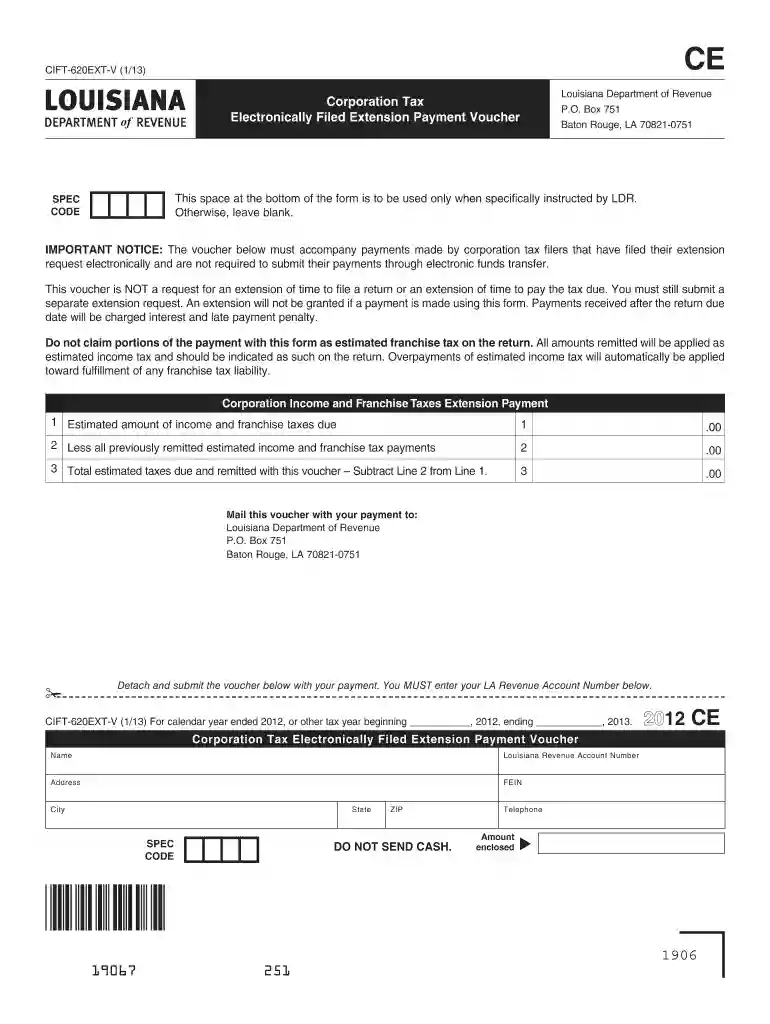
Form 620EXT for LA 2012 is a Corporation Tax Electronically Filed Extension Payment Voucher provided by the Louisiana Department of Revenue. It is specifically designed for corporations that have electronically filed a request for an extension to submit their corporate tax returns. This form facilitates the payment of estimated taxes, ensuring compliance with state tax obligations while allowing businesses additional time to complete and file their tax returns.
To effectively use Form 620EXT for LA 2012, corporations must follow a series of steps to ensure correct and timely payment of estimated taxes. First, businesses should review their tax records to accurately calculate the estimated taxes owed. Afterward, the form should be completed with the required details, such as the corporation's name, Louisiana Revenue Account Number, and the total estimated tax payment. This voucher then accompanies the payment, submitted by mail or through approved electronic payment platforms.
This form is primarily used by corporations operating within Louisiana that require an extension on filing their corporate income tax returns. It is particularly beneficial for businesses that need additional time to reconcile their financial records but still intend to adhere to their tax payment deadlines. Companies that anticipate complex tax filings or those experiencing unanticipated delays in paperwork preparation often utilize this form.


Businesses completing this form must adhere to Louisiana-specific tax regulations, which outline the requirements for estimated tax payments and filing extensions. It's crucial for companies to understand that submitting Form 620EXT is not a request for an extension of time to pay the tax due but rather a voucher indicating payment during the granted filing extension period.
Failing to submit the Form 620EXT or the corresponding estimated tax payment on time can result in penalties. These may include interest charges on unpaid taxes and additional late fees. Corporations must be vigilant in adhering to deadlines and ensuring accuracy in their tax documents to avoid costly non-compliance penalties.
The deadline for submitting Form 620EXT and the estimated tax payment generally aligns with the original tax return due date. However, businesses requesting an extension must ensure their payments are made by this date to avoid penalties. Typically, the deadline falls on the 15th day following the close of the corporation's tax year, but exact dates can vary based on business fiscal schedules and state guidelines.
We've got more versions of the form 620ext for la 2012 form. Select the right form 620ext for la 2012 version from the list and start editing it straight away!
At DocHub, your data security is our priority. We follow HIPAA, SOC2, GDPR, and other standards, so you can work on your documents with confidence.
CIFT-620EXT (1/12) For calendar year ended 2011, or other tax year beginning , 2011, ending , 2012. 11 CE. Louisiana Application for Extension of
Jun 29, 1973 Brief Description. Page. Play acey-ducey with the computer. 13. Computer constructs a maze. 15. Computer guesses animals and learns new


