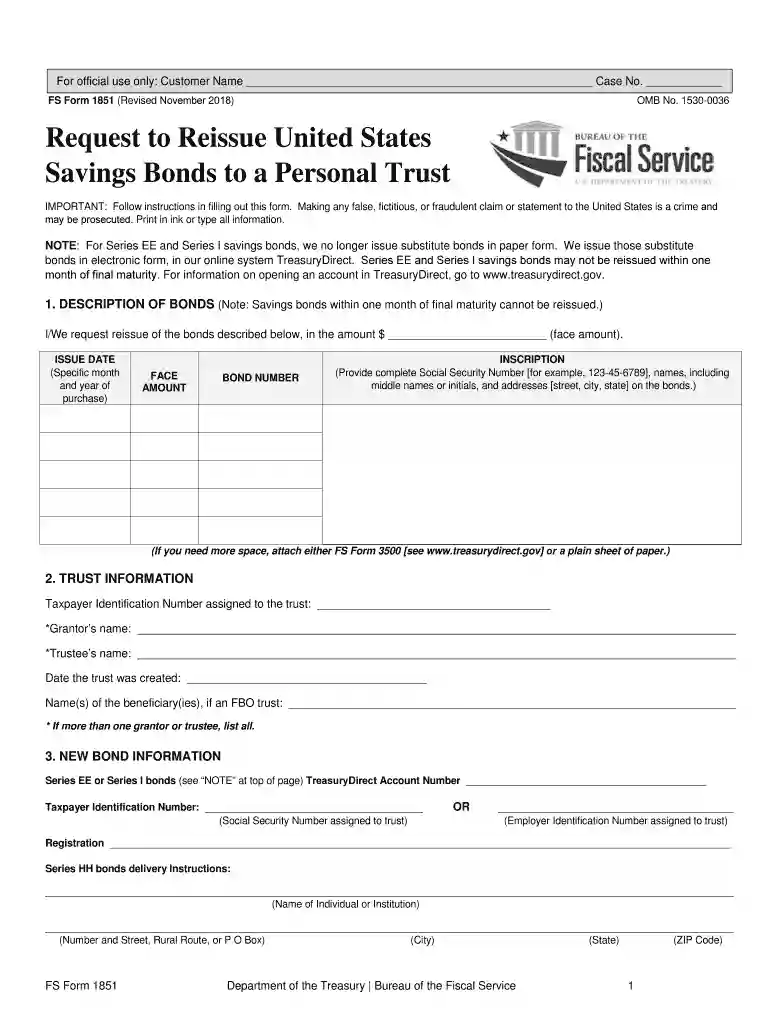
FS Form 1851 (Revised November 2018)-2026

Get Form
FS Form 1851 (Revised November 2018) Preview on Page 1

Here's how it works

01. Edit your form online
Type text, add images, blackout confidential details, add comments, highlights and more.

02. Sign it in a few clicks
Draw your signature, type it, upload its image, or use your mobile device as a signature pad.

03. Share your form with others
Send it via email, link, or fax. You can also download it, export it or print it out.

Definition & Meaning

FS Form 1851 (Revised November 2018) is an official document used to request the reissuance of United States Savings Bonds to a personal trust. This form is integral in managing how savings bonds are handled when they need to be transferred into a trust. It ensures that the process meets legal standards and accurately reflects the parties involved. The form gathers comprehensive information, including details about bonds, trust structures, and pertinent tax liabilities. It is designed to facilitate a clear and legally compliant transfer of bond ownership into a trust arrangement, safeguarding both the original owner and the new trustee.

Key Elements of the FS Form 1851

  • Bond Details: The form requires detailed information about the bonds, including their serial numbers and current value. This information helps verify the bonds in question and is essential for processing the reissuance.
  • Trust Information: The form collects detailed data about the trust to ensure it aligns with legal standards and qualifies as a valid recipient for the bonds.
  • Tax Liability Notices: Information regarding potential tax liabilities is specified, providing the trustee and original bondholder with necessary tax information.
  • Signatures: All involved parties, including the bondholder and trustee, must provide signatures to validate the form and agree to the terms of transfer.

Steps to Complete the FS Form 1851

  1. Gather Required Information: Before filling out the form, collect all necessary bond details, trust documentation, and identification for all parties involved.
  2. Fill Out Personal and Bond Information: Accurately enter details about the bondholder, trust, and bonds. Ensure serial numbers and personal information are correct to avoid processing delays.
  3. Detail Tax Information: Include any relevant tax-related information as necessary to provide a complete view of potential liabilities.
  4. Obtain Required Signatures: The bondholder and trustee must sign the form to complete the reissuance process.
  5. Review and Submit: Double-check all entered information for accuracy and completeness before submission. Depending on the method chosen, file the form either via mail or electronically, following the appropriate guidelines.

How to Obtain the FS Form 1851

FS Form 1851 can be obtained from the U.S. Department of the Treasury’s website or directly from financial institutions that deal with U.S. Savings Bonds. Many institutions offer guidance on accessing and filling out this form, especially for customers looking to establish personal trusts. Alternatively, contact bond customer service desks for assistance and potential mailing of physical copies when needed.

Who Typically Uses the FS Form 1851

Individuals who wish to transfer ownership of their U.S. Savings Bonds to a personal trust primarily use this form. This group often includes estate planners, lawyers, and financial advisors who manage estate transitions involving family members or organizations. Trustees and financial institutions active in bond management utilize it to ensure compliance and accuracy during the reissue process.


decoration image ratings of Dochub

Legal Use of the FS Form 1851

FS Form 1851 is legally binding and meant for those intending to legally transfer U.S. Savings Bonds into a personal trust. As a government-issued document, it adheres to federal laws and Treasury guidelines to prevent misuse. The form ensures that all parties acknowledge trust terms and adhere to regulations regarding the bond's reissuance process.

Important Terms Related to FS Form 1851

  • Beneficiary: The individual or group designated to receive bond benefits once transferred to a trust.
  • Trustee: The appointed person or entity responsible for managing the trust’s assets, including savings bonds.
  • Serial Number: A unique identification number crucial for documenting specific U.S. Savings Bonds on the form.
  • Reissuance: The process through which bonds are formally transferred into a new ownership format, such as a trust.

Form Submission Methods

FS Form 1851 offers several submission methods:

  • Mail: Completed forms with accompanying documentation can be mailed to the U.S. Department of the Treasury, Bureau of the Fiscal Service.
  • Online: Some financial institutions provide digital platforms to fill out and submit the form electronically, enhancing convenience and reducing processing times.
  • In-Person: Support may be offered by certain financial institutions that manage U.S. Savings Bonds directly, allowing for in-person assistance and submission.

Penalties for Non-Compliance

Failure to submit the correctly completed FS Form 1851 can result in procedural delays or rejection of the reissuance request. Inaccurate information, missing signatures, or non-disclosure of tax implications may lead to legal repercussions and the potential for bonds not being reissued to the intended trust. Ensuring precise and complete submission safeguards against such issues.

Required Documents

  • Original Bond Certificates: If available, to verify the bonds in question.
  • Trust Documents: Legal paperwork showing the legitimacy and details of the trust.
  • Identification: Valid ID for bondholders and trustees to affirm identities and consent.
  • Tax Identification Numbers: For bonds involving multiple parties or trusts, ensuring tax obligations are clear and manageable.

The comprehensive completion of FS Form 1851 with these elements guarantees the successful reissuance of Savings Bonds into trusts, aligning with federal guidelines and protecting interests involved.

See more FS Form 1851 (Revised November 2018) versions

We've got more versions of the FS Form 1851 (Revised November 2018) form. Select the right FS Form 1851 (Revised November 2018) version from the list and start editing it straight away!
Versions Form popularity Fillable & printable
2021 4.8 Satisfied (238 Votes)
2020 4.8 Satisfied (204 Votes)
2019 4.4 Satisfied (147 Votes)
2018 4.4 Satisfied (20 Votes)
2015 4 Satisfied (22 Votes)
2014 4.4 Satisfied (235 Votes)
be ready to get more

Complete this form in 5 minutes or less

Get form

Got questions?

We have answers to the most popular questions from our customers. If you can't find an answer to your question, please contact us.
Contact us
EE bonds are guaranteed to double in value after 20 years. You can hold beyond that, to 30 years, but the interest rate for that last stretch is really a pittance, generally. Without greater specifics, I would probably say its worth selling all your 20+ year old bonds and reinvesting.
Maturity dates for Series EE bonds At 20 years, the government ensures that you will be paid double the face value of the bond. Although they technically mature after 20 years, these bonds actually dont expire for 30 years. Youll keep earning interest for an extra decade.
EE bonds are guaranteed to double in value after 20 years.
Upon the death of the owner, the security becomes the property of the surviving beneficiary, despite any attempted testamentary disposition or any applicable local law to the contrary. (v) If the beneficiary does not survive the owner, the security belongs to the estate of the owner.
A Series EE Savings bond could be a good investment if youre looking for something thats long term and low risk, since its backed by the Treasury and is guaranteed to double its value in 20 years.

Security and compliance

At DocHub, your data security is our priority. We follow HIPAA, SOC2, GDPR, and other standards, so you can work on your documents with confidence.

Learn more
ccpa2
pci-dss
gdpr-compliance
hipaa
soc-compliance

People also ask

If you cashed series EE or I U.S. savings bonds this year that were issued after 1989, you may be able to exclude from your income part or all of the interest on those bonds. Use Form 8815 to figure the amount of any interest you may exclude.

Related links