




01. Edit your form online
Type text, add images, blackout confidential details, add comments, highlights and more.

Type text, add images, blackout confidential details, add comments, highlights and more.

Draw your signature, type it, upload its image, or use your mobile device as a signature pad.

Send it via email, link, or fax. You can also download it, export it or print it out.
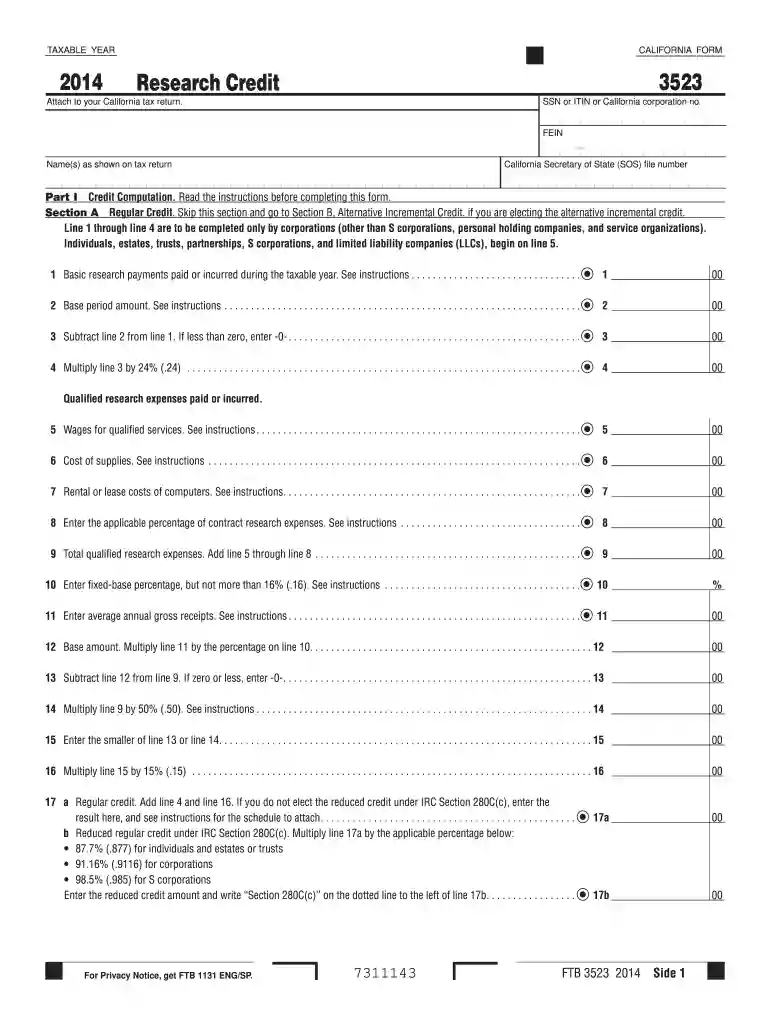
Form FTB 3523, known as California's Research Credit form, is crucial for businesses aiming to claim tax credits for increasing research activities within the state. This form assists in computing and claiming credits, thereby reducing the overall tax liability. It is pertinent for entities engaging in scientific research and experimentation to understand and correctly utilize this form to maximize tax benefits.
The form includes sections for calculating both Regular Credit and Alternative Incremental Credit. Taxpayers must accurately document eligible research expenditures and personnel costs associated with development work. It's also essential to understand this form's guidelines on how credits are shared among different business entities and partners, ensuring compliance and maximizing credit claims.
Collect Financial Data: Begin by gathering all financial documents detailing research-related expenses over the fiscal year. This includes wages, supplies, and contracted research costs.
Calculate Qualified Expenses: Use the form to compute the total qualified research expenditures. Ensure you include all eligible costs that comply with California’s tax code.
Fill Out Regular and Incremental Credit Sections: Enter the calculated figures into the appropriate sections to determine the credit amount claimable under both the Regular and Alternative Incremental Credit systems.
Report Pass-Through Credits: If applicable, report credits received through partnerships, S corporations, or other pass-through entities. This helps prevent errors in credit allocation.
Review and Submit: Double-check the entire form for accuracy before submission to avoid any errors that could lead to penalties or the disallowance of the credit.
Primarily, the form is used by corporations, partnerships, and individual business owners engaged in research and development within California. This includes both large-scale enterprises and smaller tech startups seeking tax relief from eligible research activities, aimed at fostering innovation and development.


To claim the research credit via the FTB 3523, the research must meet specific criteria:

Complying with legal standards is vital when filing the FTB 3523. Businesses must ensure that all documented research activities are applicable under California law. Failure to comply can result in penalties or disqualifications from receiving credits. Legal diligence involves maintaining accurate records and substantiation of claimed research activities and expenses.
Timing is crucial when submitting the FTB 3523 form. While the general deadline aligns with corporate and individual tax deadlines, businesses must ensure all forms are complete and submitted by the prescribed date to claim eligible credits for that tax year.
Non-compliance, whether through inaccurate reporting or missing deadlines, carries potential penalties. These can include fines and interest on unpaid taxes and the forfeiture of claimed credits. It is imperative for businesses to stay informed of compliance requirements and maintain thorough record-keeping.
Businesses can choose between filing digitally or using the traditional paper method. Digital filing is encouraged for its efficiency and ease of real-time tracking. It integrates with tax software like TurboTax or QuickBooks, facilitating a smoother process. However, companies must ensure all digital records are securely stored and backed up.
Organizations can leverage the form to claim credits across various scenarios:
These detailed sections provide a thorough insight into the 2014 California Form FTB 3523, ensuring that businesses and entities involved in research can adeptly navigate the complexities and requirements of this essential tax form.
We've got more versions of the 3523 2014 form form. Select the right 3523 2014 form version from the list and start editing it straight away!
| Versions | Form popularity | Fillable & printable |
|---|---|---|
| 2025 | 4.9 Satisfied (20 Votes) | |
| 2023 | 4.6 Satisfied (54 Votes) | |
| 2022 | 4.7 Satisfied (58 Votes) | |
| 2021 | 4.9 Satisfied (37 Votes) | |
| 2020 | 4.4 Satisfied (182 Votes) | |
| 2019 | 4.3 Satisfied (225 Votes) | |
| 2018 | 4.4 Satisfied (180 Votes) | |
| 2017 | 4.2 Satisfied (53 Votes) | |
| 2016 | 4.2 Satisfied (74 Votes) | |
| 2015 | 4 Satisfied (26 Votes) | |
| 2014 | 4.2 Satisfied (63 Votes) | |
| 2013 | 4 Satisfied (49 Votes) | |
| 2012 | 3.8 Satisfied (39 Votes) | |
| 2011 | 4 Satisfied (20 Votes) |
At DocHub, your data security is our priority. We follow HIPAA, SOC2, GDPR, and other standards, so you can work on your documents with confidence.
Form 5000-3522, Revised March 2014; Provider Agency Self-Certification, AHCA Form 5000-3523, Revised March 2014. These forms are available by photocopying
May 20, 2025 To require the Secretary of the Treasury to designate certain covered organi- zations as Foreign Financial Threat Organizations, and for other


