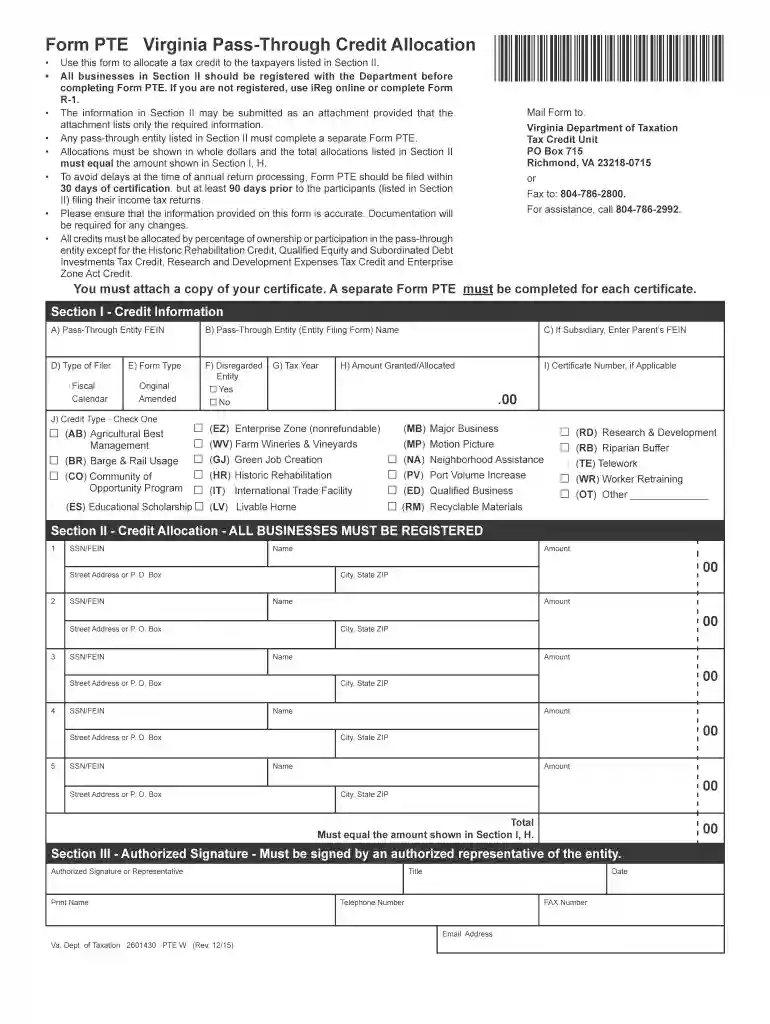
Definition and Meaning
The "VA PTE 2015 Form" stands for the Virginia Pass-Through Entity Tax Return form used in 2015. This document is essential for business entities structured as partnerships, S corporations, or limited liability companies that elect to pass income, deductions, credits, and other tax items to their owners or members. These entities are collectively known as pass-through entities because their income is passed directly to the owners and taxed at their individual rates, rather than at the corporate level. The form mandates recording how income, credits, and deductions are allocated among members, ensuring individual taxpayers report these correctly on their returns.
How to Obtain the VA PTE 2015 Form
Obtaining the VA PTE 2015 form can be accomplished through several methods:
- Virginia Department of Taxation Website: This is the primary source to access historical forms. Simply navigate to the section that archives prior year tax forms.
- Tax Software: Programs like TurboTax or QuickBooks may store past versions of state tax forms within their archives for user convenience.
- Professional Tax Preparers: Engaging a professional accountant or tax preparer who deals with Virginia taxes can also provide access to the form.
Steps to Complete the VA PTE 2015 Form
Completing the VA PTE 2015 form involves several detailed steps:
-
Entity Information:
- Enter the legal name and the entity's federal employer identification number (FEIN).
- Specify the type of entity (e.g., partnership, S corporation).
-
Income Allocation:
- Report the total Virginia-sourced income for the entity.
- Detail how the income is to be allocated among members based on ownership percentages. Allocations should match the Schedule K-1 issued to each member.
-
Deductions and Credits:
- Deduct applicable expenses from the gross income.
- Include any available state-specific tax credits, ensuring accurate reporting on member allocations.
-
Member Information:
- List members with their tax identification numbers and allocated share of income.
-
Submission:
- Verify, sign, and date the form before submission.
Key Elements of the VA PTE 2015 Form
Several elements are central to the VA PTE 2015 form:
- Income Summary: Comprehensive breakdown of all income directly linked to Virginia activities.
- Credit Allocation Section: Part of the form where you note credits against tax for each member.
- Entity Type Information: This helps to determine applicable tax treatments and rates.
- Final Calculations: Total tax liabilities or overpayments are calculated using this data.
State-Specific Rules for the VA PTE 2015 Form
Virginia implements specific rules for completing the PTE form:
- Thresholds: Entities must meet income thresholds to necessitate filing.
- Apportionment: Virginia requires income to be apportioned based on a formulary method determined by the location of the business's economic activity.
- Tax Credit Applications: Certain Virginia-based credits can only offset specific taxes and require documentation.
Important Terms Related to the VA PTE 2015 Form
Understanding the following terms aids in accurately handling the form:
- Pass-Through Entity: A business structure that passes income directly to owners, bypassing corporate tax.
- Apportionment Factor: A ratio determining the portion of income attributable to Virginia.
- Schedule K-1: Document detailing each member's share of income, deductions, and credits.
Legal Use of the VA PTE 2015 Form
The legal framework for the VA PTE 2015 form includes:
- Filing Requirements: Mandated annual filing for entities with income sourced in Virginia.
- Accuracy and Penalties: Omissions or misinformation can lead to penalties, emphasizing the importance of precision.
- Member Disclosure: Requirement to disclose all members receiving income allocations.
Penalties for Non-Compliance
Failing to comply with the rules of the VA PTE form can result in:
- Financial Penalties: Penalties calculated relative to unpaid taxes and delays in filing.
- Interest Charges: Accumulated interest on overdue amounts compounding daily.
- Audits: Potential for increased scrutiny from the Virginia Department of Taxation, necessitating meticulous record-keeping.
Who Typically Uses the VA PTE 2015 Form
Businesses using this form include:
- Partnerships: Firms where income is split based on agreed-upon ownership percentages.
- S Corporations: Entities electing subchapter S status to avoid double taxation.
- Limited Liability Companies (LLCs): Those treated as pass-through for tax purposes.
Each type presents unique challenges and advantages when completing the form, reflecting the diversity of business structures in Virginia.

Why You Should Use the VA PTE 2015 Form
Using the VA PTE 2015 form is critical for eligible entities to:
- Comply with State Requirements: Ensures all income is taxed correctly at the state level.
- Leverage Tax Credits: Proper filing allows for the allocation and utilization of state credits, reducing overall tax burden.
- Provide Clear Member Accounts: Offers members clarity on their income for personal tax filings.