Definition & Meaning
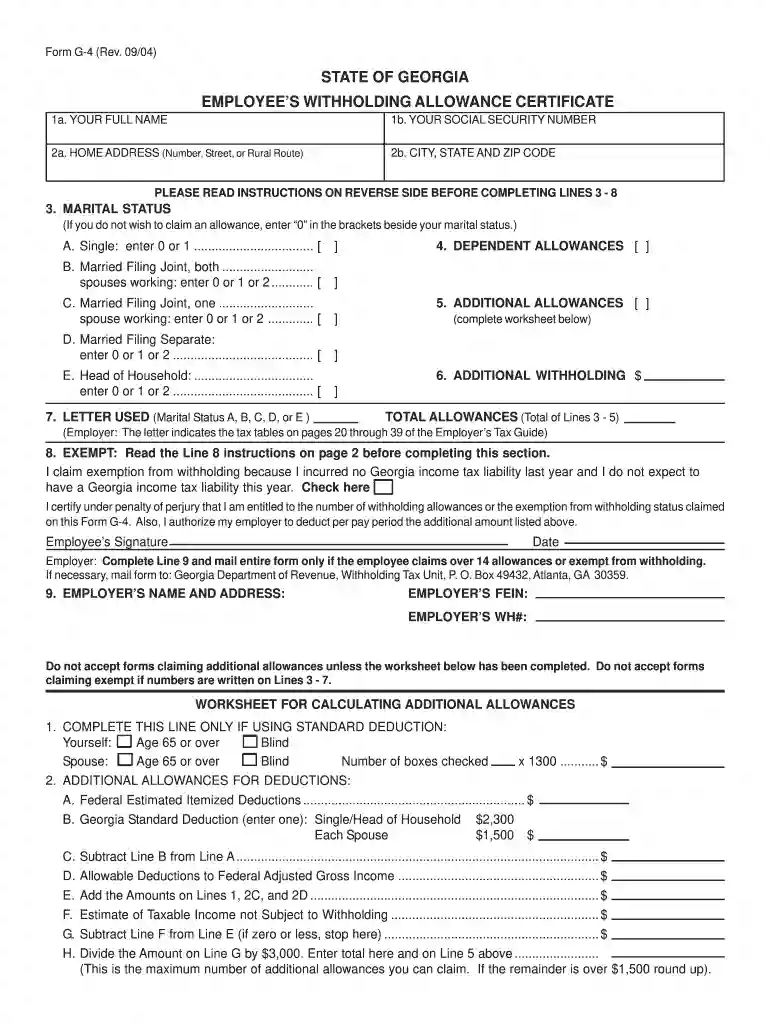
The "State of Georgia Employee Withholding Marital Status 0 2004 Form," commonly referred to as Form G-4, Employee's Withholding Allowance Certificate, is a state tax document used in Georgia. This form allows employees to declare their withholding allowances, which include factors such as marital status and number of dependents, directly influencing the amount of state income tax withheld from their paychecks. Understanding this form is essential for managing personal finances, as it ensures the correct amount of tax is withheld based on personal circumstances.
Key Elements of the Form
Form G-4 comprises several critical components that employees must complete accurately to reflect their tax situation:
- Personal Information: Includes the employee's name, address, and Social Security number, providing a unique identifier.
- Marital Status Declaration: A section where employees select their marital status, which impacts withholding calculations.
- Allowances and Exemptions: Offers space to claim allowances and express qualifications for exemptions due to factors like income thresholds or dependents.
- Signature and Date: The employee’s signature signifies agreement and accuracy of the provided information, with the date indicating when the form was completed.
Steps to Complete the Form
Filing the Form G-4 involves a series of straightforward steps to ensure accuracy and compliance:
- Gather Necessary Information: Before completing the form, gather personal details, Social Security number, and financial information relevant to dependents and income.
- Enter Personal Details: Fill out all basic personal identification fields to ensure accurate processing.
- Declare Marital Status: Select the appropriate marital status. Each status affects withholding amounts differently, thus accuracy here is vital.
- Calculate Allowances: Use the worksheet included on the form, if available, to determine the correct number of allowances.
- Sign and Date: Ensure the form is signed and dated to validate the information provided.
- Submit to Employer: Once completed and verified, submit the form to your employer for processing.
How to Obtain the Form
Obtaining Form G-4 is simple and can be done through various channels:
- Online Access: The form can be downloaded directly from the Georgia Department of Revenue’s website, providing a convenient and immediate option.
- Employer: Employers often have physical copies or access to digital versions of the form, making it easy for employees to complete during onboarding.
- Tax Professionals: Accountants or tax advisors may also provide the form as part of their services to ensure proper setup of withholding preferences.
Important Terms Related to the Form
Understanding key terms related to the State of Georgia Employee Withholding Form is crucial for correct completion:
- Withholding Allowance: A number reflecting personal and financial situations, influencing tax withholding.
- Exemption: A condition that allows an employee to opt-out of withholding under specific criteria, such as low income.
- Dependent: A qualifying individual who relies on the taxpayer financially, affecting the number of allowances claimed.
- Marital Status: An individual's current relationship status, crucial in determining withholding amounts.
Who Typically Uses the Form
Form G-4 is widely used across different employee types in Georgia:

- New Employees: Upon starting a new job, this form is essential for establishing initial withholding preferences.
- Employees Experiencing Life Changes: Those experiencing life events such as marriage, divorce, or the birth of a child should reevaluate and potentially adjust their withholding allowances.
- Individuals Seeing Financial Changes: Alterations in financial status, such as significant raises or job changes, may also warrant an update to this form.
State-Specific Rules for the Form
Georgia has specific guidelines that govern the completion and submission of Form G-4:
- Mandatory Updates: Employees are required to update the form whenever there is a significant life event or financial change affecting their withholding.
- Employer Obligations: Employers must submit these forms to the Georgia Department of Revenue when specific conditions are met, such as withholding exemptions.
- Review Periods: Regular review of withholding preferences is encouraged by the state to avoid under or over withholding.
Legal Use of the Form
The legal implications of Form G-4 ensure compliance and accurate tax contributions:
- Compliance: Completing the form accurately is a legal obligation to ensure the correct amount of tax is withheld from paychecks.
- Honest Representation: Employees must provide truthful and up-to-date information to avoid penalties related to tax underpayment or fraud.
- Documentation: Storing completed forms is vital for both employees and employers, serving as proof of compliance in cases of auditing or disputes.
Examples of Using the Form
Utilizing Form G-4 effectively requires understanding practical scenarios:
- New Hire Scenario: A new employee selects "married" on the form and calculates their allowances to accurately represent their partner and children, ensuring appropriate withholding.
- Life Change Example: After a divorce, an employee updates their marital status on Form G-4 to adjust their withholding to reflect a change to "single."
- Income Increase Case: An individual receiving a significant salary raise decides to adjust the number of allowances claimed, maintaining correct withholding to prevent unexpected year-end balances.
By integrating these detailed explorations, individuals and businesses can fully comprehend the complexities of the State of Georgia Employee Withholding Marital Status 0 2004 Form and its implications on state taxation.