







Definition & Meaning
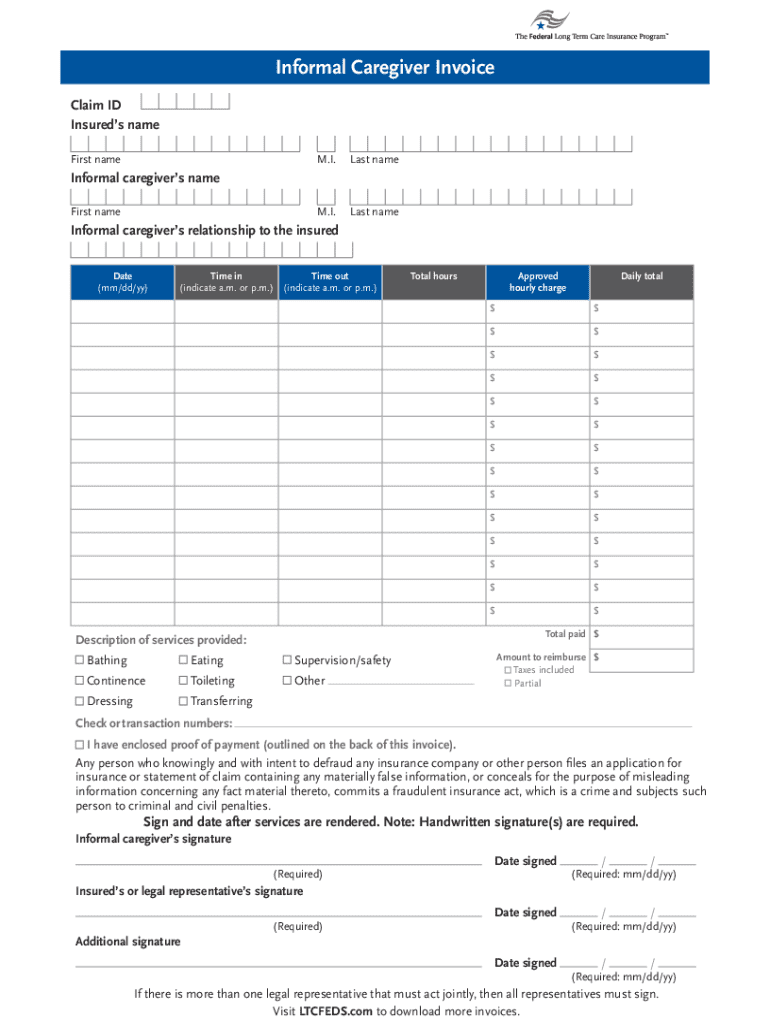
The Informal Caregiver Invoice is a document used by caregivers who provide non-professional or informal caregiving services to insured individuals. It serves as a formal record that details the reimbursement process for services rendered, including the dates of service, hours worked, and proof of payment requirements. This form is particularly important in instances where both the caregiver and the insured, or their legal representative, need to authenticate the services provided through signatures and necessary documentation.
Importance of Accurate Documentation
- Caregiving fees are typically paid by the person being cared for or their insurance provider. An accurate invoice provides clarity on services rendered.
- Proper documentation aids in avoiding disputes over services provided or payments made.
- The invoice can be used as supporting documentation for tax purposes, ensuring compliance with any relevant IRS regulations.
Key Elements of the Informal Caregiver Invoice
The invoice includes several critical elements that must be completed with care:
- Caregiver and Insured's Details: Full names, addresses, and contact information of both parties.
- Service Dates and Hours: Specific dates on which services were provided along with the total hours worked on each date.
- Description of Services: A clear and detailed summary of the types of care provided.
- Proof of Payment Requirements: Outline of acceptable documents that verify payment has been made, such as receipts or bank statements.
- Signatures: Required fields for both caregiver and the insured or their legal representative to validate the information.
Providing Proof of Payment
- Ensure that documents provided as proof are clear and legible.
- Common forms of proof include canceled checks, electronic payment records, or signed receipts.
- Additional documentation, such as a copy of the service contract, may be beneficial in establishing the terms of the caregiving services.
Steps to Complete the Informal Caregiver Invoice
Completing the invoice accurately is crucial for reimbursement:
- Collect Personal Details: Gather necessary information from both the caregiver and the client.
- Record Service Dates and Hours: Log each date alongside the number of hours worked.
- Detail Services Provided: Clearly describe the tasks performed during each session.
- Compile Proof of Payment: Gather receipts and other necessary documents.
- Sign and Date: Ensure both caregiver and the client or their representative sign the invoice.
Tips for Completing the Form
- Double-check all personal information for accuracy.
- Maintain copies of all documentation provided in the form.
- Review local regulations or insurance policy stipulations that could impact how the form should be completed.
Important Terms Related to the Informal Caregiver Invoice
Understanding certain terms associated with this form is beneficial:
- Insured Individual: The person receiving caregiving services under an insurance policy.
- Caregiving Services: Activities related to assisting with daily living, such as meal preparation, cleaning, or companionship.
- Legal Representative: An individual legally designated to act on behalf of the insured for signing and giving approvals.
- Reimbursement Policy: Insurance or payment policy allowing for the repayment of services provided.
Impact of Understanding These Terms
- Facilitates smoother communication between the insured and the caregiver.
- Ensures compliance with legal obligations and insurance requirements.
Legal Use of the Informal Caregiver Invoice
The use of the invoice must comply with legal guidelines:
- Signatures: Both parties must sign for the document to be considered valid.
- Data Privacy: Ensure that personal information is handled in compliance with privacy laws.
- Documentation Standards: Follow any state-specific documentation and retention guidelines.
State-Specific Regulations
- Regulations may vary by state; check local laws to ensure compliance.
- Some states may require additional documentation or specific formatting for invoices.
Who Typically Uses the Informal Caregiver Invoice
This invoice is commonly used by:
- Informal Caregivers: Individuals providing care to family members or friends without professional qualifications.
- Insured Persons: Individuals who require informal caregiving services and seek reimbursement through insurance.
- Legal Representatives: Persons acting on behalf of insured individuals, often requiring detailed documentation for insurance claims.


Scenarios of Common Use
- Caregivers documenting services for elderly parents.
- Individuals with disabilities needing routine non-medical assistance.
- Low-income families receiving state aid that requires service documentation.
Examples of Using the Informal Caregiver Invoice
Examples of practical scenarios:
- Family Care: A daughter caring for her elderly mother utilizes the invoice for reimbursement through Medicaid.
- Post-Surgery Care: An informal caregiver helps a family friend during recovery, ensuring all service dates and activities are recorded.
- Disability Support: An individual with a disability receives routine assistance documented with this form for insurance claims.
Case Study: Successful Reimbursement
- A caregiver accurately documenting services provided during each visit for a monthly submission to their insurance provider, receiving predictable and timely reimbursements.
State-Specific Rules for the Informal Caregiver Invoice
State laws and regulations can shape how one uses the caregiver invoice:
- Documentation Requirements: Some states may require notarization or specific forms.
- Reimbursement Policies: Variation exists in what services are reimbursable under state aid programs.
- Signature Requirements: Different states have varying stipulations for who can act as a legal representative.
Navigating State Differences
- Research each state’s Department of Health or Social Services website for current regulations.
- Consult with a lawyer or a service agency for legal interpretations specific to your state.




