




01. Edit your form online
Type text, add images, blackout confidential details, add comments, highlights and more.

Type text, add images, blackout confidential details, add comments, highlights and more.

Draw your signature, type it, upload its image, or use your mobile device as a signature pad.

Send it via email, link, or fax. You can also download it, export it or print it out.
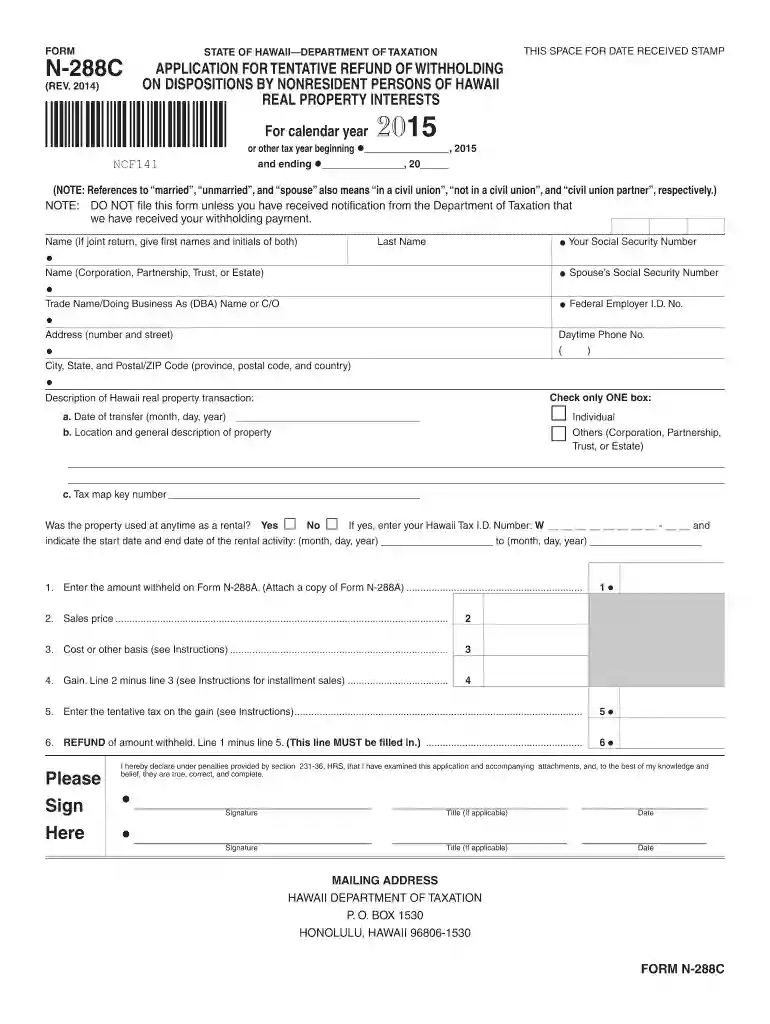
Form N-288C, also known as the Hawaii Tentative Refund Application for Withholding on Dispositions by Nonresident Persons of Hawaii Real Property Interests, is a tax document used to request a refund of excess withholding tax. This form is pertinent when the amount withheld from the sale of a Hawaii real property interest by a nonresident exceeds their actual tax liability. It's a crucial document for nonresident individuals or entities involved in such transactions, ensuring fair taxation.
The 2015 version of Form N-288C is utilized by nonresident taxpayers to apply for a tentative refund. To use this form effectively, you should:
Accuracy is essential in filling out the form to avoid processing delays or rejection.
Completing the Hawaii Form N-288C requires careful adherence to steps to ensure precision:
Proper adherence to each step is vital for the smooth processing of your refund request.
Nonresident individuals and entities engaging in the sale of Hawaii real property interests typically use Form N-288C. This includes:
The form is essential for ensuring equitable tax treatment during such real estate transactions.


Understanding key terminology is essential when dealing with Form N-288C:
Familiarity with these terms ensures better comprehension and accuracy in form completion.
Form N-288C must be used in compliance with Hawaii tax regulations. It is strictly for applying for a refund of excess withholding taxes.
Using the form within these legal boundaries guarantees a smoother process and the avoidance of legal complications.
Several elements are crucial to the successful completion and submission of Form N-288C:
Each element must be thoroughly validated to ensure compliance and efficiency.
Adhering to deadlines ensures the efficient processing of Form N-288C:
Accurate tracking of these dates aids in mitigating the risks of late filings or penalties.
We've got more versions of the hawaii form n 288c 2015 form. Select the right hawaii form n 288c 2015 version from the list and start editing it straight away!
| Versions | Form popularity | Fillable & printable |
|---|---|---|
| 2025 | 4.8 Satisfied (44 Votes) | |
| 2024 | 4.2 Satisfied (44 Votes) | |
| 2022 | 4.5 Satisfied (39 Votes) | |
| 2020 | 4.8 Satisfied (127 Votes) | |
| 2019 | 3.9 Satisfied (32 Votes) | |
| 2018 | 4.3 Satisfied (133 Votes) | |
| 2017 | 4.2 Satisfied (61 Votes) | |
| 2016 | 4.4 Satisfied (186 Votes) | |
| 2015 | 4.4 Satisfied (66 Votes) | |
| 2014 | 4.2 Satisfied (65 Votes) | |
| 2013 | 3.9 Satisfied (36 Votes) | |
| 2012 | 4 Satisfied (54 Votes) |
At DocHub, your data security is our priority. We follow HIPAA, SOC2, GDPR, and other standards, so you can work on your documents with confidence.
by R Stirling 2015 Cited by 20 Wood-consumption rate and the survival of the Formosan subterranean termite (Isoptera: Rhinotermi- tidae) when fed one of six woods used commercially in Hawaii.Read more
N-288C Application for Tentative Refund of Withholding on Dispositions by Nonresident Persons of Hawaii Real Property Interests Link to Hawaii Tax


