




01. Edit your form online
Type text, add images, blackout confidential details, add comments, highlights and more.

Type text, add images, blackout confidential details, add comments, highlights and more.

Draw your signature, type it, upload its image, or use your mobile device as a signature pad.

Send it via email, link, or fax. You can also download it, export it or print it out.
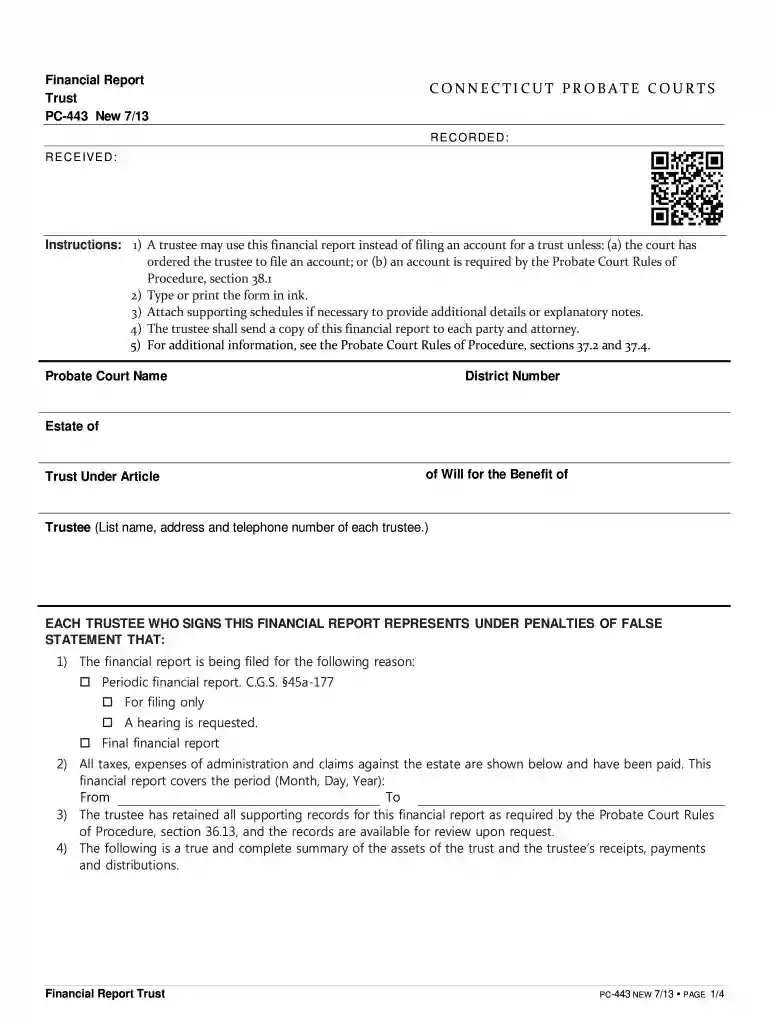
The PC-243AR form is a specific financial report used by trustees within the Connecticut probate courts system. This document serves the critical function of allowing trustees to provide detailed accounts of a trust's assets, income, expenses, and distributions. The form offers an alternative to a full accounting, streamlining the process for reporting financial activities related to a trust. Trustees are required to sign the form, certifying the accuracy of the reported information. This form is essential for ensuring transparency and accountability in the management of trust funds.
Utilizing the PC-243AR form involves a clear understanding of its layout and required information. Trustees must diligently complete each section, documenting all pertinent financial details. This process typically includes outlining the beginning and ending balances of the trust, itemizing income received during the accounting period, and listing both ordinary and extraordinary expenditures. Special attention should be paid to accurately report distributions made to beneficiaries. Before submission, trustees must ensure all sections are completed with precision to avoid the need for corrections or additional oversight by the probate court.
The PC-243AR comprises various critical sections that trustees must complete:
Each element must be completed with utmost detail to ensure the form fulfills its intended purpose.
This form is primarily utilized by trustees managing trusts within Connecticut's probate system. It's typically employed in situations where the trustee must account for the financial management of the trust, often annually or at the request of the court or beneficiaries. Additionally, legal professionals, such as estate attorneys, who assist trustees with their fiduciary responsibilities may also leverage this form in their practice to ensure compliance with state probate laws.


The PC-243AR is a legally binding document that serves as part of the official record-keeping required by the Connecticut probate courts. Its use is governed by state laws that dictate how and when trustees must report on the financial activities of the trusts they manage. Proper use of the form ensures compliance with these laws, thereby protecting the interests of all trust stakeholders, including beneficiaries and the courts.
Connecticut imposes specific rules regarding the completion and submission of the PC-243AR. Trustees must adhere to these rules to ensure their reports are accepted without issue:
It is also recommended to consult with legal counsel familiar with Connecticut probate law to ensure full compliance.
Consider a scenario where a trustee must report a trust's financial activities following the passing of the creator. The PC-243AR is used to systematically record all income, such as rental income from trust-owned property, and detail expenses like property taxes. Another example includes corrections required in reporting distributions that were inaccurately listed in a previous submission. By completing the form accurately, the trustee demonstrates due diligence to the beneficiaries and the court.
Timing is crucial when dealing with the PC-243AR. Trustees are generally required to submit the form annually, adhering to deadlines established by the probate court. Missing these deadlines can result in penalties or further court action. It is important for trustees to be aware of these timelines and allow sufficient time to gather the necessary documentation and complete the form thoroughly. Always confirm specific filing dates with the Connecticut probate court relevant to your situation.
We've got more versions of the PC-243AR form. Select the right PC-243AR version from the list and start editing it straight away!
At DocHub, your data security is our priority. We follow HIPAA, SOC2, GDPR, and other standards, so you can work on your documents with confidence.
Mar 2, 2026 TETR.IO is a free-to-play online multiplayer and singleplayer game developed by osk. Players can play against friends and foes all over theRead more
This course provides students with an understanding of computer architecture and organization. Topics include machine level representation of data, assembly


