




01. Edit your form online
Type text, add images, blackout confidential details, add comments, highlights and more.

Type text, add images, blackout confidential details, add comments, highlights and more.

Draw your signature, type it, upload its image, or use your mobile device as a signature pad.

Send it via email, link, or fax. You can also download it, export it or print it out.
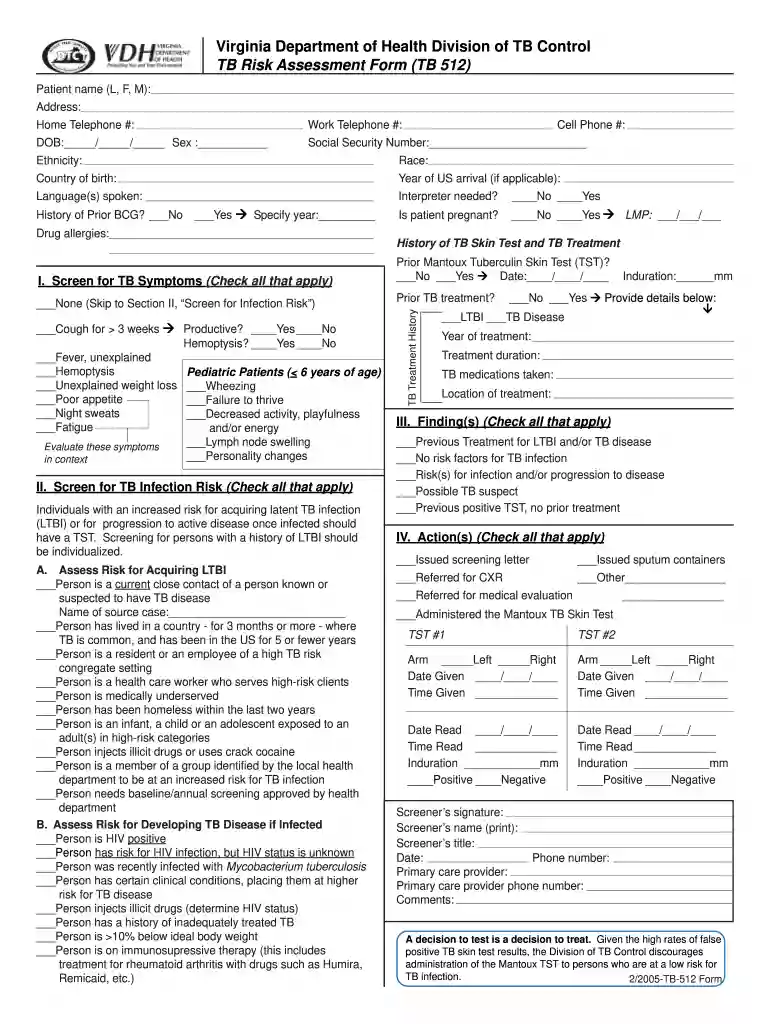
The TB Risk Assessment Form developed by the Virginia Department of Health, also known as TB 512, serves as a crucial tool for evaluating an individual's risk for tuberculosis. This document is structured to gather comprehensive data, enabling healthcare providers to identify symptoms and risk factors associated with TB. The assessment covers personal information, checks for TB symptoms, and screens for latent TB infection (LTBI), directing providers on whether further medical evaluation or testing is required. By focusing on individuals at higher risk for TB, the form aids in effective disease monitoring and management.
Utilizing the TB Risk Assessment Form involves a series of steps designed to capture critical health data and assess TB exposure or symptoms effectively. Healthcare providers must thoroughly review each section, ensuring accurate and complete information collection. The form is divided into various sections, including personal information, symptom questionnaire, and risk factor assessment. Each part must be carefully filled out by the patient under the guidance of a healthcare professional to ensure that all necessary details are documented.
Gather Personal Information: The patient provides basic details such as name, date of birth, and contact information. This section establishes the individual's identity and facilitates future communication.
Symptom Screening: Patients answer questions regarding common TB symptoms, such as persistent cough, weight loss, night sweats, and fever. This screening helps to identify potential signs of active TB infection.
Asses TB Risk Factors: The form includes questions about the patient's travel history, exposure to individuals with TB, and any prior TB infections. This data is essential in evaluating the likelihood of latent TB infection.
Documentation and Review: After completing the form, the healthcare provider reviews the responses to determine if further testing or evaluation is necessary. They may also provide recommendations for TB testing based on the risk assessment.
The TB Risk Assessment Form plays a vital role in early detection and prevention of tuberculosis. By systematically evaluating individuals' symptoms and risk factors, the form helps in pinpointing those who require further medical investigation. This preemptive approach allows healthcare providers to initiate appropriate interventions, thereby curbing the spread of TB and safeguarding public health.
The primary users of the TB Risk Assessment Form are healthcare professionals such as doctors, nurses, and public health officials involved in diagnosing and managing TB. Individuals who might be at increased risk, like those in high-risk occupations or with certain health conditions, would also encounter this form during routine screenings or medical evaluations.


Fulfillment of legal obligations under health regulations necessitates proper usage of the TB Risk Assessment Form. Healthcare providers are required to maintain confidentiality and protect the privacy of patient information during assessment, ensuring compliance with laws such as the Health Insurance Portability and Accountability Act (HIPAA).
In Virginia, specific guidelines govern the use of the TB Risk Assessment Form, aligning with both state and federal health regulations. Local health departments may implement additional requirements or procedures to enhance assessment accuracy and effectiveness. Compliance with these rules is crucial for healthcare providers in order to deliver appropriate patient care and maintain public health standards.
Healthcare providers can access the TB Risk Assessment Form through the Virginia Department of Health's website or local health departments. Electronic formats may be available, facilitating ease of use and integration into digital record-keeping systems. This accessibility ensures that healthcare facilities can keep up with current protocols and maintain consistency in TB risk assessments.
Consider a healthcare clinic conducting routine screenings in a community with high TB prevalence. Using the form, they identify an individual with significant risk factors, such as recent travel to a TB-endemic area and prolonged cough. Based on the assessment, the clinic initiates further testing, leading to early diagnosis and treatment, thereby reducing transmission risk.
We've got more versions of the TB Risk Assessment Form - vdh virginia form. Select the right TB Risk Assessment Form - vdh virginia version from the list and start editing it straight away!
At DocHub, your data security is our priority. We follow HIPAA, SOC2, GDPR, and other standards, so you can work on your documents with confidence.
The TB Risk Assessment Form (TB 512) is a tool to assess and document a patients symptoms and/or risk factors for TB infection. Virginia Department of Health
The TB Risk Assessment Form (TB 512) is a tool to assess and document a patients TB symptoms and/or risk factors.


