




01. Edit your form online
Type text, add images, blackout confidential details, add comments, highlights and more.

Type text, add images, blackout confidential details, add comments, highlights and more.

Draw your signature, type it, upload its image, or use your mobile device as a signature pad.

Send it via email, link, or fax. You can also download it, export it or print it out.
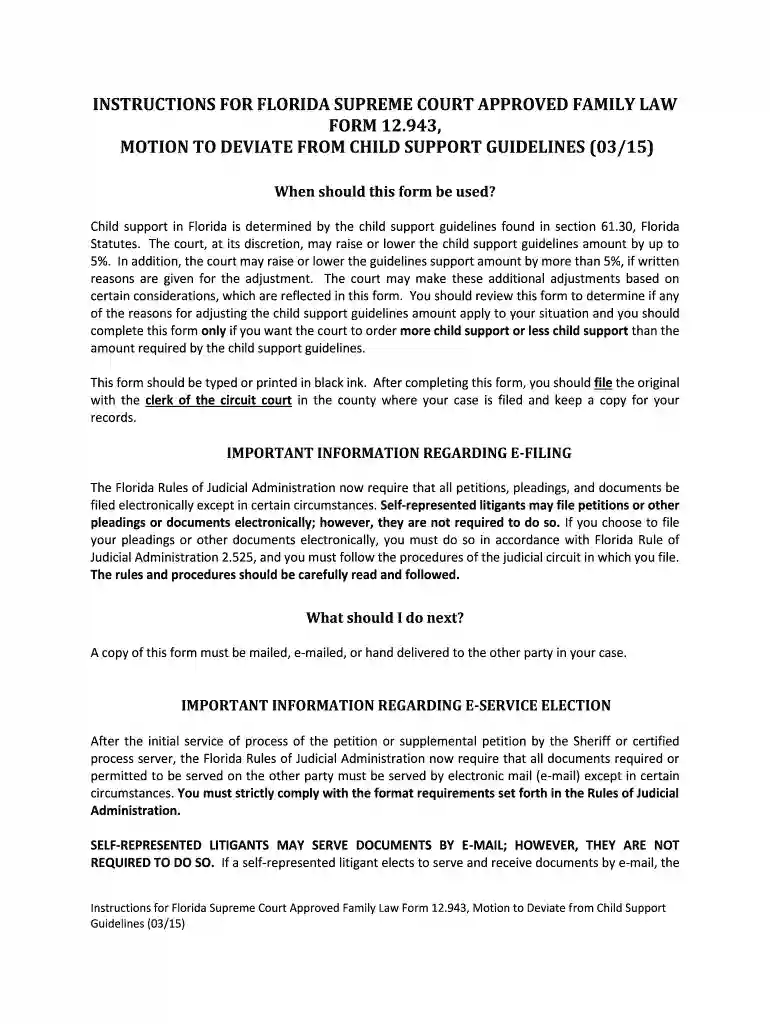
The "Motion to Deviate from Child Support Guidelines" is a formal request submitted to the court, typically within the family law system, to adjust the standard child support obligations as determined by state-mandated guidelines. This motion allows a parent or guardian to seek an increase or decrease in child support payments based on specific circumstances that justify deviation from the norm. It is crucial in ensuring that child support arrangements are fair and reasonable, reflecting the true financial situation and needs of both the child and the parents involved.
When contemplating use of the "Motion to Deviate from Child Support Guidelines," it is vital to understand the circumstances that warrant such a motion. Common reasons include:
Adaptation to local legal advice and consultation with a family attorney can also guide the appropriate application and strengthening of the motion's arguments.
Gather Documentation: Collect necessary financial documents, including pay stubs, tax returns, medical bills, and any relevant custody agreements that support the request for deviation.
Form Completion: Fill out the Motion to Deviate from Child Support Guidelines form, providing detailed explanations for the request and attaching supporting documentation.
Filing the Motion: Submit the completed form to the appropriate family court. Be mindful of guidelines that specify e-filing procedures.
Serve the Other Party: Legally notify the other parent or guardian about the filed motion, often through mail or personal delivery, to ensure that they are aware and can participate in upcoming proceedings.
Prepare for Hearing: Be ready to present your case to a judge by organizing your arguments and any additional evidence, primarily focusing on how the deviation serves the child's best interests.
The motion is predominantly used in family court settings and is subject to rigorous legal scrutiny. Courts require significant evidence justifying the deviation to ensure fairness and uphold the child's best interests. Filing this motion typically involves legal representation, though self-represented litigants can proceed with appropriate guidance from legal resources provided by their state or jurisdiction.
Different states may impose unique rules regarding the submission and justification for these motions. Key differences can include:
Case Study A: A parent who has recently been laid off submits a motion to decrease their child support obligations, providing evidence of reduced income and job hunting efforts.
Case Study B: A parent with primary custody cites increased medical expenses for a child's chronic illness as grounds for increasing the support provided by the other parent.
These examples highlight the diverse applications and scenarios for which the motion can be employed to adjust support requirements suitably.
The motion can typically be filed through multiple methods:
Failure to adhere to court-ordered deviations or to accurately represent financial status when a motion is in play can result in significant consequences, including:
Understanding these penalties reinforces the critical nature of honest and timely engagement with the motion process.
We've got more versions of the MOTION TO DEVIATE FROM CHILD SUPPORT GUIDELINES (03 15) form. Select the right MOTION TO DEVIATE FROM CHILD SUPPORT GUIDELINES (03 15) version from the list and start editing it straight away!
At DocHub, your data security is our priority. We follow HIPAA, SOC2, GDPR, and other standards, so you can work on your documents with confidence.
MOTION TO DEVIATE FROM CHILD SUPPORT GUIDELINES (11/15) The court, at its discretion, may raise or lower the child support guidelines amount by up to 5%.
Jun 30, 2021 The guidelines must be used when the court enters a temporary or permanent child support order in a non-contested case or a contested hearing..Read more


