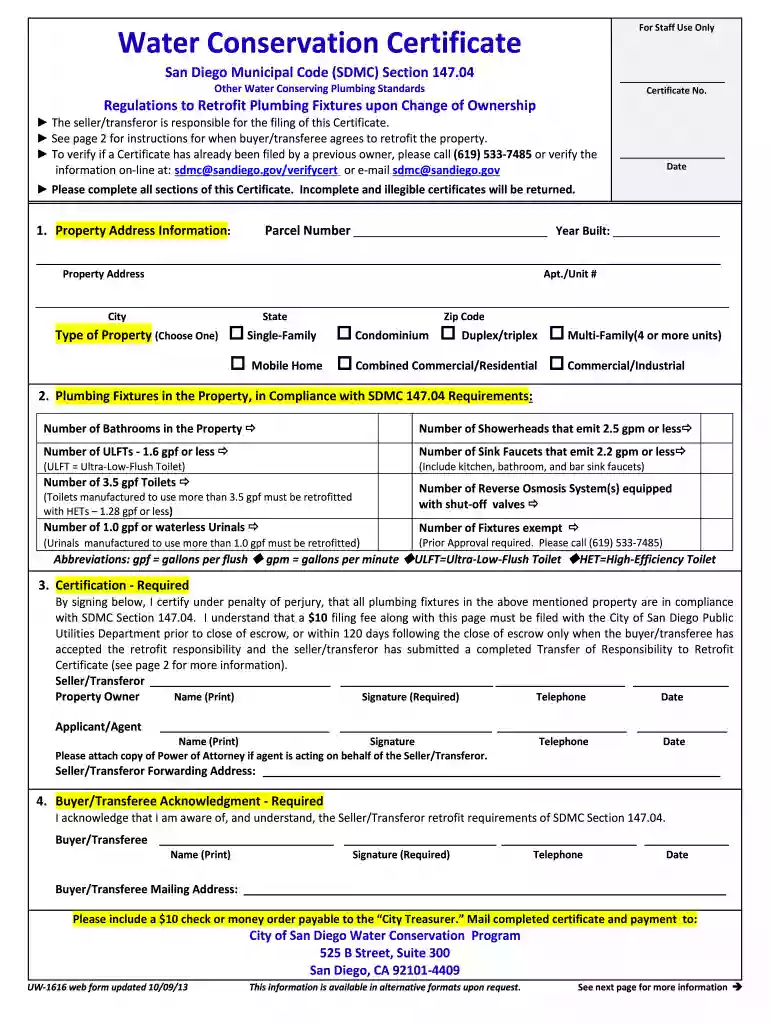
Water conservation cert 2026

Get Form
water conservation certificate san diego Preview on Page 1

Here's how it works

01. Edit your water conservation certificate san diego online
Type text, add images, blackout confidential details, add comments, highlights and more.

02. Sign it in a few clicks
Draw your signature, type it, upload its image, or use your mobile device as a signature pad.

03. Share your form with others
Send city of san diego water cert via email, link, or fax. You can also download it, export it or print it out.

Definition and Meaning

The "Water Conservation Certificate" is a document mandated by specific local ordinances, such as San Diego's Municipal Code Section 147.04, that certifies a property meets designated water conservation standards. This certificate is typically required before the transfer of property ownership to ensure compliance with water-conserving plumbing fixtures. The objective of this certification is to promote environmental sustainability and efficient water usage within residential and commercial properties. This certificate plays a crucial role in water conservation efforts at a community level by mandating adherence to ordinances that minimize water wastage through outdated or inefficient plumbing systems.

How to Use the Water Conservation Certificate

The Water Conservation Certificate acts as proof of compliance with water conservation laws during real estate transactions. Sellers usually obtain this certificate to demonstrate that their property has the required water-conserving fixtures before selling it. Typically, this certificate needs to be presented at the time of property sale, closure, or transfer to confirm the property's plumbing standards conform to the local guidelines. Both buyers and sellers benefit from understanding how and when to use this certificate to facilitate smooth property transactions and avoid legal complications associated with non-compliance.

How to Obtain the Water Conservation Certificate

To obtain a Water Conservation Certificate, property owners must first ensure that their property's plumbing fixtures are compliant with the local water conservation standards. The process may involve:

  1. Assessment and Inspection: Conducting a professional assessment or inspection to identify which fixtures meet the standards and which need upgrading.
  2. Upgrading Fixtures: Replacing outdated fixtures with low-flow or energy-efficient alternatives that meet the specified guidelines.
  3. Certification Request: Filing a request with the appropriate municipal authority to inspect and certify the property.
  4. Final Inspection: A final inspection by a certified inspector to verify compliance, after which the certificate is issued if standards are met.

Steps to Complete the Water Conservation Certificate

Completing the Water Conservation Certificate process involves several steps to ensure all plumbing and water systems meet prescribed standards. Detailed instructions typically include:

  1. Verify Requirements: Understand the specific requirements set by local ordinances regarding water conservation in plumbing.
  2. Schedule Inspection: Set up an inspection with a qualified professional to assess the current state of the property’s water fixtures.
  3. Implement Necessary Changes: Based on the inspection report, upgrade or replace plumbing fixtures to meet compliance standards.
  4. Request Certification: Submit a formal application to the designated municipal authority for certification.
  5. Conduct Final Check: Facilitate a final inspection by an approved inspector to verify compliance.
  6. Receive Certificate: Once compliance is confirmed, the certificate is issued as proof of adherence to water conservation standards.

Why You Should Have a Water Conservation Certificate

The Water Conservation Certificate is essential for multiple reasons. Firstly, it demonstrates compliance with environmental laws, reflecting a commitment to sustainable practices. Secondly, it enhances property value by assuring potential buyers of the property's efficiency and modern standards. Additionally, having this certificate readily available can expedite property transactions, reducing delays related to compliance issues. By ensuring all plumbing fixtures are up to modern standards, property owners also contribute to long-term environmental benefits and potentially reduce their water usage costs.

Who Typically Uses the Water Conservation Certificate

The primary users of the Water Conservation Certificate are property sellers, real estate agents, and property buyers. Sellers need it to confirm their compliance before transferring ownership. Real estate agents utilize this certification to ensure their listings meet local and state environmental regulations. Meanwhile, buyers often request this certificate to validate that their new property adheres to water conservation standards, thus avoiding inheriting non-compliant or inefficient plumbing systems.


decoration image ratings of Dochub

Key Elements of the Water Conservation Certificate

The Water Conservation Certificate encompasses several key elements that ensure comprehensive compliance:

  • Property Details: Includes essential information about the property, such as location and ownership details.
  • Inspection Report: Documents findings from professional inspections, including existing conditions and required upgrades.
  • Compliance Standards: Specifies the regulatory framework and specific criteria the property's plumbing systems must meet.
  • Certification Status: Clearly states if the property is compliant or details necessary changes for certification.
  • Validity Period: Indicates the time frame the certificate remains valid, after which re-certification may be necessary if regulations change.

State-Specific Rules for the Water Conservation Certificate

While the Water Conservation Certificate is applicable in various locations, rules and requirements often vary by state or municipality. For instance, California has stringent water conservation regulations due to its climate and water scarcity issues, demanding rigorous compliance standards. Property owners should remain informed of their local laws, as these regulations can influence the certification process, required upgrades, and legal implications for non-compliance. It is crucial to regularly consult municipal codes or local government websites to understand specific stipulations applicable to one's property location.

Examples of Using the Water Conservation Certificate

There are various practical scenarios where the Water Conservation Certificate is effectively utilized:

  • Real Estate Transactions: Ensures compliance in property sales, instilling confidence in buyers about the environmental standards of a property.
  • Municipal Audits: Used during local government audits to demonstrate adherence to water conservation bylaws.
  • Environmental Assessments: Organizations may require certificates for properties involved in environmental impact assessments or eco-friendly certifications.
  • Legal Documentation: Acts as legal evidence of compliance in disputes related to environmental regulations or property standards.

See more water conservation cert versions

We've got more versions of the water conservation cert form. Select the right water conservation cert version from the list and start editing it straight away!
Versions Form popularity Fillable & printable
2013 4.9 Satisfied (470 Votes)
2010 4 Satisfied (42 Votes)
be ready to get more

Complete this form in 5 minutes or less

Get form

Got questions?

We have answers to the most popular questions from our customers. If you can't find an answer to your question, please contact us.
Contact us
A short summary of the With time the 3R principle became a 4R principle and today we know it as the 5R principle. Refuse, Reduce, Reuse, Repurpose, Recycle.
How to become a water conservationist Get a bachelors degree. Consider an internship. Start with entry-level work. Take continuing education courses. Become certified.
It divides a waste stream into incremental fractions for reduction, reuse, recycling, and recovery. The 4R means Reduce, Reuse, Recycle and Restore: (i) Decrease: We should reduce our use of dangerous non-biodegradable substances.
To become a CID Agriculture you must: Register for the exam. Recommended: three years of irrigation-related experience or education in an irrigation-related field. Pass the general agriculture exam. Pass an agriculture irrigation specialty exam. Comply with the Select Certified Code of Ethics. Remain in good standing.
Conserving water saves energy. Energy is needed to filter, heat and pump water to your home, so reducing your water use also reduces your carbon footprint. Using less water keeps more in our ecosystems and helps to keep wetland habitats topped up for animals like otters, water voles, herons and fish.

Security and compliance

At DocHub, your data security is our priority. We follow HIPAA, SOC2, GDPR, and other standards, so you can work on your documents with confidence.

Learn more
ccpa2
pci-dss
gdpr-compliance
hipaa
soc-compliance

People also ask

Water conservation efforts can include measures such as fixing leaks, using low-flow appliances, and implementing drought-resistant landscaping. There are also many strategies for saving water, such as harvesting rainwater, using greywater systems, and recycling wastewater.
Keep a bottle of drinking water in the fridge. Put a layer of mulch around trees and plants. Water during the early parts of the day; avoid watering when its windy. water-saving shower heads and low-flow faucet aerators.

water certificate