




01. Edit your form online
Type text, add images, blackout confidential details, add comments, highlights and more.

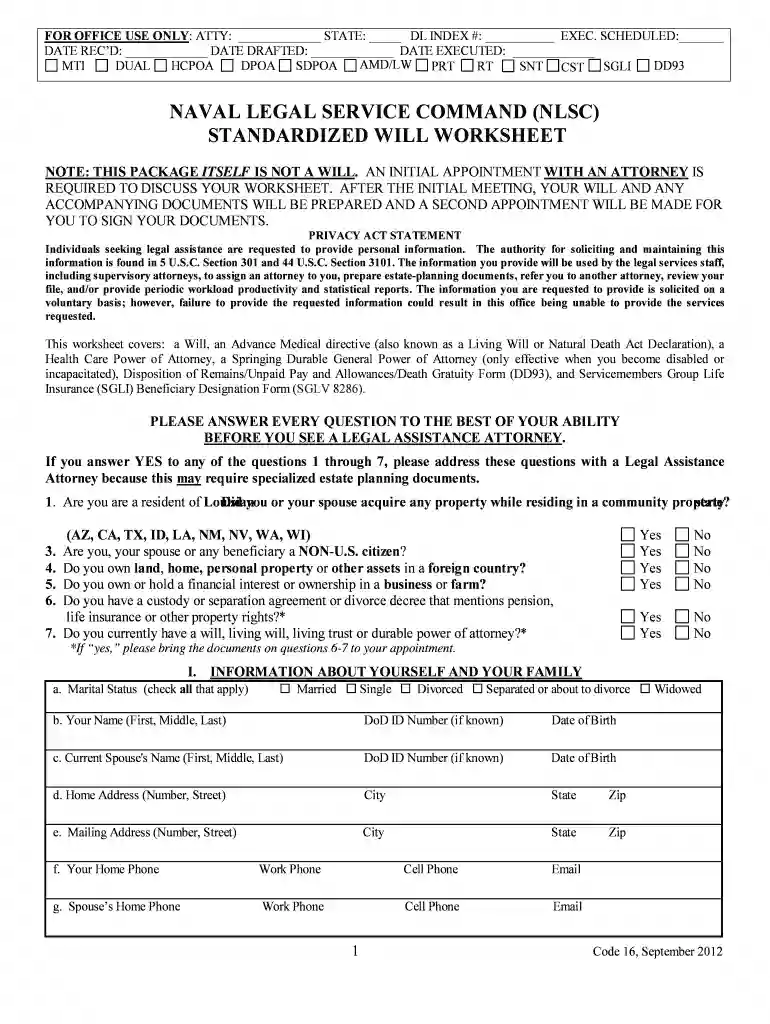
Type text, add images, blackout confidential details, add comments, highlights and more.

Draw your signature, type it, upload its image, or use your mobile device as a signature pad.

Send it via email, link, or fax. You can also download it, export it or print it out.
The Navy Will Worksheet 2012 Form is a standardized document provided by the Naval Legal Service Command (NLSC) to help service members and their families prepare for estate planning. This form assists individuals in gathering, organizing, and presenting necessary personal information, asset distribution preferences, and other essential details before meeting with a legal assistance attorney. It serves as a preparatory step that ensures compliance with military and legal standards for creating valid wills.
The form is structured to guide users through these various elements, ensuring a comprehensive approach to estate planning within the military context.
The use of the Navy Will Worksheet 2012 Form involves a structured approach to documenting personal and financial information. This process ensures that legal assistance attorneys have all necessary data to draft a will that reflects the service member’s intentions.
Obtaining the Navy Will Worksheet 2012 Form is an essential step for service members wishing to engage in estate planning. The form can be accessed through several avenues.
Accessing the form from these verified sources ensures that it is up-to-date and accurately reflects current legal standards.
Filling out the Navy Will Worksheet 2012 Form requires attention to detail and a clear understanding of personal estate planning goals.
Completing each section methodically helps ensure a comprehensive estate plan is in place.
Understanding the primary users of the Navy Will Worksheet 2012 Form helps in identifying the target demographic who benefits most from this resource.


The form serves a crucial role in the life planning of both individuals currently serving and those who have transitioned to civilian life.
In-depth knowledge of the key elements of this worksheet is essential for a thoughtful and effective estate planning process.
Understanding these elements ensures that individuals can tailor their estate plans to meet personal and familial needs effectively.
Legal compliance in using this worksheet guarantees that the resulting documents meet necessary standards.
Legal usage of the form protects service members’ intentions and secures their estates within the bounds of the law.
Understanding terms related to the Navy Will Worksheet 2012 Form enhances comprehension and proper use.
Familiarity with these terms enables clearer understanding and smoother completion of the form.
State-specific regulations may influence the completion and execution process of the will, even for federal forms like the Navy Will Worksheet.
Understanding these rules is crucial for ensuring that the will remains valid across different jurisdictions.
We've got more versions of the navy will worksheet 2012 form form. Select the right navy will worksheet 2012 form version from the list and start editing it straight away!
At DocHub, your data security is our priority. We follow HIPAA, SOC2, GDPR, and other standards, so you can work on your documents with confidence.
The purpose of this report is to provide a summary of. Technical Impracticability (TI) waivers that have been issued by U.S. Environmental Protection Agency.Read more
2012 Forms W-2, 1097,. 1098, and 1099 . . . . . . . . . . . . . . . . 10. Line Instructions for Form 1040 . . . . . . . . . 12. Name and AddressRead more
Dec 8, 2025 Complete Form W-4 so that your employer can withhold the correct federal income tax from your pay. If too little is withheld, you will generallyRead more


