




01. Edit your form online
Type text, add images, blackout confidential details, add comments, highlights and more.

Type text, add images, blackout confidential details, add comments, highlights and more.

Draw your signature, type it, upload its image, or use your mobile device as a signature pad.

Send it via email, link, or fax. You can also download it, export it or print it out.
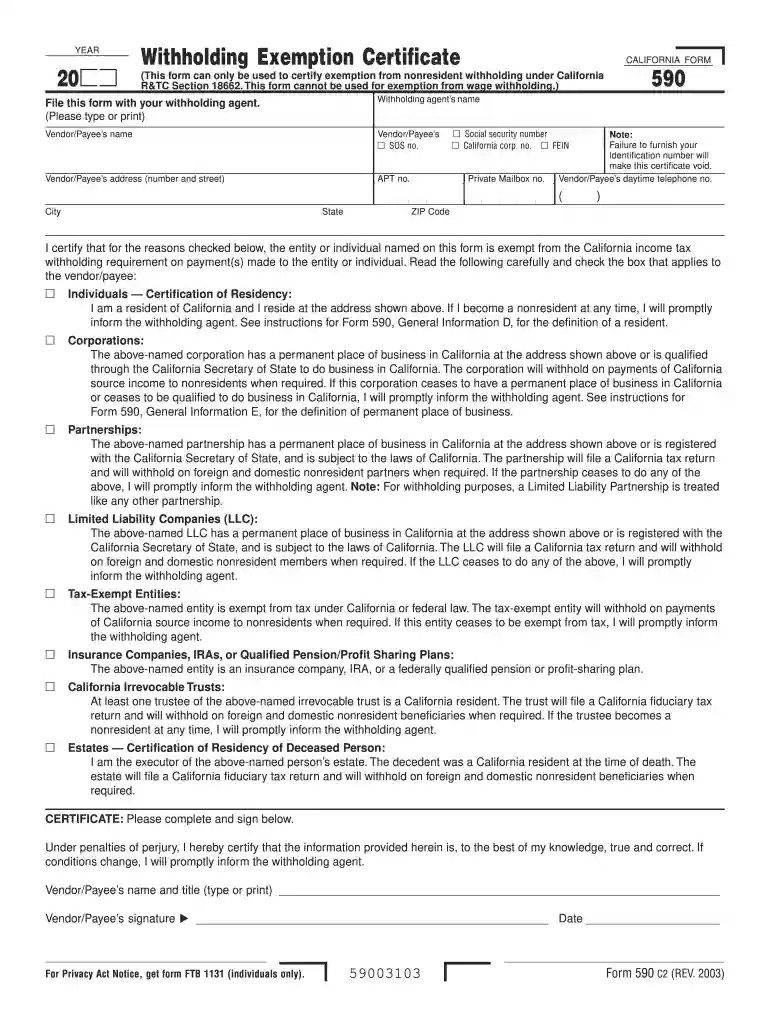
The UCLA Form 590 for 2003, relevant to California's withholding tax laws, is known as the "Withholding Exemption Certificate." Primarily utilized to certify exemption from nonresident withholding, this form is vital for vendors and payees operating in California. Its purpose is to ensure that applicable parties declare their exemption from withholding tax when they fulfill certain conditions that negate the need for such withholdings under California tax regulations.
UCLA's Form 590 for 2003 can be acquired through multiple channels. Traditionally, it is found on the UCLA website or requested through the California Franchise Tax Board for any alterations that remained consistent through 2003. These forms are also often available through companies or contractors involved in transactions requiring such documentation. Ensure you access the correct version to match your specific tax year needs.
Legal compliance is crucial when using the UCLA Form 590. It establishes lawful exemption from withholding taxes for qualifying entities based on their residency or business presence. Misrepresenting information on this form could lead to legal ramifications or penalties. It is advised to consult legal or tax professionals to ensure proper use of the form under current and relevant laws.
Failure to comply with the requirements specified in the UCLA Form could result in penalties or fines imposed by the state tax authorities. Non-compliance could include non-disclosure of necessary information, providing false information, or neglecting to update the form when circumstances change. Penalties typically depend on the severity and nature of the non-compliance.
California's tax regulations dictate specific enforcement and compliance relating to withholding. The UCLA Form 590 closely follows these state-specific laws to define when an individual or business is subject to withholding or when they can rightfully claim an exemption. Different rules may apply depending on whether the entity is a resident, nonresident, or if they maintain a permanent business in the state, necessitating a thorough understanding of these regulations to use the form appropriately.
We've got more versions of the ucla form 590 2003 form. Select the right ucla form 590 2003 version from the list and start editing it straight away!
| Versions | Form popularity | Fillable & printable |
|---|---|---|
| 2026 | 4.3 Satisfied (28 Votes) | |
| 2025 | 4.6 Satisfied (40 Votes) | |
| 2024 | 4.3 Satisfied (43 Votes) | |
| 2023 | 4.9 Satisfied (57 Votes) | |
| 2022 | 4.8 Satisfied (125 Votes) | |
| 2021 | 4.2 Satisfied (37 Votes) | |
| 2020 | 4.3 Satisfied (186 Votes) | |
| 2019 | 4.4 Satisfied (124 Votes) | |
| 2018 | 4.1 Satisfied (57 Votes) | |
| 2017 | 4.2 Satisfied (97 Votes) | |
| 2016 | 4.1 Satisfied (30 Votes) | |
| 2015 | 4.3 Satisfied (38 Votes) | |
| 2014 | 4 Satisfied (42 Votes) | |
| 2013 | 4.2 Satisfied (68 Votes) | |
| 2012 | 4.2 Satisfied (54 Votes) |
At DocHub, your data security is our priority. We follow HIPAA, SOC2, GDPR, and other standards, so you can work on your documents with confidence.


