



01. Edit your dss form 2924 online
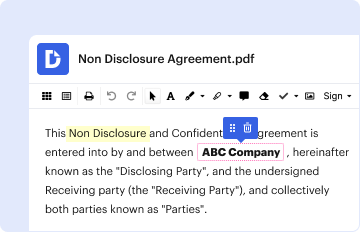
Type text, add images, blackout confidential details, add comments, highlights and more.

Type text, add images, blackout confidential details, add comments, highlights and more.
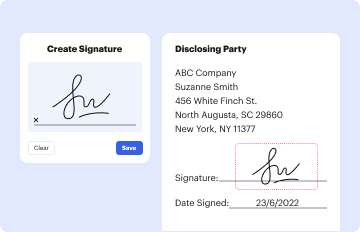
Draw your signature, type it, upload its image, or use your mobile device as a signature pad.
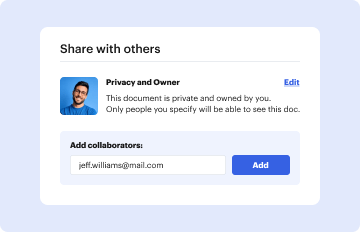
Send it via email, link, or fax. You can also download it, export it or print it out.
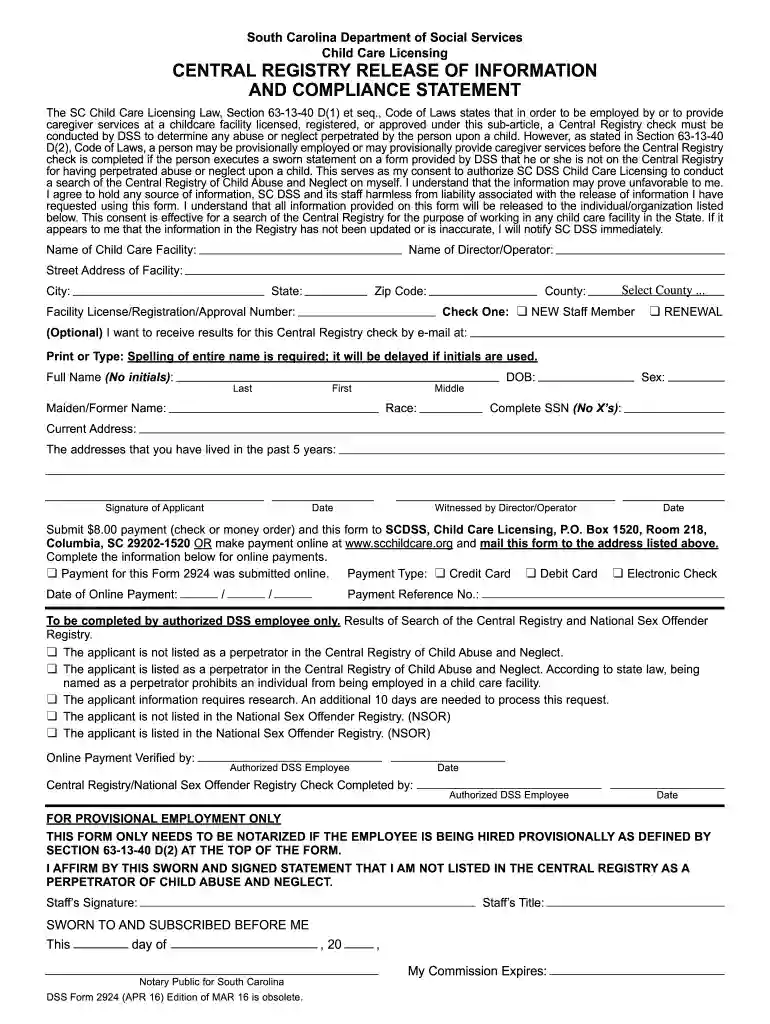
The DSS Form 2924, commonly referred to as the Central Registry Release of Information and Compliance Statement, is a document managed by the South Carolina Department of Social Services (DSS). It is primarily used to perform background checks on individuals seeking employment or volunteer opportunities in environments that cater to children, such as licensed childcare facilities. This form is crucial to ensure the safety and well-being of children by verifying the applicant’s history concerning child abuse or neglect.
The form serves a dual purpose: it facilitates the gathering of an applicant’s personal information to conduct a Central Registry check, and it acts as a compliance statement indicating the individual's consent for the release of their information. By requiring this check, licensed facilities can make informed decisions when hiring staff or volunteers, ultimately safeguarding children from potential harm. The Central Registry is a vital resource in this process, documenting cases of abuse or neglect reported within the state.
Completing the DSS Form 2924 involves several specific steps to ensure the application is processed accurately and efficiently:
Personal Information: The applicant must fill out personal details such as full name, date of birth, social security number, and current address. Accuracy is essential to prevent delays in processing.
Employment Information: Details of the position applied for, including the name and address of the facility or employer, should be provided. This connects the background check to the specific job role, ensuring relevance.
Compliance Statement: The form includes a section where applicants must sign to give consent for the DSS to release the information collected during the background check.
Payment Instructions: Depending on facility requirements, a processing fee may be applicable. Instructions for payment should be followed meticulously, as incomplete payment can result in processing delays.
Submission Process: The completed form, along with required fees and any additional documentation, should be submitted to the appropriate DSS office. This can typically be done by mail or in person.
The DSS Form 2924 is designed for several key user groups:
Potential Employees: Individuals seeking jobs at facilities licensed to care for children in South Carolina must complete this form. It is a mandatory requirement for employment consideration in such roles.
Volunteers: People looking to volunteer in environments involving children may be required to fill out this form to ensure they have no history of child abuse or neglect.
Licensed Childcare Facilities: These establishments use the form to vet potential hires thoroughly, maintaining a safe environment for children.
Government Agencies: Various South Carolina state agencies that manage childcare services use this form as part of their regulatory responsibilities.


The form plays a significant role in legal compliance for childcare providers. Facilities must adhere to state regulations mandating background checks, making this form a legal requirement under South Carolina law.
Failure to use the DSS Form 2924 as part of the hiring process for positions involving child care can result in severe legal repercussions for the facility, including fines and penalties. Compliance with these regulations helps facilities avoid potential litigation or liability issues in the event of incidents related to child safety.
Several crucial components make up the DSS Form 2924:
Applicant Information Section: Requires accurate personal details to facilitate identity verification.
Consent Declaration: The applicant authorizes the release of their information for the purpose of a background check.
Verification: A section for DSS employees to complete after assessing the applicant’s Central Registry status, ensuring the process complies with state procedures.
Facility Information: Details which connect the application to the facility requiring the background check.
South Carolina has specific regulations surrounding the use of DSS Form 2924 that differ from those in other states. These rules pertain to both the handling of sensitive information and the legal obligation of childcare facilities to obtain documented proof of a background check.
The South Carolina Department of Social Services aims to uphold child safety by implementing rigorous background checks via the Central Registry. Compliance with these procedures is mandatory for all childcare facilities to lawfully operate within the state.
When submitting the DSS Form 2924, certain documents are necessary to ensure processing. These typically include:
Completed Form: Accurately filled out with all required sections.
Identification Copies: Such as a driver's license or a state ID, to verify identity.
Fee Payment Receipts: If applicable, proof of payment needs to be included with the submission.
Employment Verification: A letter from the prospective employer indicating that the background check is required for employment.
The DSS Form 2924 can be submitted through several channels:
Mail: Sending completed forms to the DSS headquarters ensures documentation is received and processed in due course.
In-Person: Direct submission at a DSS office allows for immediate feedback on the completeness of the application package.
Digital Submission: Certain areas may offer online submission capabilities, providing a faster, more convenient method of sending documentation securely.
While traditional paper forms are still widely used, digital versions of the DSS Form 2924 offer significant advantages:
We've got more versions of the dss form 2924 form. Select the right dss form 2924 version from the list and start editing it straight away!
At DocHub, your data security is our priority. We follow HIPAA, SOC2, GDPR, and other standards, so you can work on your documents with confidence.
If you submit electronically, there is not a need to mail/fax in this form. If there are questions on what you submitted, the Office of Inspector General willRead more
DSS 2924, Central Registry for Release of Information and Compliance Statement on the operator, household members eighteen (18) years of age or older,


