




01. Edit your form online
Type text, add images, blackout confidential details, add comments, highlights and more.

Type text, add images, blackout confidential details, add comments, highlights and more.

Draw your signature, type it, upload its image, or use your mobile device as a signature pad.

Send it via email, link, or fax. You can also download it, export it or print it out.
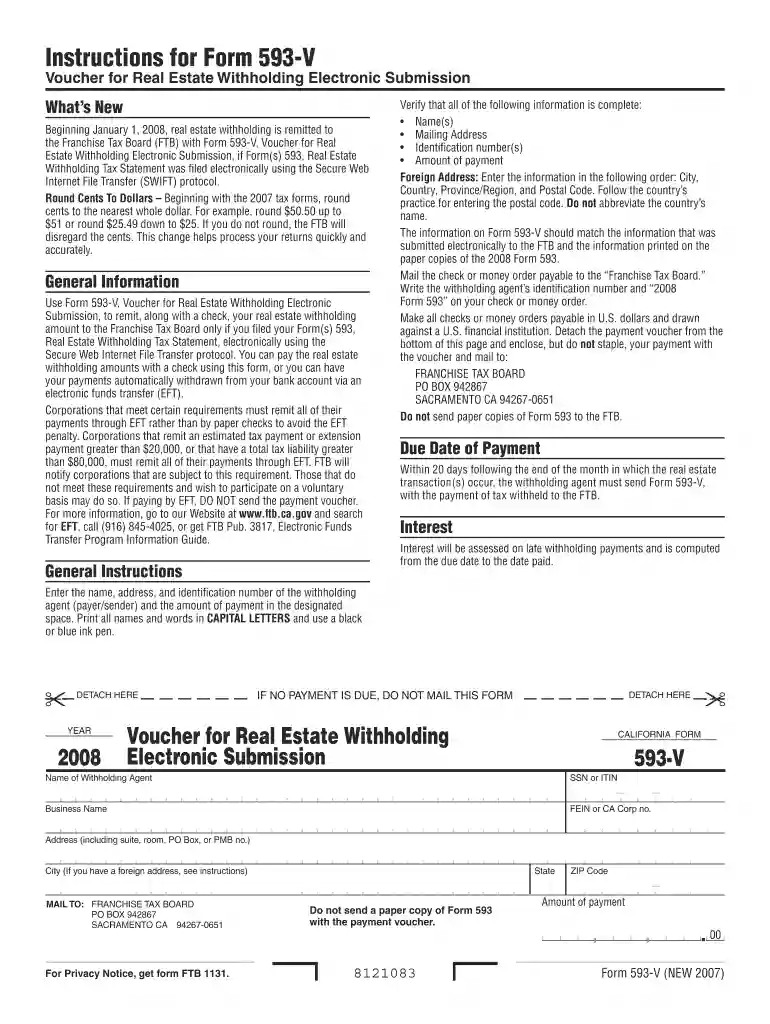
The 593-V Form, known as the Voucher for Real Estate Withholding Electronic Submission, is a document required by the California Franchise Tax Board (FTB) when real estate withholding payments are submitted electronically. This form is crucial for taxpayers who have filed the Form 593 electronically, which deals with the reporting and withholding of taxes from real estate sales. The 593-V Form ensures that the payment of withholding taxes is correctly matched with the taxpayer’s records, allowing the state to properly allocate collected taxes.
The form serves the dual purpose of facilitating payment verification and ensuring compliance with California tax regulations. When a real estate transaction occurs, and Form 593 is filed, the associated withholding tax must be remitted. The 593-V Form helps the FTB match payments received with filed withholding reports, avoiding discrepancies in tax filings. This process is vital for maintaining accurate tax records and preventing potential audits.
Utilizing the 593-V Form correctly is key to successful electronic submission of real estate withholding payments. Here's a detailed guide on effectively using this form:
Payment Preparation: Before filling out the 593-V Form, determine the exact amount of tax withholding due. This should align precisely with the amount reported on Form 593, rounded to the nearest dollar as per regulations.
Filling Out the Form: Enter all required information accurately, including the taxpayer’s name, identification number, and amount of the withholding payment. This ensures that the FTB applies the payment to the correct tax account.
Electronic Submission: The 593-V Form supports electronic submission. Ensure you’re familiar with the FTB’s recommended electronic submission methods, including acceptable file formats and platforms.
Example Scenario #1: A homeowner sells their property, and the escrow company withholds a portion of the sale as required by California law. Upon completing the real estate transaction, they file Form 593 and submit the 593-V Form along with the payment to ensure the withholding amount is recorded for that tax year.
Example Scenario #2: A business sells a commercial property and needs to remit withholding taxes. Their accounting department uses the 593-V Form to electronically submit the required withholding payment, thereby maintaining compliance with state tax regulations.
Completing the 593-V Form involves several detailed steps to ensure proper submission and compliance:
Download the Form: Access the latest version of the 593-V Form from the California FTB website.
Enter Taxpayer Information: Include the taxpayer’s full name, Social Security Number (SSN) or taxpayer identification number, and contact details to avoid misallocation of funds.
Calculate Withholding Payment: Identify and enter the total withholding amount that needs to be submitted based on the sale price and tax rate applicable.
Payment Details: Specify the payment method, ensuring it aligns with the FTB’s allowable electronic payment systems such as electronic funds transfer (EFT).
Review and Submit: Check all entered information for accuracy. Submit the form electronically following the FTB’s procedures, ensuring confirmation of the transaction for your records.
Late Submission: If the form is submitted late, penalties may apply. Ensure all payments are submitted by the due date to avoid any fines.
Incorrect Payment Amount: Submitting an incorrect tax amount may result in underpayment penalties or delays. Double-check calculations for accuracy.
Primarily, the form is used by individuals and entities involved in real estate transactions in California where withholding is mandatory. This includes:
Understanding who uses the form ensures appropriate application and correct handling of data, minimizing the potential for errors.


Recognizing the critical components of the 593-V Form is essential for accurate submission:
Each element ensures the payment is processed accurately and attributed to the correct tax period, safeguarding the taxpayer’s interests.
California has unique rules regarding real estate withholding, summarized below:
Understanding these terms is vital for processing the form correctly:
Clear comprehension of these terms aids in the effective management and submission of the 593-V Form for real estate transactions in California.
We've got more versions of the 593-V Form - California Franchise Tax Board - ftb ca form. Select the right 593-V Form - California Franchise Tax Board - ftb ca version from the list and start editing it straight away!
| Versions | Form popularity | Fillable & printable |
|---|---|---|
| 2025 | 4.1 Satisfied (45 Votes) | |
| 2024 | 4.9 Satisfied (51 Votes) | |
| 2023 | 4.2 Satisfied (41 Votes) | |
| 2022 | 4.8 Satisfied (54 Votes) | |
| 2021 | 4.3 Satisfied (124 Votes) | |
| 2020 | 4.3 Satisfied (221 Votes) | |
| 2019 | 4.3 Satisfied (39 Votes) | |
| 2018 | 4.3 Satisfied (143 Votes) | |
| 2012 | 4.3 Satisfied (43 Votes) | |
| 2008 | 4 Satisfied (50 Votes) |
At DocHub, your data security is our priority. We follow HIPAA, SOC2, GDPR, and other standards, so you can work on your documents with confidence.
Use Form 590, Withholding Exemption Certificate, to DocHub an exemption from nonresident withholding. ified by the Franchise Tax Board (FTB) Form 592-V,
Use Form 593-V, Payment Voucher for Real Estate Withholding, to remit real estate withholding payments to the Franchise Tax Board (FTB)


