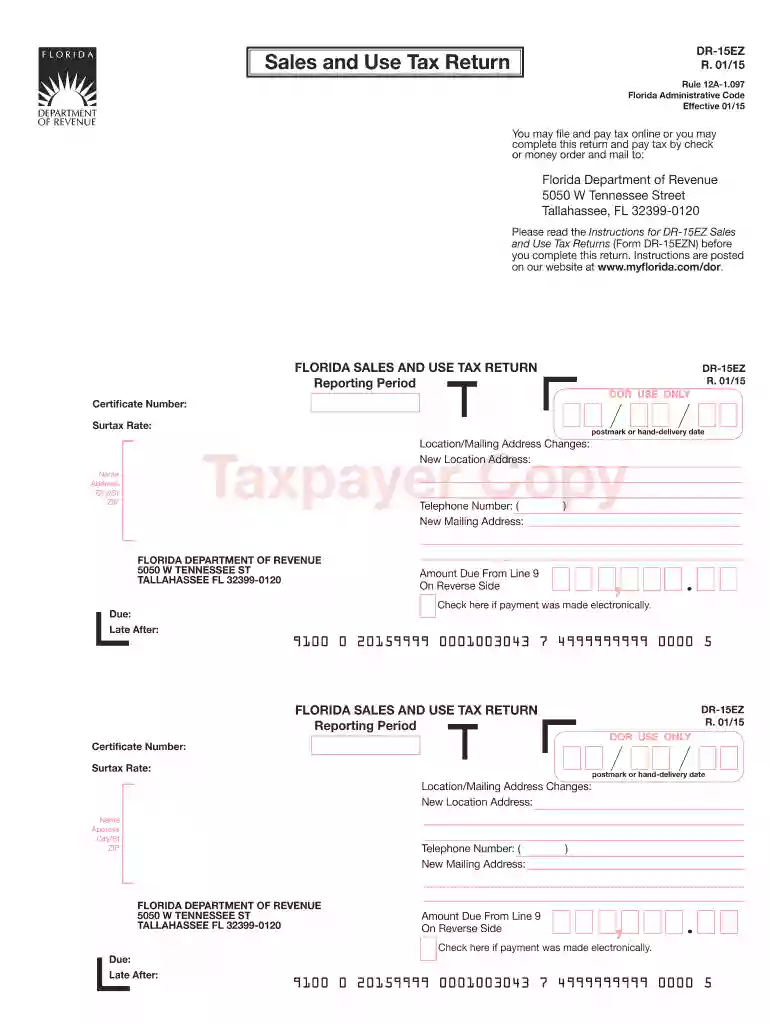
Form dr 15ez 2013-2026

Get Form
form dr 15ez 2013 Preview on Page 1

Here's how it works

01. Edit your form online
Type text, add images, blackout confidential details, add comments, highlights and more.

02. Sign it in a few clicks
Draw your signature, type it, upload its image, or use your mobile device as a signature pad.

03. Share your form with others
Send it via email, link, or fax. You can also download it, export it or print it out.

Definition and Purpose of DR-15EZ Form

The DR-15EZ form is a type of Florida Sales and Use Tax Return designed for certain businesses operating within Florida. It is used to report sales tax collected, exempt sales, taxable purchases, and to calculate the total tax due, including any discretionary sales surtax. This form is tailored for small businesses and simplifies the filing process by providing a streamlined version compared to the standard DR-15 form.

Businesses must complete the DR-15EZ form accurately, ensuring all relevant transactions within the reporting period are included. Correct completion and submission of this form are crucial for compliance with Florida's state tax regulations.

Steps to Complete the DR-15EZ Form

  1. Gather Required Information:

    • Collect records of gross sales, exempt sales, and taxable purchases made during the reporting period.
  2. Access the Form:

    • Obtain the DR-15EZ form from the Florida Department of Revenue or through your accounting software if it offers state tax forms.
  3. Report Gross Sales:

    • Enter the total gross sales amount. This includes all sales made before any deductions.
  4. Calculate Taxable Amounts:

    • Deduct exempt sales from gross sales to determine the taxable sales. Fill in taxable purchases that did not include sales tax at the point of sale.
  5. Apply Tax Rates:

    • Use the provided tables or guidelines to apply state and local sales tax rates to the taxable sales and purchases.
  6. Complete Payment Information:

    • Calculate the total tax due and provide payment details, whether you’re paying by check or electronic transfer.
  7. Finalize and Submit:

    • Review the form for accuracy, sign, and date it. Submit via online filing if available or mail to the designated state revenue office.

How to Obtain the DR-15EZ Form

The DR-15EZ form can be acquired through several methods to accommodate different preferences and resources:

  • Online Access: Visit the official website of the Florida Department of Revenue to download the form. Alternatively, locate it via your online tax filing software.
  • Local Revenue Offices: Forms are available at physical revenue service locations throughout Florida for those preferring in-person pickups.
  • Mail Request: If necessary, forms can be requested by mail from the Department of Revenue for individuals without reliable internet access.

Important Terms Related to DR-15EZ Form

Understanding specific terms is essential for accurately completing the DR-15EZ form:

  • Gross Sales: The total sales amount before any deductions, representing all transactions made during a period.
  • Exempt Sales: Transactions where sales tax is not applicable, such as for tax-exempt organizations or out-of-state sales.
  • Taxable Purchases: Purchases subject to use tax, typically where sales tax was not charged at the point of sale.
  • Discretionary Sales Surtax: Local option tax that varies by county and must be added to the state sales tax.

Legal Use of the DR-15EZ Form

The DR-15EZ form's legal application includes:

  • Sales Tax Compliance: Ensuring businesses correctly remit sales taxes collected, reflecting adherence to Florida law.
  • Accurate Recordkeeping: Maintaining comprehensive records related to sales, exemptions, and taxable purchases to avoid legal issues during audits.
  • Reporting Deadlines: Adhering to submission deadlines to prevent penalties associated with late payments.

Key Elements of the DR-15EZ Form

  • Taxpayer Information: Business name, address, and taxpayer identification number.
  • Transaction Details: Section for gross sales, exemptions, and taxable purchases.
  • Tax Calculation: Part of the form where the tax is calculated based on the sales and purchases reported.
  • Signatures: Required for form validation and compliance with tax authorities.

State-Specific Rules for DR-15EZ Form

Florida-specific regulations include:

  • Surtax Variations by County: Each county in Florida may impose different discretionary sales surtax rates; awareness is critical.
  • Filing Frequency: Dependent on the volume of sales, businesses may have different filing schedules—monthly, quarterly, or annually.
  • Tax Exemption Situations: Florida recognizes certain transactions exempt from state sales tax, crucial for businesses to identify relevant scenarios.

Filing Deadlines and Important Dates

Deadlines for filing sales tax returns in Florida are depending on your assigned filing frequency:

  • Monthly Filers: Typically due on the first of the following month for the prior month's sales.
  • Quarterly Filers: Due on the first day of the first month of the following quarter.
  • Annual Filers: Due on January 1 for the previous year's sales.

Avoiding late fees and penalties is crucial for maintaining compliance with state tax laws, making timely filing essential.

See more form dr 15ez 2013 versions

We've got more versions of the form dr 15ez 2013 form. Select the right form dr 15ez 2013 version from the list and start editing it straight away!
Versions Form popularity Fillable & printable
2020 4.9 Satisfied (59 Votes)
2019 4.2 Satisfied (67 Votes)
2015 4.1 Satisfied (59 Votes)
2013 4.3 Satisfied (43 Votes)
2012 4 Satisfied (54 Votes)
be ready to get more

Complete this form in 5 minutes or less

Get form

Got questions?

We have answers to the most popular questions from our customers. If you can't find an answer to your question, please contact us.
Contact us
Form DR-15 is a document used in Florida by businesses to report and remit sales and use tax. It captures details about taxable sales, purchases on which use tax is due, allowable deductions, and the tax amount to be remitted.
If you file your return or pay tax late, a late filing penalty of 10% of the amount of tax owed, but not less than $50, may be charged. The $50 minimum penalty applies even if no tax is due. A floating rate of interest applies to underpayments and late payments of tax.
Filing after the October 15 deadline can have a number of adverse and irreversible effects, including: Failure-to-file penalty calculated as 5% of the taxes owed for each month outstanding (capped at 25% of the total tax liability).
Picking up copies at an IRS Taxpayer Assistance Center. Going to the IRS Small Business and Self-Employed Tax Center page. Requesting copies by phone 800-TAX-FORM (800-829-3676). Hours of operation are 7 a.m. to 10 p.m., Monday-Friday, your local time except Alaska and Hawaii which are Pacific time.
The simplest IRS form is the Form 1040EZ. The 1040A covers several additional items not addressed by the EZ. And finally, the IRS Form 1040 should be used when itemizing deductions and reporting more complex investments and other income.

Security and compliance

At DocHub, your data security is our priority. We follow HIPAA, SOC2, GDPR, and other standards, so you can work on your documents with confidence.

Learn more
ccpa2
pci-dss
gdpr-compliance
hipaa
soc-compliance

People also ask

Form 1040EZ is no longer used, and has been replaced by Form 1040 and Form 1040-SR.
For most taxpayers, the federal tax return deadline to file federal taxes, pay any tax owed, or request an extension to file is April 15.

Related links